Facebook
 Google
 GitHub
 Linkedin
Cathode Calcium Doping Could Stabilize Sodium-Ion Batteries
Japanese researchers have demonstrated that low-level calcium doping in layered sodium iron-manganese oxides suppresses surface degradation under air and moisture exposure.
As sodium-ion batteries (SIBs) mature into a credible alternative to lithium-ion systems, materials-level stability remains a major barrier to adoption. Sodium’s abundance and low cost make it ideal for grid-scale energy storage, but many high-capacity cathode candidates, especially layered transition metal oxides, exhibit poor environmental stability.
Learn how the Tokyo University of Science is working to overcome challenges in sodium-ion batteries. Video used courtesy of Tokyo University of Science
One such material is NFM, a P2-type layered oxide previously shown to deliver ~190 mAh/g capacity using only earth-abundant elements. However, NFM suffers from rapid degradation in air due to Na+/H+ exchange and water intercalation, which compromise crystal integrity and lead to slurry processing issues.
Tokyo University of Science researchers have shown that introducing just 1 wt% of Ca2+ into the sodium layer substantially improves air and water stability, without sacrificing electrochemical performance. Their approach leverages a spontaneous mechanism whereby calcium migrates to the particle surface during exposure, forming a protective Ca-rich layer that suppresses sodium loss and structural breakdown.
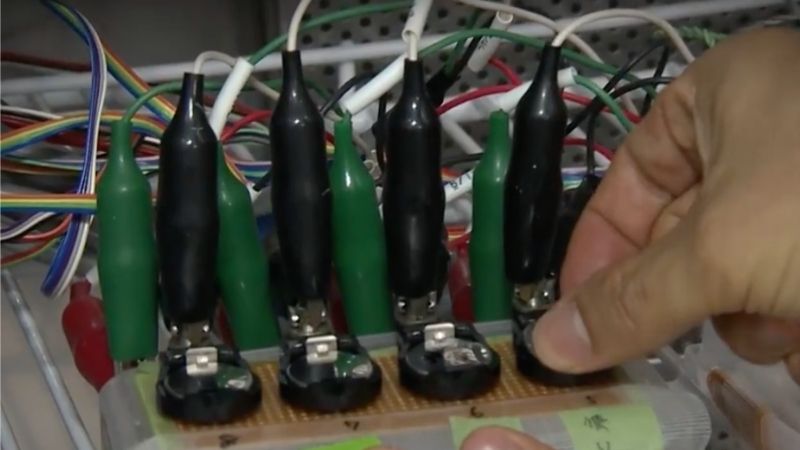
Sodium-ion battery research. Image used courtesy of Tokyo University of Science
Calcium Doping Without Disruption
Using a conventional solid-state synthesis route, the team substituted calcium for a small fraction of sodium to produce Na-Ca-Fe-Mn oxide (x = 0.01). XRD, synchrotron diffraction, and STEM-EDS mapping confirmed the formation of a clean P2 phase with improved crystallinity, slightly increased interlayer spacing, and uniform Ca distribution. Importantly, no impurity phases were observed at this doping level, and transition metal oxidation states remained unchanged.
This interlayer expansion improves sodium diffusion pathways while acting as a structural buffer against environmental stressors. Impurity phases emerged at higher doping levels (x = 0.02), suggesting a solubility limit for Ca²⁺ within the P2 framework.
Electrochemically, the 1% Ca-doped material (NCFM) retained a discharge capacity of ~190 mAh/g, with redox peaks nearly identical to the undoped NFM. Differential capacity plots showed sharper and more intense peaks, indicating improved redox kinetics. Long-term cycling (50 cycles at C/20) showed slightly better retention in NCFM (72% vs 68%).
How calcium doping adds stability to sodium-ion batteries. Video used courtesy of Tokyo University of Science
Where Ca doping stands out is in rate performance:
- At 1C, NFM drops to 44 mAh/g.
- NCFM retains 110 mAh/g.
- Even at 2C, NCFM holds 67 mAh/g, compared to just 11 mAh/g for NFM.
This suggests that calcium not only stabilizes the structure but may also modulate the Na⁺-Na⁺ repulsion within the interlayers, smoothing the diffusion landscape and enhancing kinetics.
Self-Assembled Surface Protection
To probe the air stability mechanism, the team conducted XRD, TEM-EDS, pH leaching tests, and XPS on doped and undoped materials after two to five days of air exposure at 65% RH. The researchers found that NFM showed 35% capacity loss after just two days in air, while NCFM retained full capacity under the same conditions. XRD showed formation of hydrated phases and NaHCO3 in NFM, but no new phases in NCFM, and the pH of water-soaked NFM samples jumped to 11.4 in minutes. NCFM only rose to ~9.1, indicating suppressed Na+/H+ exchange.
Electron microscopy revealed a Ca-enriched surface layer forming on NCFM during air exposure, primarily at particle edges, the most reactive sites. This layer was not pre-existing; it migrated outward from the bulk during degradation, suggesting a self-limiting protective behavior.
XPS data showed a shift in Ca 2p binding energy post-exposure and an increase in peak intensity, supporting the presence of a new surface chemical environment—likely composed of CaO, CaCO3, or similar species. FTIR confirmed carbonate formation, although it couldn't definitively assign species to Ca or Na. Nonetheless, Ca-based carbonates are known to be more stable than Na equivalents.
_and_the_filtrate_solution’s_pH_measurements_(b).jpg)
The pH analysis method (a) and the filtrate solution’s pH measurements (b) after NFM and NCFM powder immersion in deionized water for various time intervals. Image used courtesy of Mahapatra et al.
Meanwhile, the self-assembled layer appears to function like an in situ coating, offering comparable protection to artificial Al2O3 or MgO coatings, but without needing additional processing steps or material cost.
An immediate practical benefit of Ca-doped NFM is its tolerance to ambient processing. PVdF-based slurries made with air-exposed NFM showed severe gelation due to defluorination triggered by basic decomposition products. NCFM, while still showing some gelling, remained castable with uniform coatings.
This opens the door to simpler and lower-cost electrode fabrication, especially when considering aqueous binder systems. Additional tests confirmed that NCFM exhibited higher tolerance to water exposure of up to 15 minutes, a common requirement during slurry preparation.
As the research group extends this approach to other layered oxides and explores co-doping strategies, calcium’s role as a low-cost, non-toxic stabilizer may help bridge the gap between lab-scale sodium-ion cathodes and commercial reality.