Facebook
 Google
 GitHub
 Linkedin
Can Concrete Batteries Power the Future?
MIT research shows how combining carbon black, water, and cement can create supercapacitors that can transform renewable energy storage.
The U.S. has set 2050 as the target to achieve zero carbon emissions. But renewable energy resources can be fickle. The sun shines on its own schedule, and the wind does not always pick up speed when needed. With soaring renewable energy growth, a basic problem presents itself: how will this energy be stored for daily use?
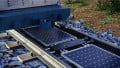
A research team at MIT has been developing a concrete battery storage system with three simple ingredients: carbon black, water, and cement. It sounds like science fiction, but the team is making it possible to capture rooftop solar energy and store it in the concrete building foundation for convenient use anytime.
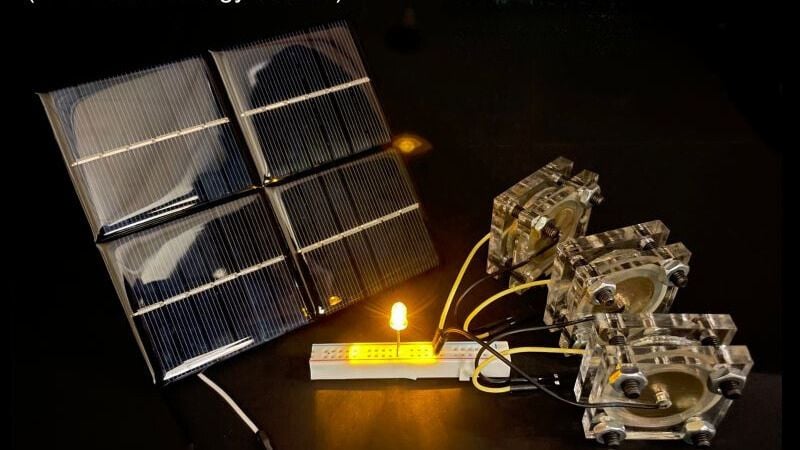
Concept showing solar panels (left) and carbon-cement supercapacitor. Image used courtesy of MIT
Renewable Energy Fluctuations and Dwindling Lithium Reserves
Wind farm installations are growing rapidly, spreading into the ocean with floating installations and into high-altitude regions to capture high-speed wind currents. Solar power is also expanding its reach as government subsidies incentivize this pivot to carbon-free power. However, when wind and solar resources fluctuate, they can create dangerous challenges for the energy systems dependent on them.
In 2021, Europe experienced the weakest winds since 1979, and this sudden drop in a renewable energy resource made power prices soar to unprecedented levels. In 2019, Britain endured a large blackout impacting over a million customers when the Hornsea 1 offshore wind facility experienced a series of failures and complications. After the infamous Texas winter storm blackout in 2021, many made the simple claim that wind turbines “froze” without considering several variables, including significantly reduced wind speed when Texans were desperate for power to heat their homes.
These examples show the need to effectively store renewable energy for later use. The industry standard for storing renewables is the lithium-ion battery (Li-ion). However, there are significant challenges with lithium mining and obtaining other battery materials.
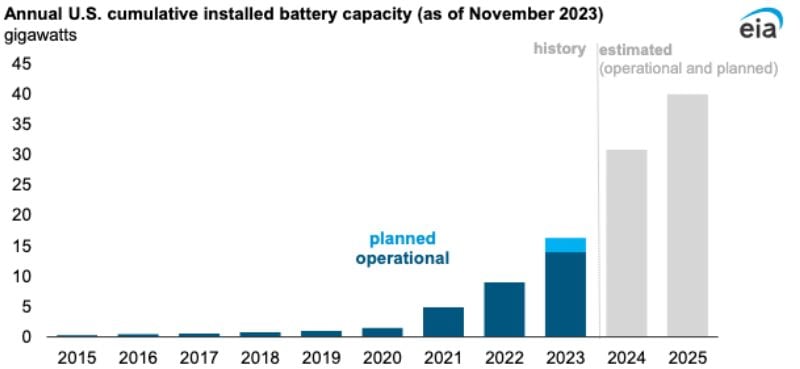
Battery capacity continues to increase along with demand. Image used courtesy of Energy Information Administration
The looming lithium shortage is expected to significantly impact Li-ion batteries’ production, crucial for electric vehicles and renewable energy storage. With global demand for lithium outstripping supply, prices have surged, increasing over 400% in the past year. Environmental concerns and regulatory challenges in major lithium-producing countries like Chile and Serbia further exacerbate the issue, potentially leading to prolonged supply deficits and higher costs for battery production. The path forward must include Li-ion alternatives.
The Concrete Supercapacitor Solution
The concrete battery system pioneered by MIT researchers is one potential candidate for a battery alternative. It could defray the pressure on the lithium market and help support the larger project of storing renewable energy efficiently.
The battery’s three basic ingredients—cement, carbon black, and water—are all cheap and widely available, thus preventing the need to keep up with worldwide lithium demand.
This battery is a supercapacitor, an enhanced capacitor that can store large amounts of charge. Capacitors are basic devices with two conductive plates separated by an electrolyte and a membrane. Applying voltage causes ions to accumulate on opposite plates, creating an electric field and storing charge. This charge can be quickly released when needed. The surface area of its plates determines the power storage capacity of a capacitor.
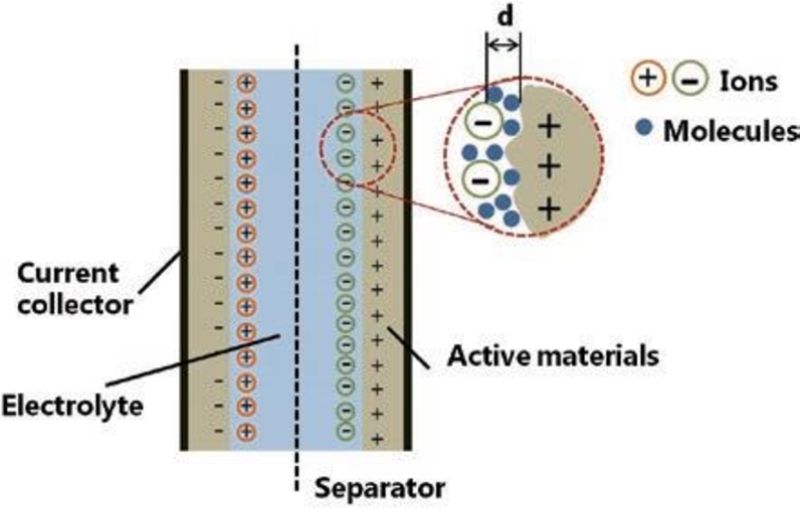
Supercapacitor structure. Image used courtesy of Pu
The MIT team’s supercapacitor utilizes a cement-based material with a high internal surface area. They created it by mixing carbon black with cement and water to form a dense, conductive network within the cured cement. The structure, resembling a fractal, provides extensive surface area in a compact volume. Soaking this material in an electrolyte like potassium chloride allows it to store and release large amounts of charge efficiently, making it a powerful supercapacitor.
The concrete battery system can power a 10-watt LED for about 30 hours. While this storage capacity may seem considerably less than Li-on batteries, it doesn’t account for the large amounts of concrete used in structural foundations. A building with a foundation between 1,060 and 1,410 cubic feet of concrete could store enough energy to power a residential home.
While engineers tweak and tinker with improvements to the Li-on battery, it is possible to conceive of completely different battery systems like this concrete supercapacitor alternative. The exponential growth in renewable energy resources demands innovation in the energy storage sector, and the MIT team is reimagining what battery storage might look like in the future.