Facebook
 Google
 GitHub
 Linkedin
Can AI Lead To Better Electronics Materials?
The AI model uses X-ray crystallography data to help researchers design materials for diverse applications, from batteries to magnets.
In material science, analyzing and understanding the structure of crystalline materials is a fundamental driver of discovery. A crystal’s atom arrangement determines its properties, making structural analysis a foundational factor in optimizing materials for specific applications.
Historically, techniques like X-ray crystallography have been the backbone of this effort. However, the process becomes more complex when dealing with powdered or fragmented samples because they limit the accuracy and efficiency of structural predictions.
Researchers at Stanford and MIT developed an artificial intelligence-driven model to analyze crystal structures of powdered samples. The AI model could streamline the discovery and application of materials in batteries and other power electronics.

Computational model using powder X-ray crystallography data to predict crystalline structure. Image used courtesy of MIT/Eric Alan Riesel
The Crystal Puzzle
Crystalline materials, such as metals, comprise repeating lattice units. These units resemble boxes with specific dimensions, where atoms are arranged in a precise pattern. While working on novel materials, analyzing the crystalline structure is a common starting point, as the lattice structure directly influences the materials’ electrical, thermal, and mechanical properties and behavior.
X-ray crystallography is a technique used to determine crystalline materials' atomic and molecular structure. When X-rays are directed at a crystal, they scatter off the atoms, creating diffraction patterns. By analyzing these patterns, researchers can deduce the positions of atoms within the material’s lattice.
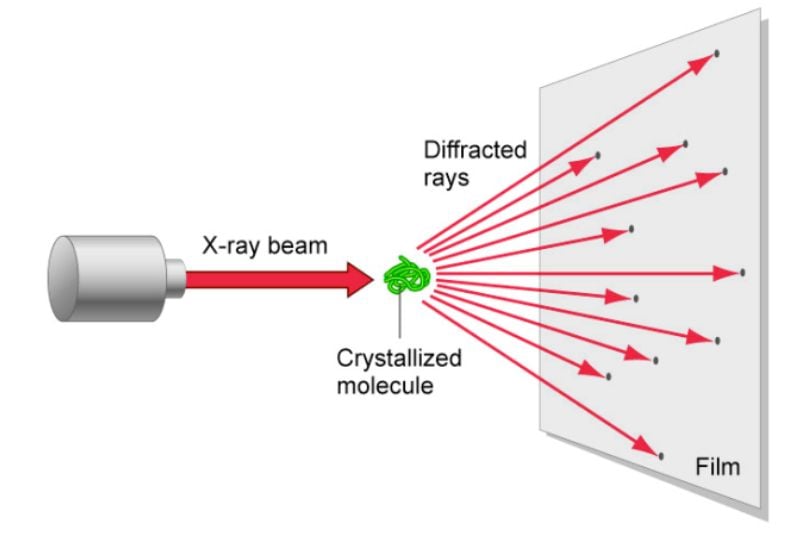
A simple setup of X-ray crystallography. Image used courtesy of Rice University
However, it’s harder to reconstruct the original 3D structure when scientists only have powdered samples of random fragments. This is problematic for many materials, such as metals, ceramics, and certain minerals crucial for superconductors, magnets, and photovoltaics applications.
Powder X-ray diffraction (PXRD) is another fundamental method for materials characterization (in powders). However, determining full structures from PXRD data remains labor-intensive and often unfeasible, particularly for new materials. Existing machine learning approaches to PXRD analysis typically predict only partial and averaged information about a material's complete crystal structure.
Mapping Crystalline Structures with AI Precision
In the Journal of the American Chemical Society, researchers described an AI-driven model called Crystalyze, designed to simplify determining crystalline material structures from PXRD data.
The Crystalyze model uses a machine learning approach to predict the structures of crystalline materials by analyzing diffraction patterns. By training on tens of thousands of materials from the Materials Project database, the model generates probable structures based on lattice dimensions, atom arrangements, and diffraction patterns. The model functions as generative AI, capable of producing multiple structure predictions and refining them by comparing generated diffraction patterns to the input data, ensuring high accuracy.
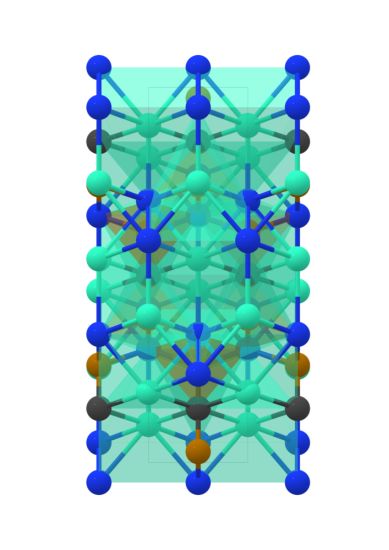
Crystalline structure. Image used courtesy of Materials Project
In testing the model, the researchers found that, on over 100 experimental diffraction patterns, the model achieved a 67% success rate. Additionally, the model was able to solve previously unsolved diffraction patterns from the powder diffraction file, providing structural data for 134 materials, including NaCu2P2, Ca2MnTeO6, ZrGe6Ni6, LuOF, and HoNdV2O8. Crystalyze can also predict structures for novel compounds, such as those synthesized under high-pressure conditions (Rh3Bi, RuBi2, and KBi3).
Future of AI in Material Science
As AI evolves, its role in solving complex challenges within materials science will only expand. By accelerating the discovery and optimization of new materials, AI can analyze and predict structures more efficiently, which could lead to breakthroughs in energy storage, electronics, magnetism, and beyond.