Facebook
 Google
 GitHub
 Linkedin
BYD vs. Tesla: Who Wins the EV Battery Battle?
Researchers broke down BYD’s LFP Blade battery and Tesla’s cylindrical cells. This comprehensive comparison of the industry’s two leading contenders may surprise you.
Researchers at RWTH Aachen University in Germany have provided unprecedented insights into the battery technologies powering the world's two leading electric vehicle manufacturers, BYD and Tesla.
The detailed examination reveals how BYD's lithium iron phosphate (LFP) Blade batteries and Tesla's nickel manganese cobalt (NMC) cells represent fundamentally different approaches to solving the challenge of energy storage for EVs. Each design reflects distinct priorities and engineering philosophies that shape the performance, safety, and cost profiles of these competing technologies.
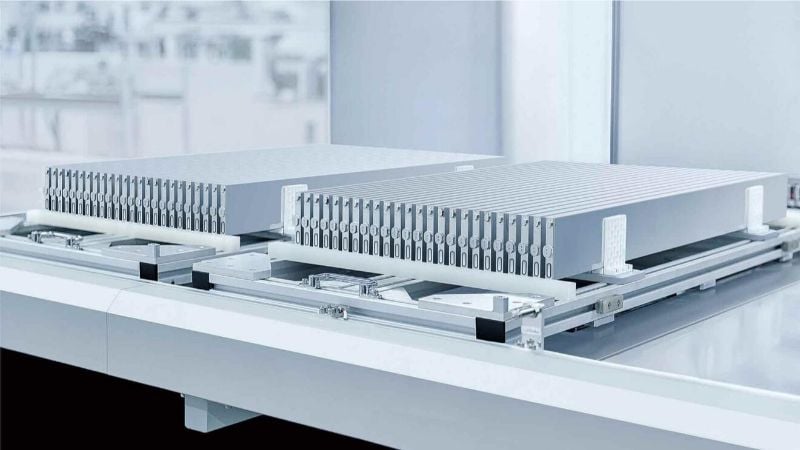
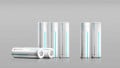
BYD’s Blade EV battery. Image used courtesy BYD
Battery Chemistry and Materials
The most fundamental difference between these battery technologies lies in their chemical composition. BYD's Blade battery employs a lithium iron phosphate (LiFePO4) cathode, which incorporates iron and phosphate as its primary active materials. These components are abundant in nature, relatively inexpensive to source, and considered more environmentally friendly compared to other battery chemistries. Notably, LFP batteries contain no cobalt, eliminating the ethical concerns and supply chain issues associated with cobalt mining.
Tesla primarily uses nickel-manganese-cobalt (NMC) or nickel-cobalt-aluminum (NCA) chemistry in its batteries, including in its advanced 4680 cells. The NMC811 formulation used in Tesla's batteries contains eight parts nickel, one part manganese, and one part cobalt. This higher nickel content contributes to the battery's superior energy density, but the cobalt increases material costs and raises environmental and ethical considerations.
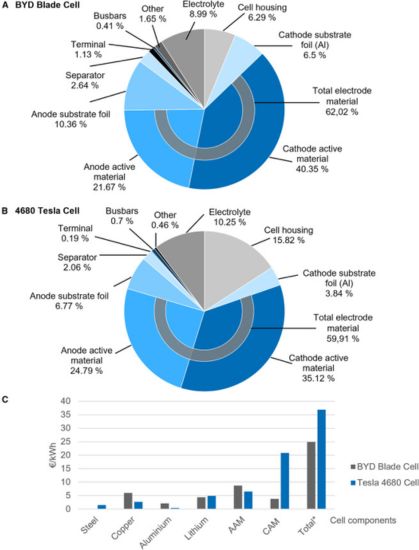
BYD vs. Tesla materials composition. Image used courtesy of Gorsch et al.
The RWTH Aachen University study, published in Cell Reports Physical Science, found that both manufacturers' anodes are graphite-based with no silicon content. This is surprising, as silicon is widely regarded in research as a way to increase energy density.
Physical Design and Form Factor
The batteries’ physical architecture is significantly different from that of energy storage. Tesla's 4680 cell adopts a cylindrical format that resembles a significantly larger version of traditional battery cells. The name reflects its dimensions: 46 mm in diameter and 80 mm in height. The Tesla 4680 cell uses a jelly roll design, which is essentially a cylindrical roll of electrodes and separators. This design allows for more active material to be packed into the cell, enhancing energy storage and power output. The cylindrical jelly roll’s center is empty to allow a spot-welding tool to pass through the center cavity to attach the cathode tab to the cell terminal during production.
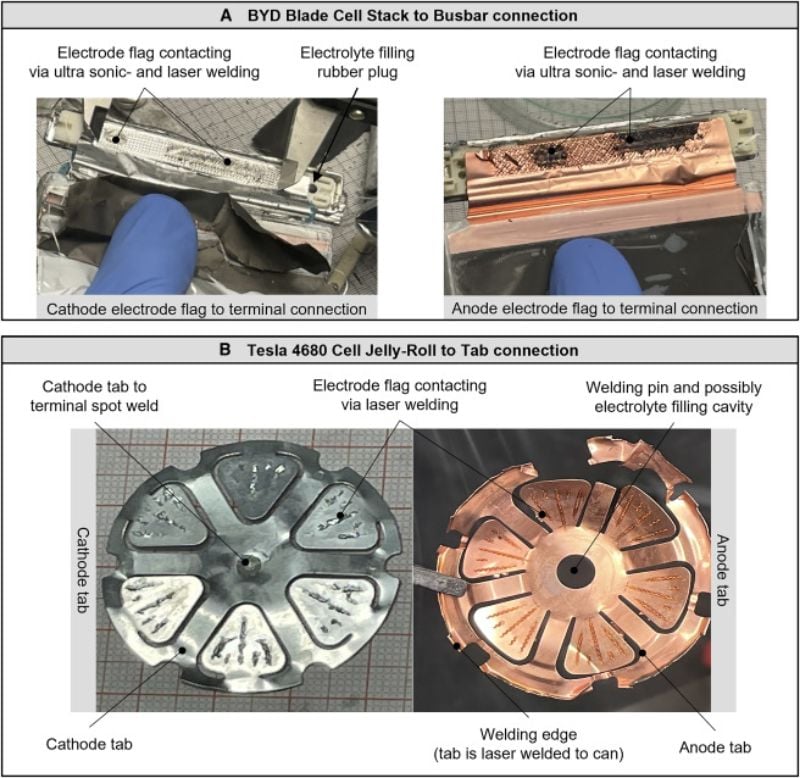
Physical structure of BYD and Tesla batteries. Image used courtesy of Gorsch et al.
The 4680 cell features a tabless design. The jelly roll’s edge replaces the traditional tabs, both reducing the cell’s internal resistance and improving its thermal characteristics. The jelly roll manufacturing process is critical for efficient production, focusing on flexible design and format manufacturing.
BYD's Blade battery features a unique prismatic design, with individual cells shaped like long, thin "blades" that can be arranged in an array and inserted into a battery pack. A typical Blade cell measures approximately 96 cm (37.8 inches) long and 9 cm (3.5 inches) wide, with more specific dimensions from the research showing 965 mm length, 90 mm height, and 14 mm thickness.
The BYD Blade battery uses an electrode stack with 38 double-coated cathode sheets, 39 double-coated anode sheets, and 79 separator layers, which are Z-folded into three layers. The separator overhangs the rest of the layers and is laminated, closing off the assembly’s sides and helping to fix the cathode and anode into position.
The Tesla 4680 cell is sealed using an edge-bending process, whereas the BYD Blade cell involves multiple laser welding steps. This results in the prismatic cell requiring two additional assembly steps. However, because the BYD cell is much larger, the energy content per unit assembled is approximately five times greater for the Blade cell despite its lower energy battery chemistry. To achieve the same output in kWh, BYD needs only to assemble about one-fifth of its blade units when compared to the number of Tesla 4680 cylindrical cells that need to be manufactured.

Battery cell cross sections. Image used courtesy of Gorsch et al.
The Blade battery features a module-less design. The battery pack is reinforced with a honeycomb-like aluminum structure, enhancing structural integrity and safety. This design simplifies the production process by eliminating modules, reducing structural components, and improving space utilization by up to 50 percent.
While cylindrical cells have excellent structural integrity, their maximum theoretical packing efficiency is 90 percent, compared to the 100 percent achievable with prismatic designs like BYD's Blade battery. This difference affects the overall volumetric efficiency of battery packs constructed with these respective cell types.
Safety Considerations
Safety represents one of the most compelling advantages of BYD's LFP Blade battery technology. The chemical structure of lithium iron phosphate provides inherently greater thermal and chemical stability compared to nickel-based chemistries. BYD has highlighted this advantage through extreme testing scenarios, demonstrating that the Blade battery emits no smoke or fire after being penetrated in nail tests, with surface temperatures reaching only 30 to 60°C (86 to 140°F). The company has also subjected their batteries to crushing, bending, heating to 300°C (572°F), and 260 percent overcharging without triggering fires or explosions.
Tesla's NMC batteries, while engineered with numerous safety features, inherently face greater thermal management challenges. At abnormally high temperatures, NMC batteries can potentially catch fire or, in extreme cases, explode. This necessitates more sophisticated cooling systems and protective measures in Tesla's battery packs. The higher heat generation observed in the 4680 cells during charging further underscores the importance of these thermal management systems.
Energy Density and Range
Perhaps the most significant performance difference the Aachen University study highlighted between these battery technologies is their comparative energy density. Tesla's NMC-based 4680 cells demonstrate substantially higher energy density at 241 Wh/kg and 643 Wh/l, compared to BYD's LFP Blade battery at 160 Wh/kg and 355 Wh/l. This translates to approximately 33 percent greater energy density for Tesla's battery at a similar weight. For electric vehicle applications, this higher energy density allows Tesla to pack more energy into the same space, potentially enabling longer driving ranges or smaller, lighter battery packs for equivalent range.
Charging and Thermal Performance
While Tesla's batteries offer higher energy density, BYD's LFP Blade cells demonstrate superior thermal characteristics. The study revealed that the BYD Blade cell generates approximately half the heat per cell volume compared to Tesla's 4680 cells when subjected to similar charging conditions. This significant difference in thermal behavior has important implications for battery management systems, charging speeds, and overall safety.
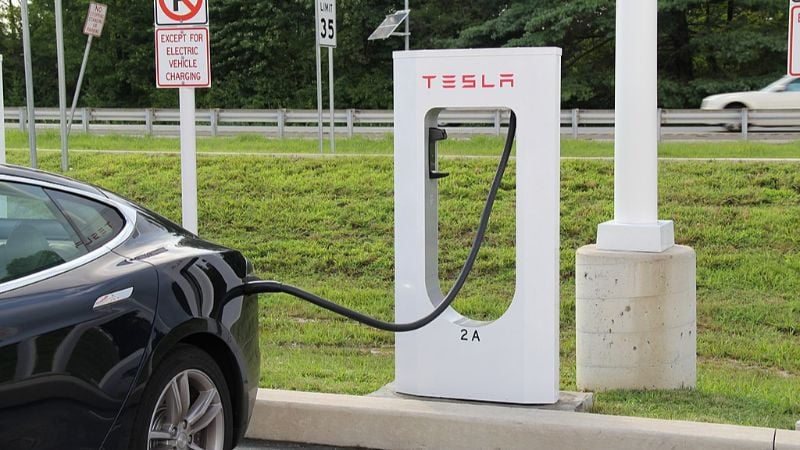
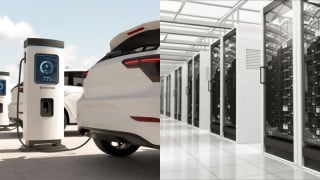
Tesla charging. Image used courtesy of Wikimedia Commons
LFP batteries generally tolerate repeated rapid charging better than NMC batteries and are less sensitive to being fully charged and discharged. Additionally, the smaller particle size in BYD's electrodes increases the surface-to-volume ratio, allowing lithium ions to flow more easily and resulting in better charging capabilities and lower resistance. This improved electrical performance could enable faster charging with less heat generation, potentially extending battery life and enhancing safety.
Longevity and Degradation
Battery lifespan represents another area where BYD's LFP technology demonstrates advantages. LFP batteries typically offer longer cycle life, with BYD claiming up to 4,000 cycles for their cells. The chemistry also exhibits a lower degradation rate over time compared to NMC batteries. In practical terms, this means a BYD battery will likely retain more of its storage capacity after 8-9 years of use than a comparable NMC battery.
While Tesla's NMC batteries still offer good longevity (some indications are more than 15 years) by industry standards, they may experience faster degradation due to their higher resistance and greater thermal stress during operation. However, Tesla's sophisticated battery management system helps mitigate these issues and maximize battery life.
Cost and Economic Factors
The economic considerations of these battery technologies reveal significant differences in manufacturing costs and market positioning. BYD's LFP Blade batteries benefit from lower production costs since they use abundant, less expensive materials like iron and phosphate and don’t use costly cobalt. Aachen’s research indicates that BYD's battery costs approximately €10 ($11 U.S.) less per kilowatt-hour to produce compared to Tesla's battery. This cost advantage helps position BYD's vehicles more competitively in mass-market segments.
Tesla's NMC batteries involve higher material costs, particularly due to their nickel and cobalt content. However, their superior energy density provides value in premium vehicle segments where performance and range are prioritized over the base price. The cost differential between these technologies has influenced market strategies, with Tesla now reportedly using BYD's LFP cells for some of its standard-range models to achieve lower costs.
Manufacturing Innovations
Both companies have implemented innovative manufacturing approaches in their respective battery designs. The RWTH Aachen study found that BYD's Blade battery employs an electrode stack with its novel laminating the edges of the separator between electrodes. Tesla's 4680 cell uses a unique binder to hold active materials together, differing from the industry standard and potentially helping control costs.
Both manufacturers utilize laser welding to connect electrode foils instead of the more common ultrasonic welding used by many others in the industry. This shared manufacturing approach, despite the different cell formats, suggests that this technology will become more commonplace in battery production.
What We Can Conclude
Comparing BYD's LFP Blade batteries and Tesla's NMC cells reveals two fundamentally different but equally innovative approaches to electric vehicle battery technology. Tesla prioritizes energy density and performance, creating batteries that enable longer range and higher power output at the expense of higher costs and greater thermal management challenges. BYD emphasizes safety, longevity, and cost-effectiveness, producing batteries that may offer less range but provide enhanced thermal stability, longer life, and lower production costs.
As the electric vehicle market matures, both approaches will likely find their place in different market segments and use cases. The ongoing competition between these technologies will drive further innovation as each company seeks to address the inherent limitations of its chosen chemistry while building on its strengths. For consumers and the industry at large, this technological rivalry promises to accelerate the development of better, safer, more affordable electric vehicles, ultimately supporting the broader transition to sustainable transportation.