Facebook
 Google
 GitHub
 Linkedin
Breakthroughs in Diamond, EV, and Sodium-Ion Batteries
Battery technology advancements could increase battery life and durability.
With electric vehicle and renewable energy storage demands growing, the need for advanced battery technologies has never been greater. Traditional lithium-ion batteries, while reliable, face limitations in raw material availability, environmental concerns, and performance longevity. As researchers and companies strive to overcome these hurdles, alternative solutions are emerging to address specific challenges.
Recent breakthroughs in battery technology could redefine how energy is stored and used.
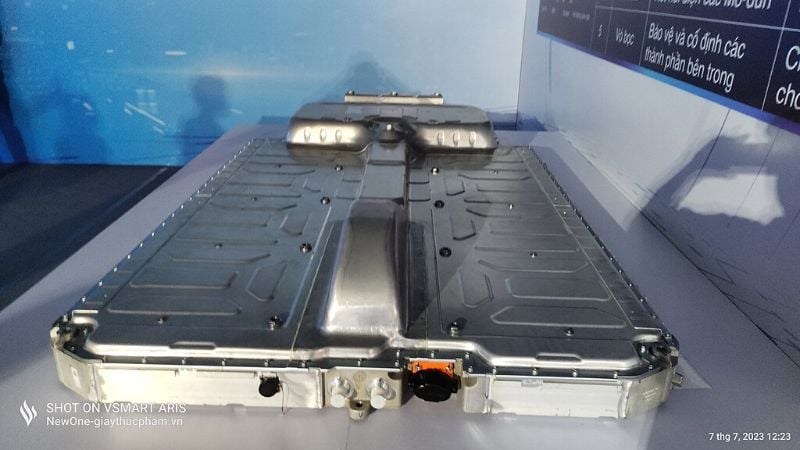
Electric vehicle battery pack. Image used courtesy of Wikimedia Commons
The Diamond Battery
Researchers at the U.K. Atomic Energy Authority and the University of Bristol have addressed the challenges of storage duration and nuclear waste with a carbon-14 diamond battery.
This battery derives power from the radioactive decay of carbon-14, a harmful byproduct of nuclear reactors because it emits radiation that could harm the human body. Encased in a synthetic diamond shell, it converts the decay’s fast-moving electrons into a continuous low-power electric current, as the diamond structure effectively shields radiation. Measuring approximately 10 mm by 10 mm and less than 0.5 mm thick, the battery is highly compact and maintains half of its initial power even after 5,700 years (i.e., the half-life of carbon-14.)

Diamond battery sample. Image used courtesy of University of Bristol
The battery’s manufacturing process employs plasma deposition to form the diamond casing. By utilizing nearly 95,000 tonnes of graphite-based carbon-14 from nuclear waste in the U.K., the battery mitigates storage costs and ecological risks associated with radioactive materials.
Early tests suggest scalability and adaptability for extreme environments, making the researchers envision potential applications span medical implants, deep-space exploration, and remote sensors.
Increasing Life Expectancy of EV Batteries
Researchers at Stanford University and SLAC National Accelerator Laboratory have addressed the challenge of accurately predicting electric vehicle battery lifespans.
Traditional laboratory testing relies on constant charge-discharge cycles, which underestimate battery longevity under real-world driving conditions. By studying 92 commercial lithium-ion batteries over two years and using machine learning, researchers developed dynamic discharge profiles based on actual driving behaviors, including frequent acceleration, braking, and idle periods. These profiles revealed that EV batteries could last 30–40% longer than previously estimated, extending the life of costly battery packs.
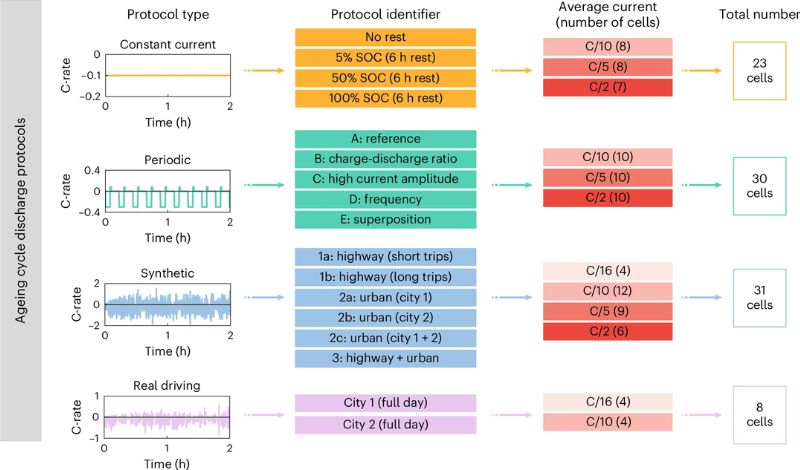
The four discharge profiles from the study. Image courtesy of Geslin et al.
Contrary to traditional assumptions, they found that sharp accelerations and braking events reduce battery degradation. Additionally, the study highlighted the balance between time-induced aging, which dominates for consumer use, and cycle-induced aging, prevalent in commercial vehicles.
Improving Sodium-Ion Batteries
In light of lithium shortages, researchers at Argonne National Laboratory have advanced sodium-ion battery technology by addressing a significant performance barrier.
Sodium-ion batteries have suffered from rapid degradation due to cracking in cathode particles during cycling. The team developed a method to mitigate these cracks using a sodium-ion oxide cathode design based on a lithium-ion counterpart. By optimizing the heat-up rate during cathode synthesis to one degree per minute, they eliminated strain-induced fractures in gradient-structured particles where nickel-rich cores are surrounded by manganese-rich shells for capacity and stability, respectively.
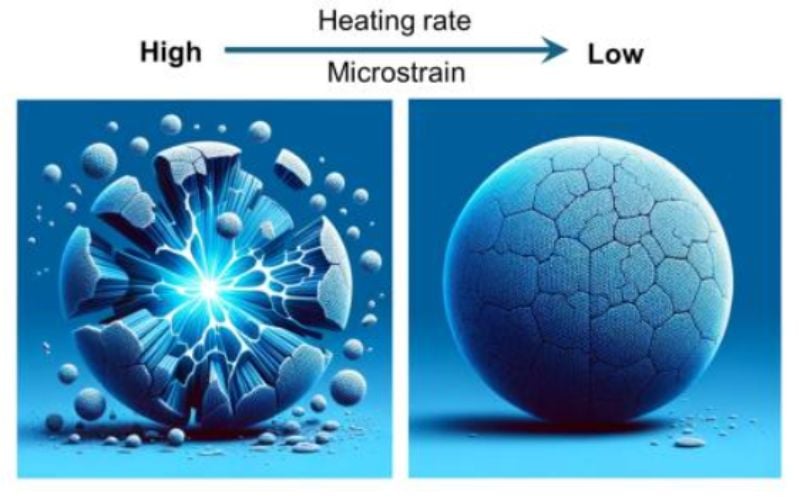
The research team reduced microstrains in core-shell particles. Image courtesy of Argonne National Laboratory
The synthesis process involved heating a precursor material mixed with sodium hydroxide to 600°C, with real-time structural monitoring through advanced X-ray techniques. Uniformly distributed particles showed no cracks, whereas gradient-structured particles experienced core-to-shell strain-induced fractures at higher rates. Optimized cathodes maintained performance over 400 cycles in tests, demonstrating improved durability.
The researchers believe this development brings sodium-ion technology closer to parity with lithium-iron-phosphate systems. Future efforts aim to remove nickel, enhance sustainability, and reduce costs.
New Directions
This slew of recent battery advancements illustrates a growing focus on reshaping energy solutions for long-term sustainability and efficiency. As industries and researchers collaborate further, the potential for integrating such technologies into everyday applications is immense and exciting.