Facebook
 Google
 GitHub
 Linkedin
Powering AI Safely in a New Era of High Voltage Data Centers
As AI workloads push rack power into megawatt territory, data centers are shifting to 800 VDC and beyond — raising arc-flash risk and outpacing today's safety standards.
This article was co-authored by Lisa Grams and Michael Jensen of UL Solutions.
Every electrical system operates within limits. The more power you move through a system, the more carefully it must be controlled. Nowhere is this principle more visible today than in the rapid expansion of data center infrastructure.
Just a few years ago, a typical server rack in a data center might have required around 10 kilowatts (kW) of power. Today, that number has already grown significantly to 120 kW. And soon, individual racks in data centers are expected to require as much as 1,000 kW, or 1 megawatt (MW).
This growth is driven largely by the widespread adoption of artificial intelligence (AI). As demand and use for AI scale, the graphics processing units (GPUs) used to train and operate AI models require increasingly high levels of power. This power is needed to optimize their operation.
To put this in perspective, a 1 MW rack is equivalent to the electrical consumption of 300 single-family homes. That amount of power is consolidated into an enclosure about the size of a household refrigerator. Data centers can incorporate hundreds of these racks within a single facility, consuming the same amount of power as a city.
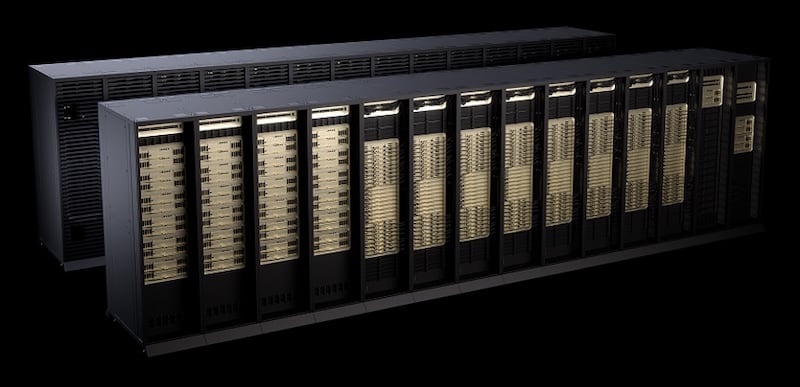
Rising rack power, as in the NVIDIA DGX Vera Rubin NVL72, is pushing data centers toward higher-voltage DC distribution. Image used courtesy of NVIDIA
To keep up, data centers are moving to higher-voltage distribution, specifically 800 Volts Direct Current (VDC) and eventually 1500 VDC. That helps deliver more power efficiently, but it also means the types of hazards in the system are different and can be significantly more hazardous.
Managing the risks of increased power distribution requires rethinking how systems are designed and how work is performed. It also requires rethinking how safety is applied across the entire data center environment.
The Power Flow of a Data Center
In earlier data center designs, the way power was distributed naturally limited where higher energy existed and who interacted with it. Electricity entered the facility, moved through centralized infrastructure and stepped down to a lower voltage before reaching IT equipment.
That structure worked because power demand was lower and simpler. Delivering electricity at reduced voltage near the point of use kept the operating environment relatively stable. It also meant that most routine work by computer technicians could take place without direct exposure to higher-energy parts of the system.
However, as demand increases to the levels required for AI workloads, those conditions begin to shift. Supplying hundreds of kilowatts or megawatts to a rack can be optimized with both higher voltage and direct current sources. Moving power efficiently at that scale depends on bringing it closer to where it is consumed.
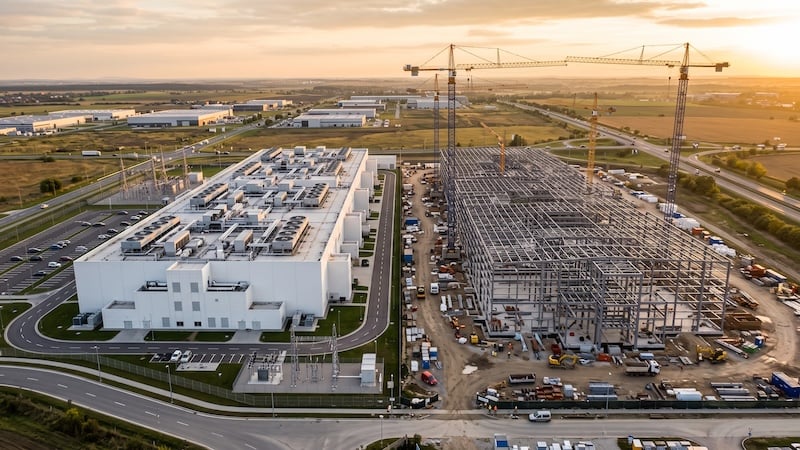
Newer AI data centers place increased demands on energy delivery and power flow. Image used courtesy of Adobe Stock
This change affects both system design and system behavior. Power infrastructure such as transformers, conductors, and protective devices becomes more closely integrated with computing equipment. In addition, because of the need for high reliability, facilities typically incorporate additional energy sources, including on-site generation and energy storage. These added sources can complicate power flow and protection.
The result is a system that no longer operates with the same level of separation between electrical infrastructure and operations. Higher voltage and energy are more widely distributed across the AI data center environment. As a result, equipment must work together under more complex modes of operation in both normal and fault conditions. The safety assumptions built around lower-voltage, more contained systems no longer apply in the same way.
Why Operating Practices Need to Adapt at Higher Voltage
In those earlier data center designs, much of the routine work around IT equipment could be done while systems remained energized. In many cases, systems delivered power at around 48 VDC, which falls below the threshold where electric shock risk becomes significant. That allowed personnel to perform tasks such as connecting and disconnecting equipment or replacing components, without extensive protective measures.
However, at 800 VDC, the system operates at a level where exposure to energized conductors introduces significant risk. The combination of elevated voltage and power also presents a significant risk of arc flash, a potentially violent and explosive release of electrical energy.
OSHA establishes requirements for protecting employees from electrical hazards. NFPA 70E, the Standard for Electrical Safety in the Workplace, outlines procedures and practices for reducing those risks, including establishing electrically safe work conditions before work is performed. Under NFPA 70E, conductors and circuits operating at or above 50 volts should be placed in an electrically safe work condition when there is a risk of exposure.
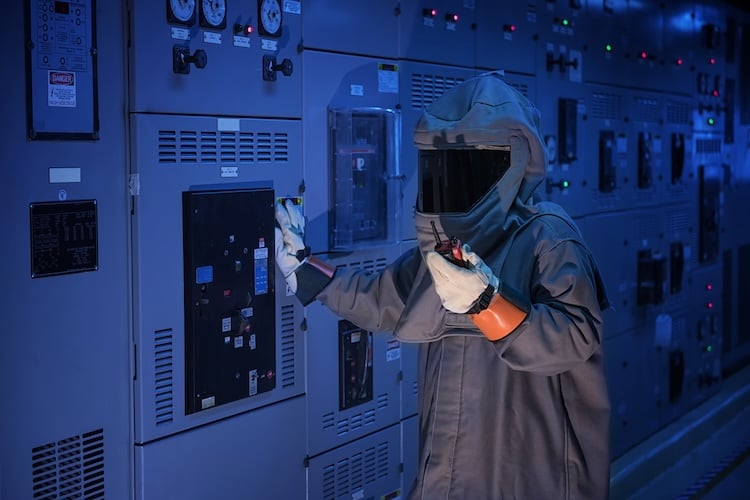
Insulated gloves and other personal protective equipment may become essential as data center technicians work closer to higher-voltage, higher-energy circuits. Image used courtesy of Adobe Stock
Activities such as hot-swapping — performing maintenance or replacing components while equipment remains energized — become significantly more hazardous at higher voltage. The potential for initiating an arc during a connection or disconnection (or other maintenance) increases. The consequences of that arc also become more severe due to the higher energy involved.
Fully de-energizing systems for maintenance may not always be feasible from an operational standpoint. To address this, some facilities are exploring controlled approaches such as semi-hot-swapping. In this approach, the component being serviced is de-energized even though voltage remains present elsewhere in the system. This reduces current flow during the operation, which can help limit risk, but it also requires additional safeguards and compliance with OSHA regulations.
What Higher Energy Means for Protection and Coordination
In any electrical system, protective devices are responsible for interrupting current when it exceeds safe limits. Higher energy levels create greater challenges for protection and coordination, particularly when interrupting fault currents. Both alternating current (AC) and direct current (DC) systems can present unique interruption challenges. It’s more challenging to interrupt DC than AC because it does not naturally pass through the periodic zero-current points found in AC systems.
Data centers can also contain large amounts of stored energy in capacitive equipment, which influences how fault currents behave. This stored energy can make those fault currents more challenging to safely interrupt than the resistive or inductive currents commonly found in many other electrical systems.
Two related concepts become especially important at this scale. The first is interrupting rating, which defines the maximum level of fault current a protective device can safely stop. The second is short-circuit current rating, which reflects whether the equipment in the system can withstand that current long enough for protection to operate.
In lower-power environments, these ratings are often easier to satisfy. However, as available fault current increases, these limits become critical constraints. If protective devices are not properly rated, they may fail to interrupt the fault. If equipment cannot withstand the current, it can fail before protection clears the event. Either condition can lead to significant damage within fractions of a second.
This is where coordination across the system becomes essential. Protective devices cannot operate in isolation; they must respond in a defined sequence so that the fault is cleared at the appropriate point in the system. Proper coordination ensures that only the affected portion of the system is interrupted, while the rest continues to operate as intended.
While protection and coordination systems exist to interrupt current when it exceeds safe limits, that only tells part of the story. What happens when a fault event is not fully contained?
How High-Energy Faults Translate Into Real-World Hazards
At higher power levels, the consequences of abnormal conditions or faults escalate significantly. Faults can translate into catastrophic physical effects that can impact both equipment and the people working nearby. One of the most well-documented examples is arc flash.
An arc flash occurs when current moves through the air between conductors, creating a conductive plasma that allows very high levels of current to flow. In lower-power environments, this may result in a brief, contained event. In higher-power systems, the energy release is far more substantial. According to Eaton, temperatures can reach approximately 35,000°F — more than three times hotter than the sun. This heat is accompanied by intense light, pressure waves and sound levels capable of causing hearing damage.
These effects happen almost instantaneously. The heat alone can cause severe burns, while the pressure wave or arc blast can physically displace equipment or people close by. The release of vaporized metal and gases adds another layer of hazard in confined spaces.
In a commercial or industrial setting, voltages and currents are significant, so electrical faults can release far more energy. In an AI data center environment, even a short-duration fault can produce a powerful explosion that is difficult to control once initiated.
Where Standards and Guidance Are Still Evolving
The systems now being deployed in modern data centers do not always fit neatly into the assumptions that existing standards were built around.
Requirements such as the National Electrical Code (NEC), NFPA 70E, and UL standards provide the foundation for electrical safety. They define how systems should be installed and how work should be performed to reduce risk. However, much of the existing knowledge and established testing practices are rooted in extensive experience with high-current AC applications. Standards exist today for evaluating arc hazards, but the ability to measure and predict arc-flash energy in DC systems remains limited. As a result, mitigation is generally accomplished through engineering analysis and work protocols.
At the same time, data center design continues to evolve. Power systems are becoming more integrated, and higher-voltage distribution is moving closer to computing equipment — conditions that were not fully anticipated in legacy safety requirements. As new power architectures emerge, particularly DC systems and high-density data center applications, standards and guidance must continue to evolve to address safety challenges.
Aligning Standards for a New Generation of Power Distribution
Addressing these gaps requires a coordinated view of how standards, installation practices, testing methods, and certification pathways should evolve as data centers move toward higher-voltage DC architectures.
UL Solutions’ Data Center Power Distribution Standards Roadmap is focused on supporting that transition for emerging 800 VDC and future 1500 VDC power architectures and cutting-edge technologies. Through a gap analysis of more than 60 power-related standards, UL Solutions has identified areas where existing requirements need to evolve to support emerging DC data center applications. These areas include power distribution equipment, protection devices, cabling, connectors, compute infrastructure, and modular power systems.
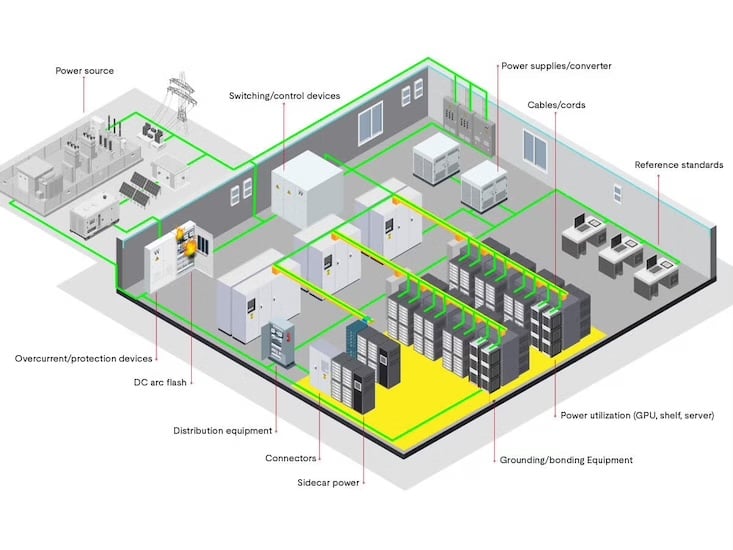
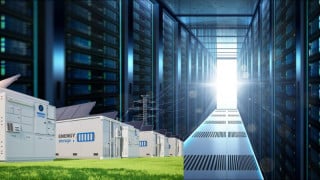
Existing requirements need to evolve to support emerging DC data center applications, including power distribution equipment, compute infrastructure, modular power systems, and more. Image used courtesy of UL Solutions
Several priorities have emerged from that work. One is the need for greater alignment around higher-voltage DC architectures, including how the industry approaches 750 VDC and 800 VDC systems. Another is the need for greater harmonization across UL, IEC, IEEE, and NFPA requirements. This would let equipment manufacturers, data center operators, and authorities having jurisdiction work from a more consistent framework. Continued research into DC arc-flash behavior is also important. This is particularly true as the industry works to better understand how fault energy should be measured, evaluated, and mitigated in these systems.
The roadmap also considers how standards can better support emerging data center designs, including sidecar and modular architectures. At the same time, it aims to create clearer pathways for evaluating and certifying new power technologies. This is important because innovation in data center infrastructure is moving quickly. Still, deployment depends on confidence that new systems can be installed, operated, and maintained safely.
Industry engagement is a key part of that work. UL Solutions is collaborating with organizations such as the Open Compute Project (OCP) and Current/OS. Together, they are working to align hyperscalers, manufacturers, standards organizations, regulators, and solution providers around technical requirements and best practices for next-generation power systems. Through OCP’s Power Distribution Sub-Project, UL Solutions leads the Codes & Standards workstream. This workstream brings together stakeholders from organizations including IEC, IEEE, NFPA, NEMA, hyperscalers, and manufacturers to support consensus-based approaches for DC power distribution in data centers.
In parallel, work with Current/OS is helping advance interoperability requirements, testing methodologies, installation specifications, and research initiatives related to DC safety, including arc-flash considerations. Together, these efforts are intended to support more than standards development alone. They help create the broader framework needed for product compliance, interoperability validation, workforce education, and market adoption of high-voltage DC technologies at scale.
Rethinking How Systems Are Designed and Managed for the Future of Data Centers
As data centers move to higher voltage and greater power density, the central challenge is shifting. What greatly matters is how that power is controlled. That means how it behaves under both normal and peak conditions, how it is managed when something goes wrong, and how consistently the system responds across all scenarios.
Higher voltage and energy levels increase both exposure to risk and the potential consequences of failure. At the same time, power distribution is moving closer to computing equipment, which brings those higher-energy conditions into closer alignment with day-to-day operations. This combination reduces the margin for variability and raises expectations for how systems must perform, particularly during fault events.
Looking ahead, this places greater emphasis on system-level alignment. Equipment, protection, and overall design must function together in a predictable way, and that coordination must be maintained as systems scale and evolve. For these new applications, parties should comply with the evolving safety requirements being developed by UL Solutions, the National Fire Protection Association (NFPA), and other trusted safety organizations. In practice, that means applying established safety principles with a deeper level of engineering judgment. It also means acknowledging that the margin for uncertainty is smaller when operating at higher energy levels.
As data centers take on the scale and characteristics of high-density electrical systems, success will depend on maintaining control over how energy moves through the environment. That means ensuring power remains predictable, coordinated, and aligned with established safety practices — even as the system continues to grow and voltage continues to increase.