Facebook
 Google
 GitHub
 Linkedin
Oceans of Info: Dual Platform Tests Wave Energy Converter Tech
European research group creates dual hardware-in-the-loop platform for rigorous testing of wave energy converter technology.
Wave energy converters (WEC) are a promising renewable energy generation technology that harnesses the continual power of ocean waves. However, commercializing WEC technology faces hurdles, particularly in ensuring the reliability and efficiency of power take-off systems (PTO). Addressing these challenges requires rigorous testing and advancements in engineering and materials.
SINTEF, a European research institute, helped develop a novel method for evaluating WECs’ reliability, performance, and durability. The group’s testing platform could significantly advance wave energy technology.
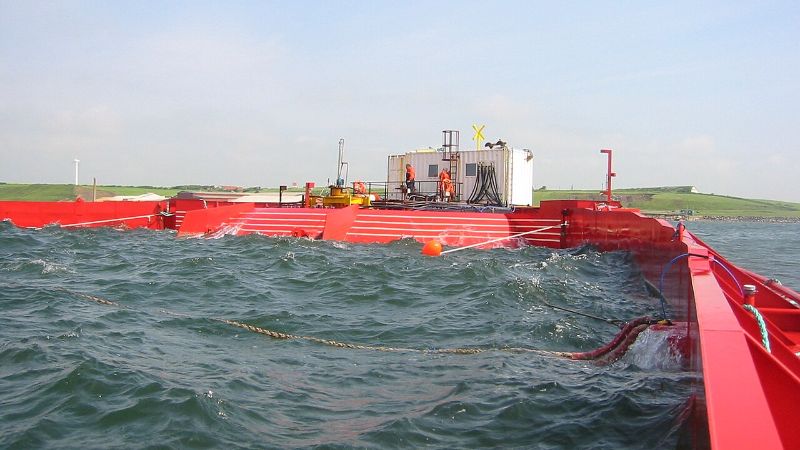
WaveDragon, a wave energy converter near Denmark. Image used courtesy of Wikimedia Commons/Erik Friis Madsen
Wave Energy Converter Basics
WECs are energy harvesting devices that capture ocean waves' kinetic and potential energy for various purposes, including generating clean electricity for the grid, powering ocean vehicles, and facilitating seawater desalination through pumping operations.
WECs come in many styles, including oscillating water columns, point absorbers, and attenuators, which use different mechanisms to convert wave energy. For instance, oscillating water columns use wave motion to compress air and drive turbines, while point absorbers convert wave-induced motion into energy through hydraulic systems or direct generation.
The PTO system within a WEC converts this absorbed energy into usable electricity, typically using hydraulic pumps or turbines to drive generators. These systems generally include mechanical components like hydraulic pumps or turbines, which transform wave-induced motion into rotational or hydraulic energy. This energy then drives generators, converting them into electricity.
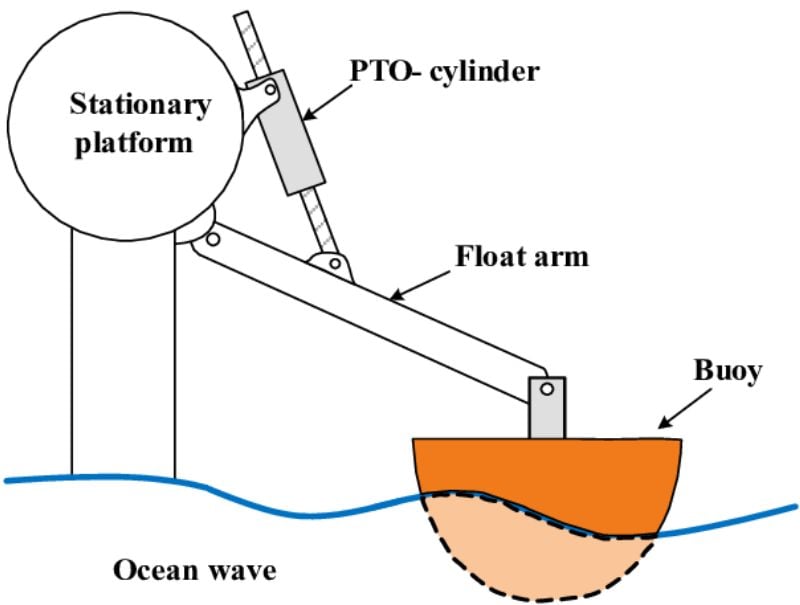
Point-absorber type WEC. Image used courtesy of Zhao et al.
Rigorous testing is crucial for PTO systems in WECs, involving a comprehensive approach spanning from component-level evaluations to full-scale sea trials. This process encompasses environmental simulations to assess durability in harsh marine conditions, performance optimization across various wave states, and extensive reliability testing to ensure longevity.
Scale model testing in wave tanks precedes full-scale deployment, allowing for design validation and performance prediction. Grid integration capabilities are also thoroughly examined to ensure compatibility with existing power infrastructure. Throughout the testing phase, control systems are fine-tuned, and potential failure modes are analyzed to enhance safety and reliability.
Accelerating WEC Technology
SINTEF helped develop a new dual hardware-in-the-loop (Dual HIL) platform to accelerate WEC technology testing. This platform simultaneously tests different WEC components to provide a holistic view of their behavior and interactions.
To achieve this feat, the Dual HIL system uses two independent test rigs: a drivetrain and a structural components rig.
The drivetrain rig, originally developed in the EU IMAGINE project and further enhanced through IMPACT (Innovative Methods for Wave Energy Pathways Acceleration through Novel Criteria and Test Rigs), evaluates linear and rotary PTO systems under various grid conditions and common coupling points. This rig simulates diverse mechanical stresses induced by waves to verify PTO reliability and efficiency, with data acquisition and analysis performed using MATLAB.
The structural components rig tests WEC parts’ mechanical integrity, such as mooring systems, dynamic power cables, joints, and seals. This rig, already used to test Carnegie Clean Energy’s CETO 6 WEC belt, leverages a digital twin created by SINTEF Ocean to collect detailed performance data.
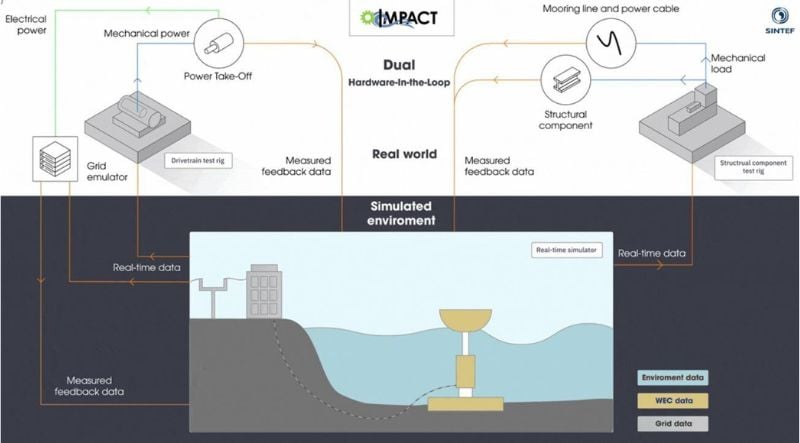
IMPACT Dual HIL testing platform with drivetrain and structural components test rigs. Image courtesy of the SINTEF
By running these rigs simultaneously, the Dual HIL platform provides real-time data feedback into a simulator, enabling a comprehensive understanding of the WEC’s behavior in various environmental conditions.
Toward Sustainable Seas
SINTEF's Dual Hardware-in-the-Loop platform development could have a tangible impact on accelerating the commercialization of wave energy converters. By providing more comprehensive and realistic performance data, the platform could lead to more robust and efficient designs, potentially reducing costs and increasing wave energy system reliability. This, in turn, could make wave energy a more viable option in the global renewable energy mix. In meeting the pressing challenge of climate change, advancements like these in renewable energy testing and development will be essential for creating a sustainable energy future.