Facebook
 Google
 GitHub
 Linkedin
The Importance of Ruggedness: Littelfuse Polar MOSFETs
Learn how Littelfuse addresses the planar MOSFET gap with its Polar MOSFET portfolio, offering rugged and thermally reliable products that are tailored for industrial power conversion environments.
Article co-authored by co-authored by Littelfuse's Sachin Shridhar Paradkar and Raymon Zhou.
This article is published by EEPower as part of an exclusive digital content partnership with Bodo’s Power Systems.
Littelfuse Polar MOSFETs have powered diverse applications for decades and remain a compelling solution for both legacy and emerging designs where simplicity, reliability, and proven maturity are essential. Unlike newer technologies that emphasize switching speed and low conduction losses, Polar MOSFETs excel with superior avalanche capability, wide safe operating area (SOA), and ease of integration.
Their extensive portfolio supports both established and next-generation systems, making Polar MOSFETs a dependable choice for designers focused on long-term reliability. The recent expansion of Littelfuse’s fabrication footprint in Dortmund, Germany further strengthens the positioning, enhancing innovation, supply chain stability and manufacturing excellence, while leveraging the strategic advantages of European-based production for high-reliability applications.
Image used courtesy of Adobe Stock
Power Electronics Applications and their Requirements
Power electronics (PE) applications such as power supplies, process power systems, and test and measurement equipment demand a careful balance of performance and reliable operation. At a fundamental level, these applications require components with suitable voltage and current ratings, optimal on-state resistance for reduced conduction losses, and fast switching capabilities to enhance system efficiency.
However, under real-world operating conditions disturbances like voltage transients due to inductive switching, overvoltages and overcurrents due to abrupt line and load fluctuations, and pulsed power cycling can occur. This demands for additional features such as overvoltage ruggedness, wide SOA, low thermal resistance, and pulsed power cycling capability to ensure fault tolerance and long-term reliability.
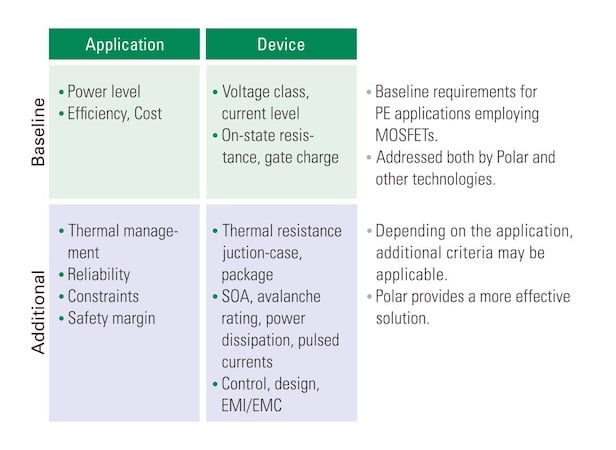
Figure 1. Simplified map of power electronics application requirements. Image used courtesy of Bodo’s Power Systems [PDF]
Figure 1 illustrates a simplified requirements map for most PE applications, showing how system-level application needs translate into device-level parameters. Depending on the application, certain criteria become more critical, highlighting the areas where Polar MOSFETs can provide more suitability. While competing technologies such as Silicon Superjunction (SJ) and SiC excel in addressing requirements like efficiency and fast switching, they may not always offer comprehensive ruggedness under stress conditions.
In contrast, Littelfuse Polar MOSFETs present a comprehensive solution by fulfilling fundamental requirements and fast switching capability while also delivering enhanced overvoltage ruggedness, robust SOA, low thermal resistance, and enhanced pulsed power cycling capability. This makes them particularly suitable for demanding applications where simplicity and reliable operation under harsh conditions is crucial.
Polar MOSFET Family
The Polar MOSFET family depicted in Figure 2 consists of two subfamilies: Polar and Polar3, each offering both standard MOSFETs and HiPerFETs with a fast-body diode for enhanced switching behavior. The Polar series covers voltage ratings from 100 V to 1200 V, current ratings from 0.2 A to 300 A, and on-state resistance values ranging from 0.0055 Ω to 75 Ω.
The Polar3 series extends the voltage range significantly, offering devices rated from 300 V to 3000 V, with current ratings from 0.4 A to 210 A and on-state resistance values between 0.0145 Ω and 190 Ω. Built on Littelfuse proprietary planar gate designs, Polar MOSFETs deliver a good balance of key performance metrics along with enhanced ruggedness and reliability. These are available in a wide variety of standard as well as unique discrete packaging options such as the isolated (ISOPLUS) and high-voltage (HV) packages.
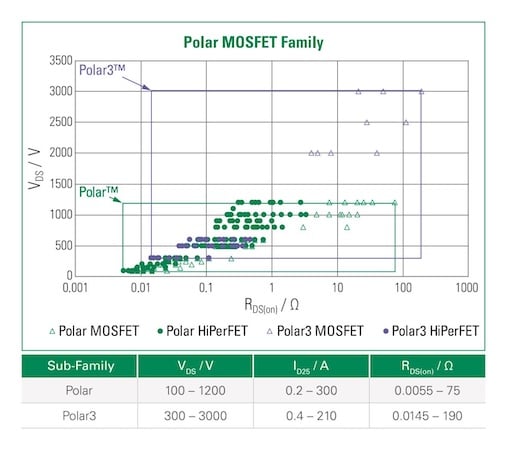
Figure 2. Littelfuse n-channel Polar MOSFET portfolio. Image used courtesy of Bodo’s Power Systems [PDF]
Competing MOSFET technologies can introduce certain challenges to the design and integration which are easily addressed by Polar MOSFETs. These include:
- Enhanced ruggedness: Superior avalanche and SOA capabilities enable reliable operation under overvoltage, overcurrent, and abrupt line and load changes.
- Standard gate drive compatibility: Reliable operation without the need for negative gate voltages reduces complexity and cost in gate driver design.
- Simplified design integration: Requires minimal tuning of layout, parasitics, and thermal paths, enabling easier and faster design implementation across applications.
- Reliable paralleling: Controlled switching behavior and positive temperature coefficient of on-state resistance supports easier and safer paralleling without the risk of current imbalance
- Enables cleaner, noise-free switching with reduced dv/dt stress, simplifying PCB layout and minimizing the need for complex EMI mitigation techniques
- Robust body diode performance: HiPerFETs feature a fast body diode with lower forward voltage drop, improving efficiency in application.
As competing technologies continue to shrink chip geometries with each new generation, thermal management becomes increasingly difficult. Designers are required to dissipate more heat from smaller die areas, adding complexity to system-level thermal design. In contrast, Polar MOSFETs provide optimal thermal performance, simplifying system-level thermal design.
Polar Advantage: Avalanche or Overvoltage Ruggedness
PE systems typically fall into two categories:
- Soft-switching topologies, which leverage zero-voltage (ZVS) and zero-current switching (ZCS) to minimize switching losses. While efficient, these designs are complex and highly sensitive to overvoltage and overcurrent conditions, making them vulnerable to sudden failures.
- Hard-switching topologies, which are simpler to implement but generate higher switching losses and subject devices to greater voltage stress.
Overvoltage ruggedness is essential regardless of the topology. Even in well-designed circuits, parasitic inductances and fast switching transitions can cause voltage spikes. This is where avalancherated MOSFETs become critical. When a MOSFET during a turn-off event is subjected to a voltage spike that exceeds its breakdown voltage, it can momentarily enter avalanche mode - a controlled condition where the device safely conducts excess energy without being damaged.
An avalanche rated MOSFET has been specifically designed and tested to survive such event, within specified limits. These devices provide the built-in robustness needed to withstand unexpected transients, enhancing system reliability and longevity.
Avalanche-rated MOSFETs play a critical role in protecting devices from transient overvoltages that exceed breakdown voltage, providing an essential safety margin in real-world applications. By withstanding occasional avalanche events, they help prevent device failure, reduce the risk of system-level damage, and avoid costly line-down scenarios, especially in critical infrastructure. This added robustness improves overall system reliability while remaining a cost-effective solution.
Figure 3 and Figure 4 illustrate the superior avalanche capability of Littelfuse Polar MOSFETs compared to other existing technologies. The comparison is based on single-pulse avalanche ratings from datasheets, across MOSFETs of similar voltage classes, nominal current ratings, and packaging.
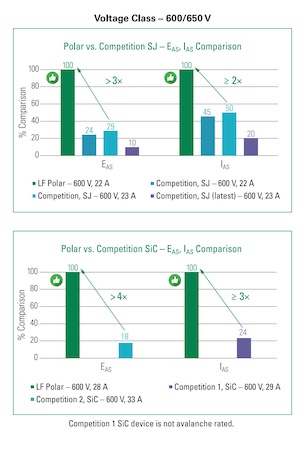
Figure 3. Comparison of datasheet single pulse avalanche parameters for 600/650 V MOSFETs from different technologies. Image used courtesy of Bodo’s Power Systems [PDF]
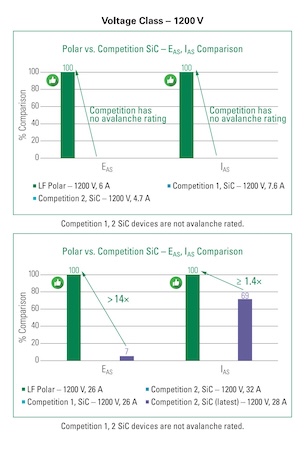
Figure 4. Comparison of datasheet single pulse avalanche parameters for 1200 V MOSFETs from different technologies. Image used courtesy of Bodo’s Power Systems [PDF]
Polar Advantage: Safe Operating Area
The SOA defines the permissible ranges of voltage and current a MOSFET can withstand without risking damage. It specifies the amount of power the device can safely handle in the saturation (linear) region and includes limits for both continuous and pulsed operation. SOA is a key indicator of a MOSFET’s robustness.
t reflects the device’s ability to endure demanding conditions without degradation or failure, making it a critical parameter in many applications. This is especially important in scenarios where MOSFETs briefly operate in the linear region – such as during start-up, sudden load changes, or slow switching transitions.
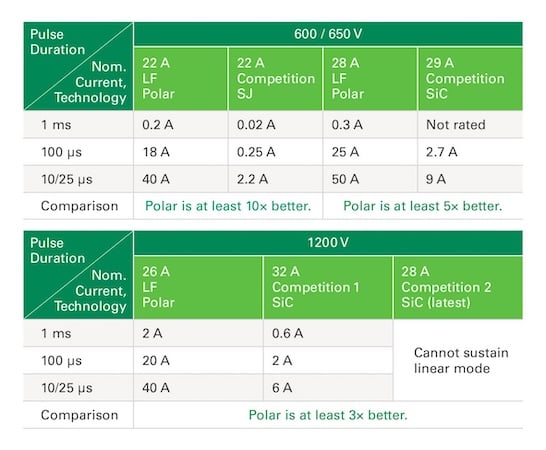
Figure 5. Comparison of datasheet SOA parameters for pulsed operation. Image used courtesy of Bodo’s Power Systems [PDF]
Applications that rely heavily on SOA performance include power amplifiers, push-pull topologies, auxiliary power supplies, and booster circuits in power supplies. In these cases, the MOSFET’s ability to handle short but intense periods of power dissipation ensures system reliability and long-term durability.
Figure 5 presents a comparison of the maximum currents from datasheet SOA for pulsed operation at the maximum voltage rating for both 600/650 V and 1200 V MOSFETs in similar packages. The comparison clearly highlights Littelfuse Polar MOSFETs as the leading option, offering significantly greater safety margins than competing technologies.
Applications Where Ruggedness Matters
As described at the beginning of the article there are several applications where ruggedness and reliable operation are critical. Table 1 captures some of the key applications where Polar advantage can make a difference.
| Applications | Key Concern | Polar Advantage |
| Industrial and laboratory power supplies | Overvoltage, pulsed linear mode operation | Avalanche ruggedness, robust SOA |
| Test and measurement equipment | Sustain transient linear mode operation | Robust SOA |
| Medical and missioncritical power systems | Lifecycle, EMI, maturity, legacy designs | Availability, mature technology with proven decades in the field, clean noise free switching |
| Process and pulsed power such as plasma, laser and welding | Packaging, pulsed power, availability | Special packaging, superior pulsed power capability |
| Industrial servo drives and robotics | Overvoltage, pulsed linear mode, pulsed power handling | Avalanche ruggedness, robust SOA, superior pulsed power capability |
| Auxiliary power supplies in transmission and distribution, PV inverters and motor drives | Overvoltage, transient linear mode operation, ease of design | Avalanche ruggedness, robust SOA, simplified design |
| Power amplifiers in audio and signal amplifiers | Transient linear mode operation, EMI | Robust SOA, clean noise free switching |
Table 1. Typical applications where reliable operation is a critical requirement.
Conclusion
Littelfuse Polar MOSFETs continue to demonstrate their value in modern power electronics by offering a robust combination of performance, ruggedness, and ease of integration. Their ability to withstand overvoltage events and operate reliably under harsh conditions, makes them a compelling choice for several industrial applications. As designers navigate the trade-offs between emerging technologies and proven solutions, Polar MOSFETs offer a balanced path forward, supporting both legacy systems and next-generation innovations.
References
- https://www.littelfuse.com/products/power-semiconductors-control-ics/ mosfets-si-sic/n-channel-standard
- https://www.littelfuse.com/products/power-semiconductors-control-ics/ mosfets-si-sic/n-channel-hiperfets
- https://www.littelfuse.com/products/integrated-circuits/gate-driver-ics.aspx
This article originally appeared in Bodo’s Power Systems [PDF] magazine and is co-authored by Sachin Shridhar Paradkar, Raymon Zhou, and José Padilla; Product Marketing, Littelfuse
Related Content