Facebook
 Google
 GitHub
 Linkedin
Onsemi, Würth Elektronik Power Up Virtual Design
Würth Elektronik has integrated Würth’s passive components into onsemi’s Self-Service PLECS Model Generator.
Engineers often encounter challenges when trying to model real-world conditions such as power loss, conduction, and thermal performance, as typical simulation tools can struggle to capture these complexities. Inaccurate models can lead to performance bottlenecks and costly delays, making it essential for designers to identify and resolve issues early in development.
The PLECS model generator. Video used courtesy of EEPower/onsemi
To address these challenges, onsemi and Würth Elektronik have collaborated to integrate Würth Elektronik’s passive component database into onsemi’s Self-Service PLECS Model Generator (SSPMG). This tool provides engineers with enhanced high-fidelity PLECS models, enabling a more realistic simulation of complete power electronic applications. With this addition, designers can achieve optimized, first-time-right system designs, accelerating time to market by allowing them to troubleshoot and refine systems in a virtual environment.
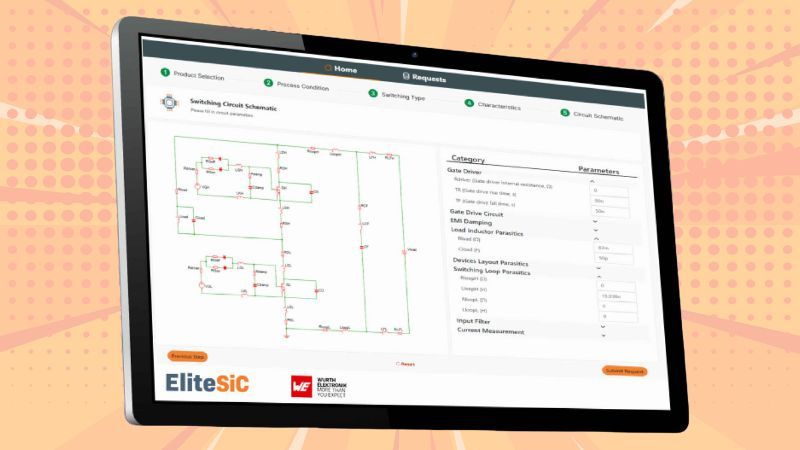
Self-Service PLECS Model Generator. Image used courtesy of onsemi
The Importance of Accurate Modeling in Power Electronics
In power electronics, every component must function optimally to avoid inefficiencies leading to wasted energy, excess heat, and increased costs. These inefficiencies, such as power loss, can significantly affect devices' performance and lifespan. Engineers traditionally rely on laboratory testing to identify these issues, but physical prototypes’ limitations can lead to lengthy design cycles. As virtual design becomes more accessible, engineers need tools to accurately represent electronic systems' complex conditions.
Integrating Würth Elektronik’s passive components into onsemi’s SSPMG tool marks a step forward in high-accuracy simulation. Engineers can model entire systems, accounting for active and passive components. Designers can observe how various components interact under numerous conditions, offering insights into performance bottlenecks that may go unnoticed until the testing phase. With precise virtual models, engineers can make adjustments before a physical prototype is assembled, reducing the time and costs associated with fabrication.
For example, engineers face challenges in designing electric vehicle inverters, like managing heat dissipation and ensuring efficiency under variable loads. Using SSPMG integrated with Würth Elektronik’s components, designers can simulate these scenarios to predict power losses and optimize thermal performance before building prototypes.
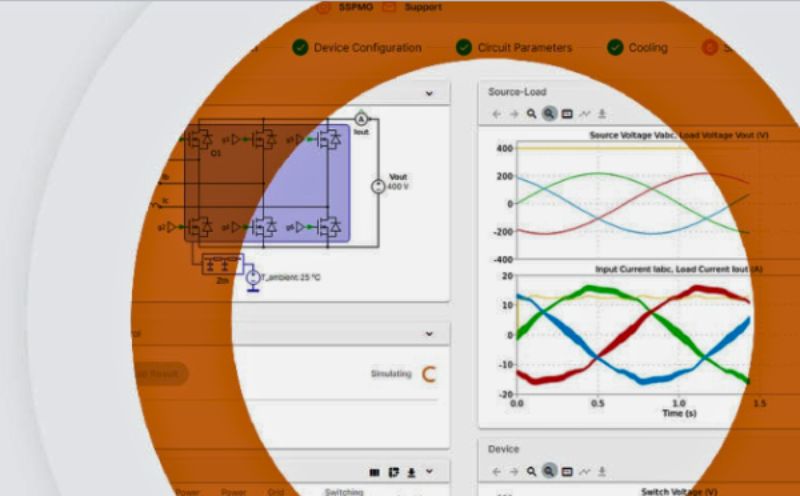
Visualization of Onnsemi’s Elite Power Simulator. Image used courtesy of onsemi
How SSPMG Brings a New Accuracy Level
Onsemi’s Self-Service PLECS Model Generator (SSPMG) sets itself apart with its user-friendly, web-based interface, allowing engineers to tailor simulations to their specific power applications. SSPMG incorporates onsemi’s SPICE (Simulation Program with Integrated Circuit Emphasis) models, reflecting actual semiconductor physics and manufacturing variations. Using these realistic models, engineers can anticipate real-world performance more accurately.
Future Impact of High-Fidelity Modeling
With SSPMG and Würth Elektronik’s passive components database, engineers can create PLECS models compatible with onsemi’s Elite Power Simulator (EPS). The EPS tool provides additional functionality by simulating system performance with onsemi’s latest power components, such as EliteSiC MOSFETs and Field Stop 7 IGBTs. This ensures compatibility across multiple applications.
As the demand for energy and cost-effective solutions grows, tools like SSPMG and EPS enable engineers to innovate faster and more accurately. By eliminating some guesswork from the design process, onsemi and Würth Elektronik’s collaboration paves the way for a future where virtual modeling brings first-time-right designs closer to reality, empowering engineers to achieve higher performance and reliability in power electronic systems.