Facebook
 Google
 GitHub
 Linkedin
What’s Going on With Clean Energy Jobs?
The U.S. Department of Energy recently released a report on 2022 clean energy job growth, and the results might surprise you.
At the end of June, the DOE released the 2023 U.S. Energy and Employment Report (USEER) detailing changes in employment within the energy sector in 2022.
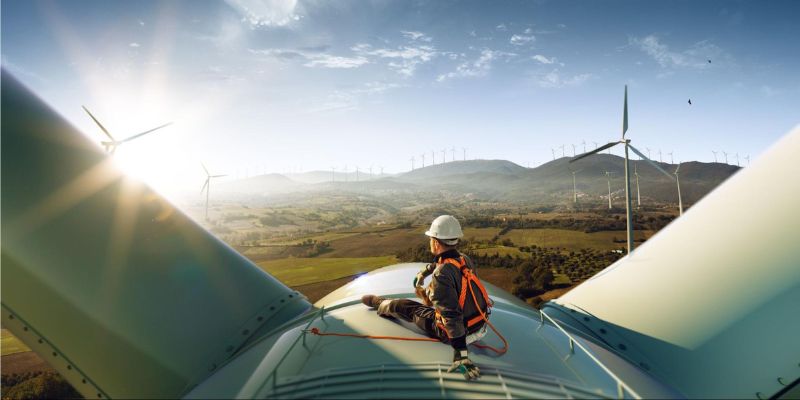
Wind turbine maintenance. Image used courtesy of Adobe Stock
The USEER provides a comprehensive overview of employment-related data at both national and state levels in various critical energy technology sectors. These sectors include electricity production and generation; transmission, distribution, and storage; fuels; energy efficiency; and motor vehicles and component parts. The USEER was initiated in 2016 to enhance the monitoring and comprehension of employment trends in significant energy sectors that were previously challenging or impossible to track using publicly available data sources.
With continually increasing investment from the private sector into American-made energy, the 2023 USEER reported a 3.8 percent growth in energy workforce jobs with almost 300,000 new positions.
Job Growth in the Clean Energy Sector
In 2022, clean energy jobs saw an increase of 3.9 percent, adding 114,000 jobs nationally. Clean energy jobs now account for over 40 percent of the total energy job market. This growth outpaces the overall job growth observed in 2021, which aligns with the increased investments and job creation.
Within this sector, solar and wind technologies played a significant role, contributing to more than 84 percent of the net new electric power generation jobs.
All employment within the clean vehicle sector, encompassing battery electric, plug-in hybrid, and hydrogen/fuel cell vehicles, has surpassed pre-COVID-19 levels. Employment opportunities associated with zero-emissions vehicles saw a remarkable growth rate of nearly 21 percent, generating over 38,000 jobs. The most significant growth was observed in electric vehicle jobs, with an addition of over 28,000 positions, a growth rate of nearly 27 percent.
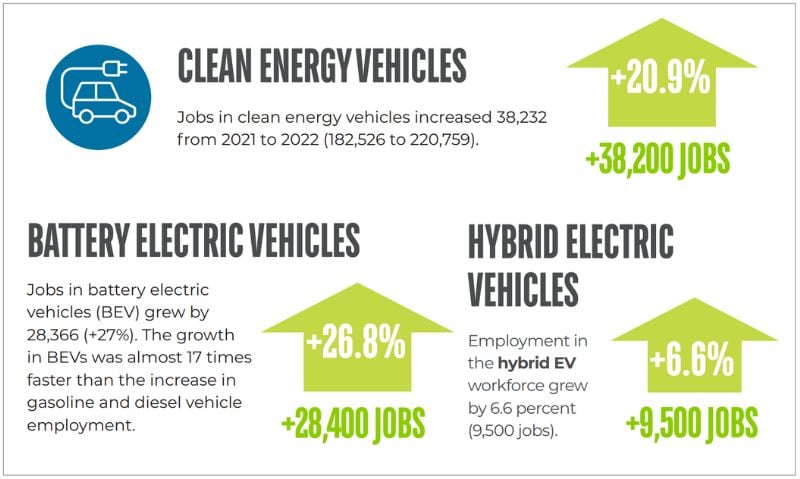
Employment within the clean energy vehicles sector increased by 20.9 percent in 2022 from 2021. Image used courtesy of US DOE
This increase in electric vehicle jobs is nearly equal to the number of jobs added in the gasoline and diesel vehicle sector. However, the growth rate in the clean vehicle sector was 17 times faster than that of the gas and diesel vehicle sector.
Job Growth by State
In 2022, all 50 states and Washington, DC, saw increased clean energy jobs. The top three states (when including transmission and distribution jobs) were California with 13,293 new jobs (+3.2 percent), West Virginia with 6,975 new jobs (+19 percent), and Texas with 5,136 new jobs (+3.5 percent).
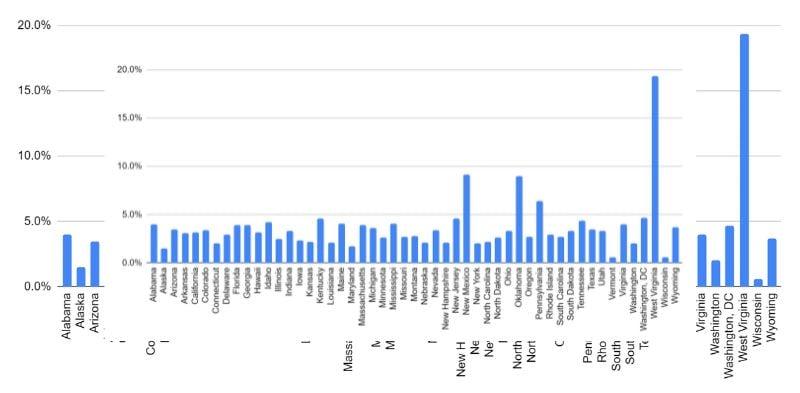
Percent growth in clean energy jobs by state in 2022. Image used courtesy of Claire Turvill, based on the USEER State Report
Demographics
The USEER also provides insight into workforce trends in demographics.
In 2022, women accounted for more than half of the total increase of 300,000 energy jobs, despite only making up 26 percent of the entire energy workforce.
Compared to the national workforce, the energy sector has a younger demographic profile. Only 17 percent of the energy workforce is aged 55 or older, and 30 percent is under 30 years old, in contrast to 24 percent and 22 percent in the national workforce, respectively.
Black or African American and Hispanic or Latino workers were inadequately represented within the energy workforce.
Veterans comprised 9 percent of the U.S. energy workforce, surpassing their representation in the overall U.S. economy, which stands at 5 percent.
Union employers exhibited a higher likelihood of implementing formal diversity, equity, inclusion, and access plans for the improved recruitment and retention of a diverse workforce compared to non-union employers. Union employers were 50 percent more inclined to have policies focused on recruiting women, twice as likely to have policies for recruiting individuals from diverse racial and ethnic backgrounds, and 2.5 times more likely to have policies for recruiting LGBTQ+ individuals.
It is essential to utilize the skills, determination, and innovative mindset of the diverse American workforce to accomplish a transition to clean energy. The DOE closely monitors energy jobs across various industries, occupations, and technologies through the USEER. With the commencement of more federal and private sector investments, it is anticipated we will see continual growth in employment within the energy sector.
Related Content