Facebook
 Google
 GitHub
 Linkedin
Sunny Proposition: Renewable Energy Future Could Be in Space
Space-based solar power could replace terrestrial solar farms and provide more reliable, less expensive energy, according to researchers.
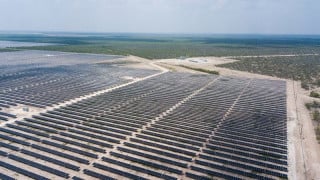
Many regions worldwide have installed solar panels in sites with regular solar irradiation. However, another option for solar energy, perhaps more reliable, is to harvest the sun’s energy in space, where the Earth’s atmosphere hasn’t filtered the more intense solar rays. Space-based solar energy has long been debated but has never been implemented.
King’s College London (KCL) researchers concluded that putting solar panels in space could impact Europe’s solar generating capacity and reduce the need for land-based solar. The study analyzed two potential designs from NASA. The researchers calculated that space-based solar power could decrease the need for land-based panels by 80%, cut battery energy storage needs by over two-thirds, and lower the costs for European power systems by 15%, saving €35.9 billion per year.
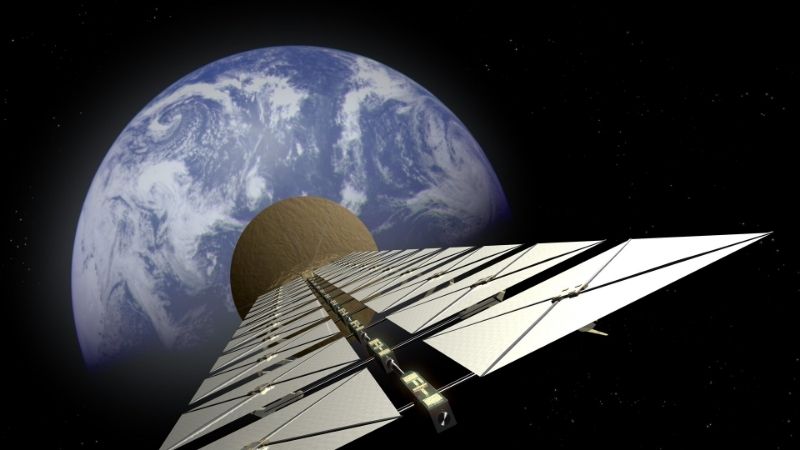
A concept of space-based solar. Image used courtesy of European Space Agency
Why Target Space Solar?
Many nations, including the U.S., China, Japan, the U.K., and other European countries, are investigating whether putting solar panels up in space could provide power on Earth. Space-based solar could contribute to goals for integrating renewable energy and meeting net-zero emissions by 2050.
Earth's cloud cover does not affect space-based solar energy, and natural disasters like floods or earthquakes do not threaten or damage the infrastructure. Space has no day and night cycle, allowing for continuous harvesting at all times of the day.
Space-based solar power generation will likely involve placing large solar panels on orbiting satellites. The energy would then be transmitted to a station on Earth via microwaves and converted into electricity on Earth using rectennas (rectifying antennas). The rectennas would span several square kilometers and convert the incoming microwaves into DC. From there, it would be inverted into AC and delivered to the grid or stationary storage batteries, like typical renewable harvesting on Earth.
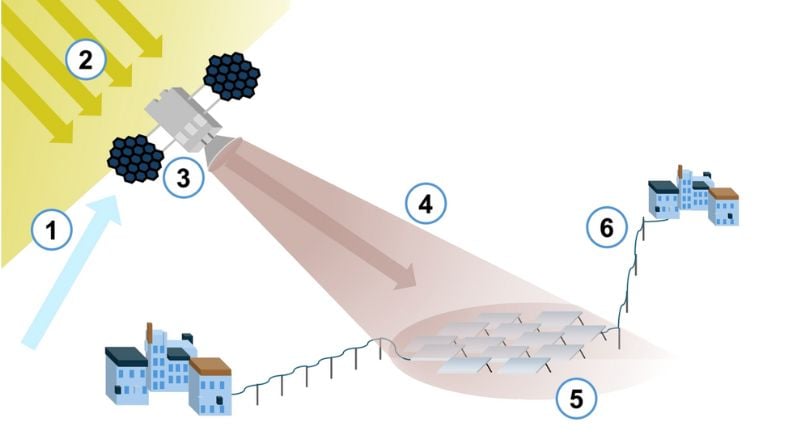
Space-based solar, including launch (1), energy harvesting (2), conversion to microwave (3), transmission to earth (4), Earth reception (5), and distribution (6). Image used courtesy of Che, Liu, and He
Two NASA Concepts for Space Solar
The KCL study, published in Joule, analyzed two NASA concepts for space-based solar for the feasibility of implementation by 2050. The researchers used the European model for a fully decarbonized grid.
The first concept is a nearly continuous heliostat swarm design with a low technology readiness level (TRL). This concept utilizes a swarm design comprising a large steerable array of mirror-like reflectors. These reflectors would continually adjust their position to focus the sunlight in space onto a concentrator. The light would be converted into microwaves and transmitted down to Earth. Scientists believe this design could achieve 99.7% annual power availability.
The second concept is a partially intermittent planar array design with much higher TRL. This design uses a single solar PV collection face. Still, it has microwave transmission technology on the opposite side to transmit microwaves to Earth, as the lower face of the planar panels would naturally face toward the Earth due to gravity gradient forces. However, this approach has a less continuous power profile of around 60% annual power availability but is easier to implement because the hardware has already been demonstrated.
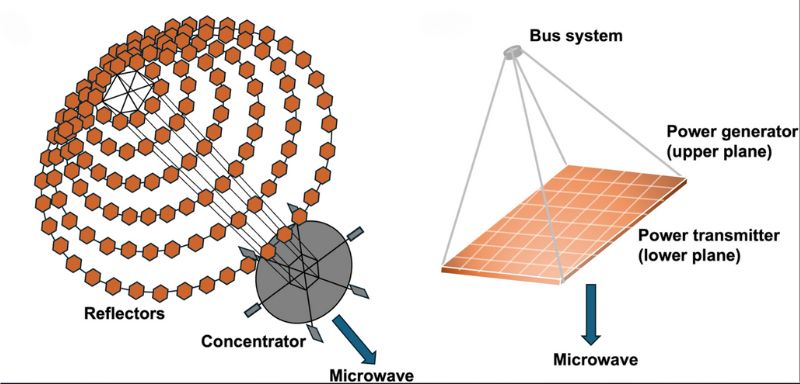
Researchers studied two models of space-based solar. Image used courtesy of Che, Liu, and He
The study examined design concepts against the European power system and investigated how the models could meet the electricity demands set out in ENTSO-E’s 2050 vision for a carbon-neutral Europe by 2050. They evaluated the native demand and the interactions with land-based renewables, stationary storage systems, and transmission infrastructure under net-zero constraints. They assessed grid-balancing benefits by determining how these space solar systems could reduce energy storage requirements and transmission investments by offsetting terrestrial renewable energy systems’ inherent daily variability.
Overall, the study found that space-based solar power could bring several key benefits to the European grid:
- Helping to fill the natural gaps of terrestrial wind and solar power when no local stimuli exist
- Reducing power decarbonization costs by up to 15%, including reducing energy generation, storage, and network infrastructure costs
- Reducing the reliance on wind, solar, and battery storage to meet decarbonization targets
Planar Array Design: The Most Likely Short-Term Solution
Since the planar array design has the highest TRL, it will likely be implemented first. This system will be easier to install in space and start the space energy harvesting process. However, this will probably only be a short-term solution, because unless the annual fixed costs of this approach come down significantly, it will remain uneconomic by 2050 compared to terrestrial renewable energy options. However, it could be the way to provide the first steps in energy harvesting in space.
Heliostat Swarm: Longest Timeline but Most Benefits
Despite the lower TRL, the swarm design could theoretically deliver between 6 and 9 times the electricity of ground photovoltaic systems by 2050. This could lead to this approach cutting the total PV system costs by 7-15%. The lower costs could decrease annual infrastructure system costs up to €35.9 billion ($42 billion).
The space-based heliostat solar could also displace up to 80% of wind and solar capacity and reduce the stationary storage battery requirements by 70%. However, storage options, such as hydrogen storage, would still be required for seasonal balancing. Battery usage declines by 78% each year in the winter, and hydrogen storage becomes more prominent. These seasonal challenges will still exist, so while the heliostat design could mitigate the short-term imbalances, it can’t eliminate the seasonal challenges.
The Way Forward: Coordinated Strategy for Both Approaches
The swarm design is not commercial-ready, and the planar array, most likely to spearhead space solar harvesting, is not feasible long-term. Instead, a coordinated strategy using both is likely the way forward. The planar design can be the first approach to refine the core technologies, including wireless power transmission and in-orbit assembly. It can demonstrate feasible solar energy harvesting around the clock. At the same time, the R&D should be accelerated for the swarm design.