Facebook
 Google
 GitHub
 Linkedin
Future Flight: Archer Plans eVTOL Taxis for U.S. Cities by 2027
Archer Aviation advances its Midnight eVTOL aircraft toward deployment in U.S. cities.
California-based Archer Aviation may soon have electric air taxis operating in cities across California, Florida, Texas, New York, and Georgia, including a proposed exclusive slot with Huntington Beach for Los Angeles-area operations ahead of the 2028 Olympic Games.
Archer has filed multiple applications to pilot its Midnight electric air taxis in response to a federal program for electric vertical takeoff and landing (eVTOL) aircraft. The eVTOL Integration Pilot Program (eIPP) is a public-private initiative that will include at least five projects involving piloted and uncrewed short-range air taxis, longer-range fixed-wing aircraft, cargo, logistics, and safety systems. Selected cities and operators are expected to be named by mid-2026, with the first flights following later in the year.
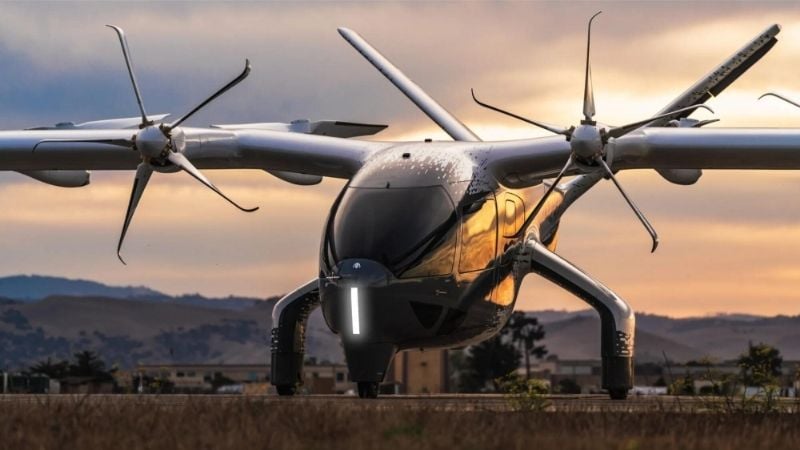
Midnight. Image used courtesy of Archer Aviation
Archer's Midnight Air Taxi
Many eVTOL aircraft under development are generally designed to operate between 1,500 and 5,000 feet during typical operations. However, Archer says Midnight has already been tested at altitudes reaching 10,000 feet, allowing greater flexibility to maneuver certain elevations or high-density areas.
Archer's Midnight is intended for high-frequency, short-range urban routes—typically 20 to 50 miles—flown back-to-back throughout the day. It uses a 12-rotor lift-plus-cruise configuration, with six tilting propellers on the front wing providing both vertical lift and forward thrust, while six fixed rotors on the rear wing manage takeoff and landing. This architecture addresses two key needs in urban service: redundancy in case a motor or rotor fails, and significantly lower noise levels than helicopters, especially after transitioning to forward flight.
Learn about the Midnight’s design. Video used courtesy of Archer Aviation
Midnight carries a pilot and four passengers, travels up to 150 miles per hour, and is designed for rapid turnaround charging between flights. The electric engine is powered by six battery packs with cylindrical lithium-ion cells. Archer states Midnight can recharge from 20-80% in about 10 minutes with minimal downtime, a selling point that could help make air taxis more competitive as a fast alternative to 90-minute car trips.
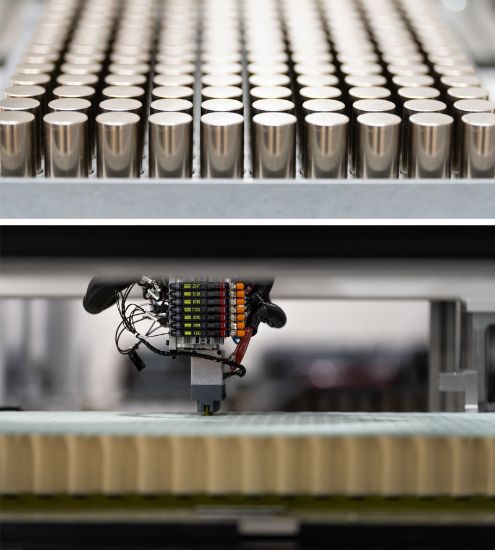
Archer's cylindrical battery cells. Images used courtesy of Archer Aviation
Archer is assembling its first Midnight fleet, which will then proceed directly into early commercial deployments or certification testing. The company said it planned to increase annual production up to 50 aircraft across 700,000 square feet of manufacturing and testing sites in California and Georgia.
Archer has also acquired a strategic air taxi network hub, the Hawthorne Airport in Los Angeles, and plans to upgrade the 80-acre site with charging, maintenance, and storage facilities, alongside redeveloped hangar space. The airport is also expected to serve as a testbed for the company's AI-powered airspace integration tools, such as smart sensor-equipped runways, autonomous ground vehicles, advanced security systems, and AI-assisted air traffic and surface management.
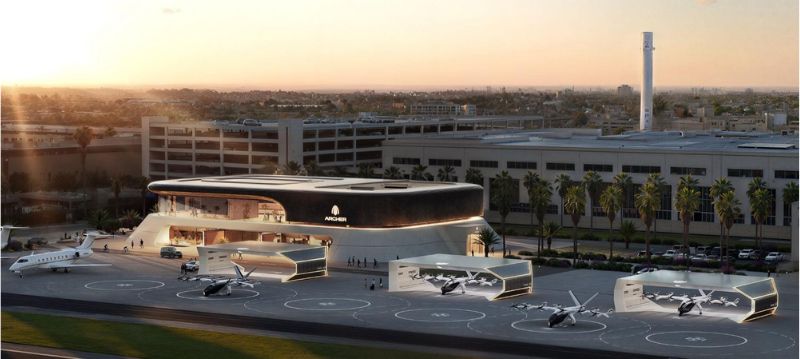
A rendering of Archer Aviation's plans for Los Angeles's Hawthorne Airport. Image used courtesy of Archer
At CES 2026, Archer and Nvidia unveiled a partnership to integrate Nvidia’s IGX Thor modules into future onboard computing systems for AI-assisted flight planning and safety awareness. The pair will also focus on merging IGX Thor with Archer's control software to support future autonomous or semi-autonomous aircraft.
Efforts To Kickstart Urban eVTOL Flights
If the eIPP pilot projects proceed on schedule, 2026 could mark the first time U.S. cities see electric air taxis operating across an early network. For manufacturers like Archer, the program is a critical proving ground for whether eVTOL aircraft can function reliably along dense urban corridors.
Archer noted that establishing long-term urban service in the U.S. would require local operations teams, new or upgraded infrastructure, and coordination with local emergency response and safety agencies.
Companies that secure municipal partnerships could gain an advantage as the Federal Aviation Administration and Department of Transportation (DOT) consider new airspace rules, vertiport standards, grid connections, and emergency planning needs.
The DOT’s Advanced Air Mobility (AAM) National Strategy also aims to integrate eVTOL into national airspace, including existing air traffic control workflows. The plan lays out 40 recommendations covering vertiport infrastructure, security vetting requirements, and workforce needs, among other considerations.
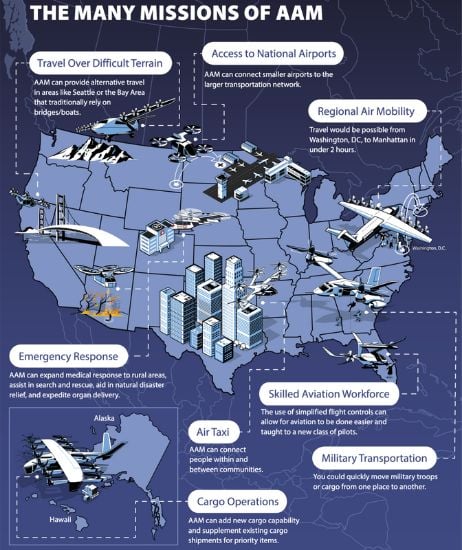
An overview of the DOT's Advanced Air Mobility strategy. Image used courtesy of the DOT
By 2030, the DOT aims to enable short VTOL and powered-lift flights with accessible vertiport infrastructure and a new AAM-ready Air Traffic Control system designed to manage low-altitude traffic for both piloted aircraft and uncrewed drones.