Facebook
 Google
 GitHub
 Linkedin
Net-Zero House Uses PV, Thermal Battery, and Heat Pump Combo
A Western University research team has engineered a real-world net-zero house blending photovoltaics, heat pumps, and thermal storage into one responsive energy system.
A detached house in Komoka, Ontario, may not look revolutionary from the curbside, but beneath its insulated walls and rooftop solar panels, it serves as a live testbed for a future where homes produce, store, and intelligently allocate their own energy without burning a single fossil molecule.
In this ambitious integration of technologies, researchers from Western University’s Faculty of Engineering and Ivey Business School have combined solar photovoltaics, an air-source heat pump, and a latent heat thermal battery built from phase-change materials (PCM-TES) to try to achieve net-zero without sacrificing comfort or grid stability.
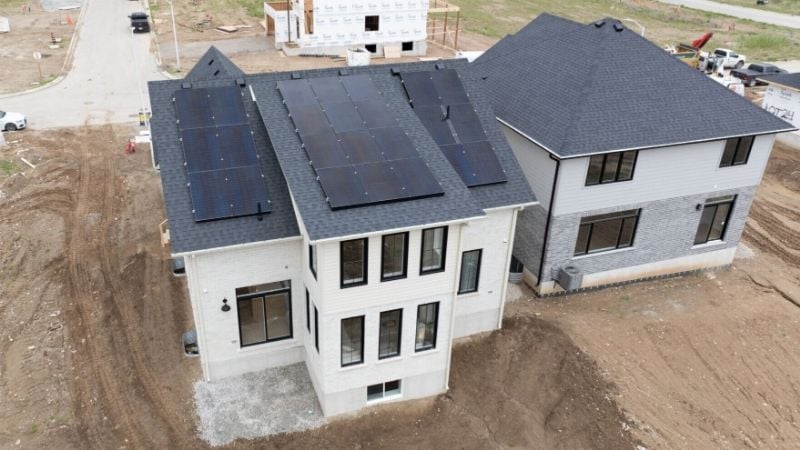
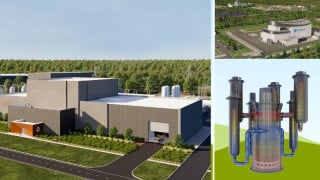
The Komoka research house in Ontario, Canada. Image used courtesy of Western University/Steve Anderson
Solar Energy Doesn’t Sleep
An enduring challenge in home energy design is temporal mismatch. Solar PV generates energy during the day, but heating demand peaks at night, particularly in Canada’s long winters. Standard solar-plus-heat pump systems can reduce a home’s carbon footprint but still rely heavily on grid electricity to meet off-hour thermal loads.
To close this gap, the Western team introduced a thermal battery: a latent heat energy storage system filled with paraffin-based PCMs, integrated with the heat pump. When solar production exceeds household electrical demand, the surplus diverts to either run the heat pump or power a resistive heating element to charge the PCM-TES. The PCMs melt, storing large amounts of heat at a near-constant temperature. When space heating or domestic hot water is needed, a water-based loop extracts the heat.
In one tested configuration, a modular PCM unit with aluminum fins accelerated charge-discharge cycles, with water as the thermal transfer fluid. Numerical simulations validated the design, optimizing the geometry and flow rate to match peak load curves. According to their research, increasing the heater charge temperature from 60°C to 80°C improved storage capacity by 12% and cut PCM melting time by 67%.
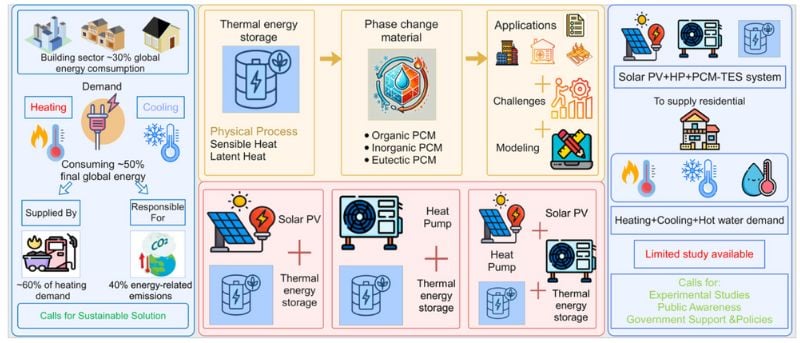
A graphical abstract of the PCM-TES system. Image used courtesy of Rana and Pearce
Sizing the PV and heat pump correctly was crucial. The researchers modeled different PV-HP system pairings across electricity rate scenarios, climate data, and demand profiles. Ultimately, they found that a 5 kW PV system combined with an optimally sized ASHP and PCM-TES achieved up to 76% reduction in annual grid electricity consumption, while preserving comfort and hot water availability.
Integrating the PCM-TES gave the system a competitive edge over conventional electric batteries. The team noted that thermal storage avoids lithium-ion systems' material toxicity and capital costs while providing greater round-trip efficiency in heat-dominant climates. In fact, when compared side-by-side, the levelized cost of thermal energy storage was half that of lithium battery storage.
One key advantage of PCM-based thermal storage is its narrow-band temperature control. Unlike water tanks, which require either pressurization or sub-boiling operation, PCMs operate within a tight melting-solidifying band, allowing precise thermal energy delivery for radiant heating or DHW. Importantly, this also simplifies the control algorithms needed to operate the system autonomously.
Overcoming Climate-Specific Challenges
Winter poses special challenges, particularly in northern climates where temperatures drop below -25°C. Under such conditions, air source heat pumps alone may not meet heating demand efficiently. The system design accounted for this by using the thermal battery as both a buffer and a preheater. When needed, the control logic can dynamically switch between HP-powered charging or direct electrical heating of the PCM-TES, a flexibility validated through real-time simulations on the Komoka site.
In terms of environmental impact, the triple-integration strategy offers quantifiable benefits. According to the researchers’ review, coupling PV with a heat pump alone can reduce a home’s GHG emissions by up to 50%. Add thermal storage, which can climb as high as 90% over time, particularly as grid carbon intensity decreases. A related study also found that pairing PV with PCM-TES can reduce natural gas consumption by up to 71% during heating seasons.
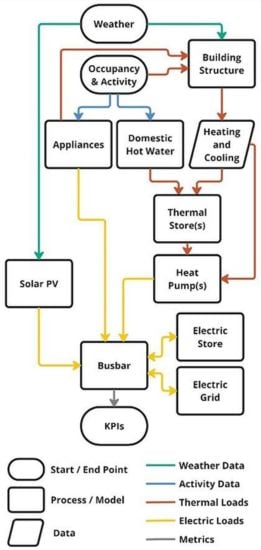
The researchers’ target model showing all critical physical processes in a building energy system. Image used courtesy of Rana et al.
These gains come with practical challenges, particularly concerning cost and policy. In Ontario, PV interconnection fees can range from $1,130 to over $28,000, depending on system size and utility, complicating the economics. The researchers argue that public incentives, such as Canada’s Oil to Heat Pump Affordability Program, are essential to de-risk adoption at scale.
A Replicable Model for Electrified Housing
What sets this research apart isn’t just the modeling sophistication or the thermal design novelty, but the fact that it’s rooted in a real, occupied house. The Komoka home represents a rare experimental validation of PV+HP+PCM-TES integration, moving beyond simulated or component-level studies. By treating the house as a complete system, the researchers could tune load profiles, test control strategies, and monitor performance across real weather events.
As the researchers correctly pointed out, current literature is full of pairwise integrations—PV with HP, HP with water tanks, PV with batteries—but few papers have explored all three technologies as a unified, closed-loop system. This research aims to fill that gap with technical modeling and hard data from a functioning, sensor-equipped residence.
The research appears in four peer-reviewed papers: Energy and Buildings, E-Prime, and two articles in Energies.