Facebook
 Google
 GitHub
 Linkedin
Making Waves: Ocean Energy Technology Surging Ahead
Wave energy generators are emerging as an innovative technology that can harness the ocean's constant motion.
As cleaner, more reliable energy sources gain momentum, wave energy generators are emerging as a promising way to harness one of the world’s most abundant renewable resources: the ocean.
Although wave energy technology has developed more slowly than solar and wind power, the potential for making waves in the renewable energy sector is significant. According to the U.S. Energy Information Administration, the theoretical annual wave energy potential along U.S. coastlines is estimated at 2.64 trillion kilowatt-hours, equivalent to roughly 63% of the nation’s total utility-scale electricity generation in 2023.
Internationally, organizations such as Wave Energy Scotland and the EuropeWave program are helping accelerate the development of wave energy systems that can survive harsh offshore environments while delivering reliable electricity.
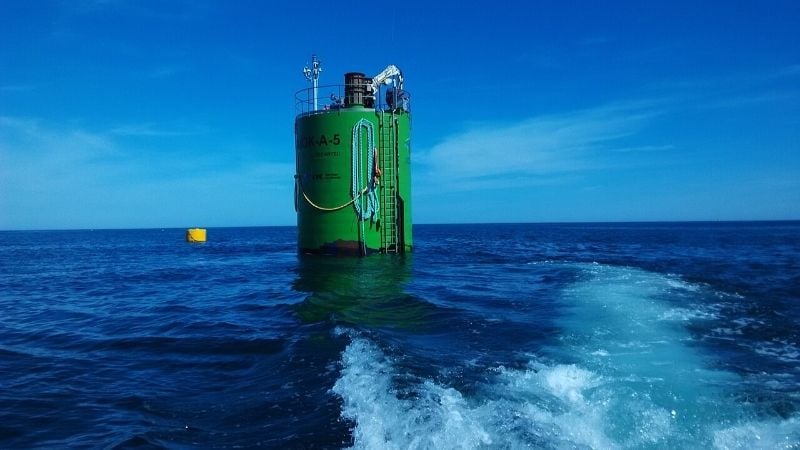
MARMOK-A-5. Image used courtesy of Wikimedia Commons
What Is a Wave Energy Generator?
A wave energy generator, also called a wave energy converter, is a device that captures the energy created by ocean waves and converts it into electricity. Ocean waves contain tremendous amounts of kinetic energy generated by wind moving across the sea surface.
Wave energy differs from tidal energy because it relies on the up-and-down motion of waves rather than the predictable rise and fall of ocean tides. This makes the potential for wave energy along coastlines with strong and consistent wave activity especially promising.
Several types of wave energy generators are used, including floating devices that bob up and down with the waves, floating snake-like devices that float on the waves, and wave surge converters, which are used near the shore. Submerged wave energy generators, or submerged pressure differentials, are buoys tethered to the sea bed that capture energy from the high and low pressure of the waves overhead.
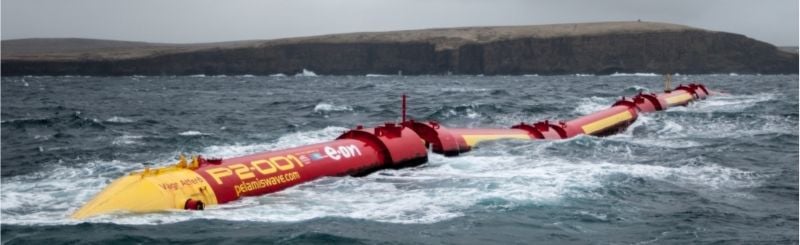
Pelamis, a snake-like floating wave energy generator. Image used courtesy of European Marine Energy Centre
MARMOK-A-5
One recent advancement of this technology is the MARMOK-A-5 project developed through the EuropeWave program. The MARMOK device uses a system called an oscillating water column.
The device operates as a floating buoy-like structure anchored offshore. Inside the buoy is a cylindrical water column and an air chamber. As waves move the buoy up and down, the water inside acts like a piston. This motion compresses and decompresses the air in the chamber above it. The moving air is then forced through a turbine, spinning it to generate electricity. The electricity is transferred to shore through underwater cables connected to the electrical grid.
Watch the MARMOK-A-5 in action. Video used courtesy of Global Update
The MARMOK-A5 measures 42 m high and is 5 m in diameter, with a displacement of 162 Tm. Developed in 2018 by Oceantec (later acquired by IDOM), the prototype is located in the Bay of Biscayne in Northern Spain. Its installed capacity is 30 kW. The design allows the system to generate power without requiring large moving mechanical parts exposed directly to seawater, improving reliability and reducing maintenance challenges.
EuropeWave and MARMOK Atlantic Projects
The EuropeWave initiative is a European research and development program focused on accelerating wave energy technology toward commercial use. The program combines more than €22 million in public funding and supports several prototype technologies across Europe.
The MARMOK-A-5 project was tested at the Biscay Marine Energy Platform off the coast of Spain, where the prototype successfully connected to the power grid. Researchers have improved the device’s power take-off system to increase energy production while maintaining durability in difficult offshore conditions.
Engineers are now using the data collected during testing to refine future commercial-scale systems.
Future Potential
Wave energy offers several advantages over traditional energy sources. Ocean waves are more predictable than solar or wind energy, enabling more stable electricity generation forecasts. Wave energy systems also use relatively little land space since they operate offshore.
However, challenges remain before wave energy becomes widely commercialized. Devices must withstand corrosive saltwater, powerful storms, and continuous mechanical stress. Costs also need to decrease to compete with established renewable technologies such as wind and solar power.
Despite these challenges, continued investment and successful prototype deployments suggest wave energy could become an important part of the future renewable energy mix. Projects like MARMOK and EuropeWave are demonstrating that the energy contained in ocean waves can be transformed into practical, clean electricity for coastal communities around the world.