Facebook
 Google
 GitHub
 Linkedin
Big Moves Propel eVTOLs Closer to Autonomous Flight and More
Archer Aviation is developing pilotless eVTOLs, CATL is ready to produce safer batteries, and Florida is building out its flight testing track.
Electric vertical takeoff and landing (eVTOL) aircraft are pushing closer to practical deployment in the skies. In the latest, Archer Aviation is adding autonomous flight, defense UAS, and airspace software through its planned Boeing acquisitions; CATL has put a 350 Wh/kg aviation battery through a key thermal propagation test; and Florida is expanding SunTrax to give advanced aircraft a dedicated place to test.
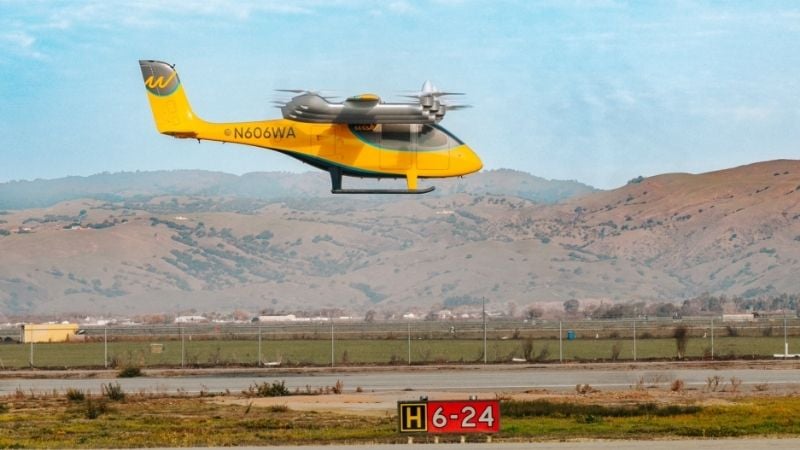
Wisk's Generation-6 self-flying eVTOL aircraft. Image used courtesy of Wisk Aero
Archer Acquires Boeing Assets for Autonomous Flight, More
Archer Aviation has agreed to acquire Boeing subsidiaries Wisk Aero, Insitu, and SkyGrid, strengthening its efforts in autonomous eVTOLs, defense drones, and digital airspace operations. Boeing will receive an ownership stake in Archer and preserve access to Wisk’s autonomous technology for use in its own commercial and military aircraft programs.
Wisk gives Archer a much more mature autonomous-flight program. The current Gen 6 follows five earlier aircraft designs and more than 1,700 test flights. Gen 6 is built to carry four passengers with no pilot on board, and Wisk is using the aircraft for its FAA certification process.
SkyGrid addresses coordinating aircraft from the ground, developing software to handle tasks such as planning traffic flow before departure, sequencing aircraft, and maintaining separation as traffic moves through the airspace.
Testing the eVTOL’s autonomy. Video used courtesy of Wisk Aero
Insitu adds an established defense-drone operation with aircraft used for surveillance and reconnaissance. Its production history exceeds 3,500 UAS, and its current systems can be equipped for vertical takeoff, satellite communications, and AI-assisted payloads.
The mix also spans different flight profiles. Archer’s Midnight is built around short passenger trips with a pilot aboard, while Wisk is pursuing passenger operations without an onboard pilot. At the other end of the endurance spectrum, an Integrator equipped with P-LEO satellite communications can remain airborne for as long as 27.5 hours.
The three businesses give Archer access to technology at several layers of autonomous aviation: onboard flight control, unmanned aircraft hardware, and the software needed to coordinate traffic from the ground. Archer also expects the acquired technologies to support ZEE, its aviation AI platform. The system is developed to turn information from multiple aviation data streams into a common model that can analyze and predict aircraft activity.
CATL's 350 Wh/kg eVTOL Battery Clears Thermal Propagation Test
CATL has completed a key safety validation for its passenger eVTOL battery system, demonstrating that thermal runaway initiated in adjacent cells did not propagate throughout the pack.
The battery uses prismatic cells with a 350 Wh/kg energy density. During testing, engineers initiated failures in paired cells at several locations within the pack, including central and edge areas. CATL said the resulting thermal events remained contained, with no propagation to surrounding cells.
eVTOL batteries face unusually demanding operating conditions. They must deliver high specific power for vertical flight while carrying enough specific energy for useful range, all within a tightly constrained mass budget.
Limiting cell-to-cell thermal propagation is a key safety requirement for electric aircraft; a single cell failure must be prevented from cascading through the battery pack. The combination of high specific energy and fault containment is particularly important for eVTOLs, as battery mass directly affects payload, range, and overall aircraft performance.
The result advances the battery system’s safety validation for civil aviation, but CATL didn't say if the system—or any aircraft using it—has received regulatory certification.
The company reported that the battery system is ready for mass production, with its partner AutoFlight expected to be the first passenger eVTOL manufacturer to integrate the system.
Florida Expands Advanced Aircraft Testing Capabilities
Florida has expanded its 775-acre SunTrax test site in Auburndale to accommodate eVTOL research alongside its existing connected and autonomous vehicle programs, with flight testing slated to begin by the end of 2026.
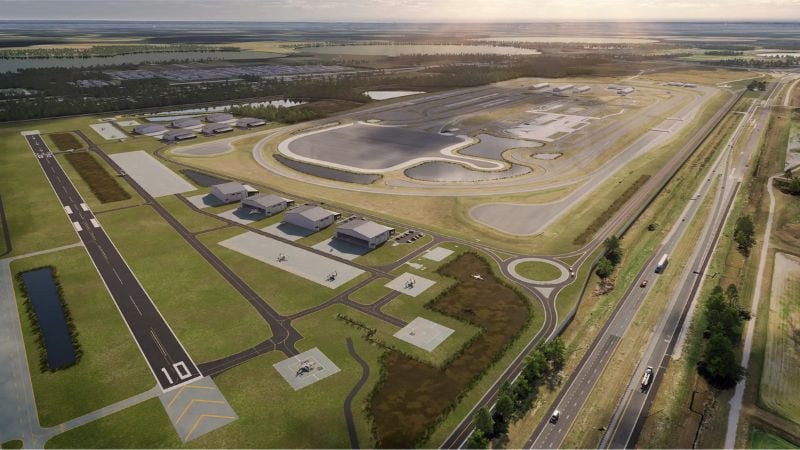
The SunTrax testing facility in Florida features a dedicated test track for next-gen aircraft. Image used courtesy of SunTrax
The air mobility infrastructure will give developers a controlled setting to test aircraft, communications systems, and operating procedures before broader deployment. The site includes a dedicated aerial test course, with hangar space planned for research, limited production, and final aircraft assembly.
The expansion aligns with the FAA's eVTOL and Advanced Air Mobility Integration Pilot Program, which is designed to generate operational data and experience to inform the regulations and procedures needed to introduce advanced aircraft into the national airspace system.
The FAA expects early AAM flights to use existing aviation infrastructure where practical and to operate much like helicopter service, with more specialized routes and procedures potentially emerging as traffic grows. The agency has already issued vertiport design guidance and is continuing research on performance standards for facilities that could serve both helicopters and powered-lift aircraft.
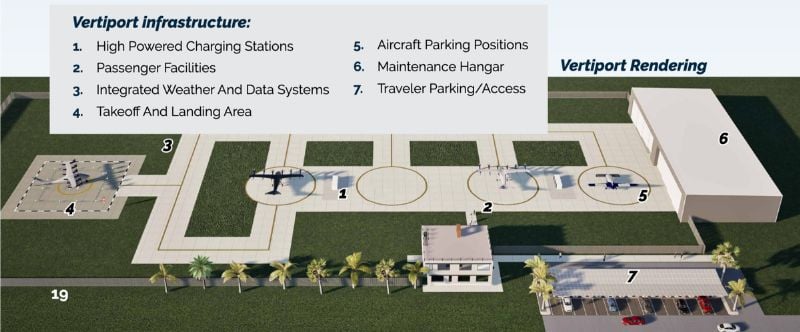
Rendering of a vertiport infrastructure setup from the Florida Department of Transportation's AAM Business Plan. Image used courtesy of SunTrax
The Florida Department of Transportation's broader AAM planning also considers the electrical infrastructure required for eVTOL operations. Its model for a two-charger vertiport assumes peak demand of about 1.2 MW, including roughly 700 kW for two aircraft charging simultaneously. Actual requirements would depend on factors like aircraft duty cycles, battery chemistry, charging rates, and the number of chargers at a site.
In addition to eVTOL aircraft testing, SunTrax will continue testing autonomous and connected vehicles in parallel. Its facilities include a high-speed autonomous test track and configurable environments for evaluating vehicle performance around simulated weather, traffic, pedestrian activity, roadway grades, and other realistic operational scenarios.