Facebook
 Google
 GitHub
 Linkedin
AI Speeds Solar Cell Innovation by 85x with Automated Material Testing
An MIT engineering team has created a breakthrough process using machine learning to test and characterize experimental materials at a speed never seen before.
Dramatic leaps forward in technology often seem tied to surprising engineering innovations rooted in big changes. We leave the combustion engine behind in favor of all new electric protocols. Geothermal tech advances drastically, and instead of drilling for oil, we are digging to capture the earth's natural heat.
But sometimes critical advancements are made in minute strides that are no less important, and such small steps are often tied to material experimentation. For example, the wind power sector has discovered that returning to wood turbines rather than steel ones in harsh offshore maritime environments improves performance and longevity.
An engineering team at MIT has figured out how to rapidly deploy machine learning to test and characterize experimental materials, opening the door to unforeseen possibilities for materials with extremely nuanced compositions. The implications for the solar sector are significant as engineers have been searching for material advancements to improve solar cell performance. MIT’s computer vision method promises to make such advancements a reality.
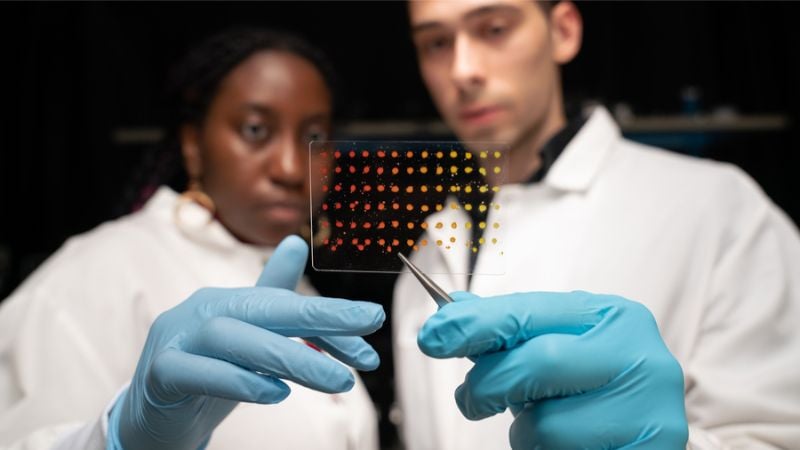
MIT engineers with a sample analyzed with machine learning. Image used courtesy of MIT/Bryce Vickmark
The Need for Solar Cell Innovation
Solar power is a pillar of clean energy progress, and engineers are still trying to advance solar cells’ quality and improve their performance. Currently, 95% of solar cells on the market are silicon-based, but they lag behind other possible materials in efficiency.
Perovskite solar cells have been a major research focus because they outperform silicon in efficiency. However, they degrade in outdoor conditions when exposed to water and heat, obvious hazards every solar panel must endure.
Researchers are exploring perovskite tandem solar cells, which can combine silicon’s sustainability and perovskite’s performance efficiency. While investigating this combination, superior combinations remain likely, but engineers need an efficient means to discover and test novel material combinations.
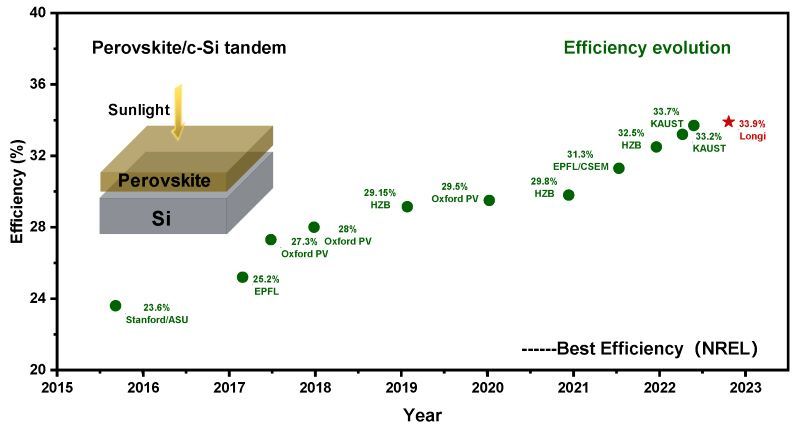
The advancing efficiency of perovskite tandem solar cells. Image used courtesy of MDPI
Engineers have already figured out how to use artificial intelligence (AI) to generate promising material compositions and developed automated machines to print these samples. However, the analysis, testing, and characterization processes have remained manual, thus significantly diminishing the overall efficiency of the discovery process.
Domain Experts and Manual Characterization Challenges
Previously, a single person known as a domain expert had to review each new material sample manually. The expert used a tool known as a UV-Vis to analyze where the semiconductor material would absorb various light colors to different degrees.
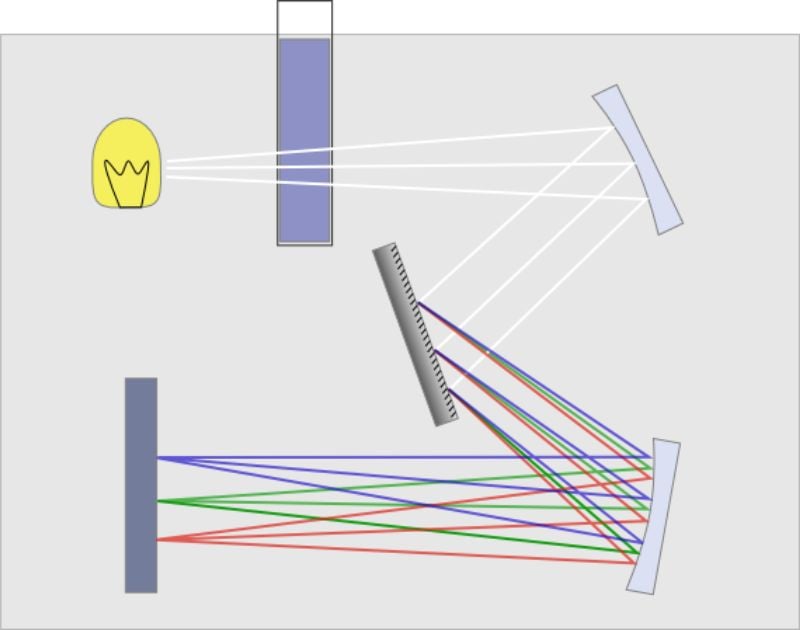
UV-Vis spectroscopy. Image used courtesy of Wikimedia Commons
This manual process has persisted because the tool provides high confidence levels and accuracy combined with the user’s expertise. But what the manual process lacks in speed, it makes up for in accuracy.
Even as AI has been used to advance the ability to generate possible material combinations at increasingly rapid rates, this manual characterization process has been necessary, so those advancements were functionally useless. What utility is there in rapid material composition sample generation without the ability to test them?
It isn’t just that engineers figured out how to use AI to seek and identify promising material compositions with nuanced makeups for idiosyncratic applications. They also have been able to build machines to print material samples quickly.
The machines printing these samples can generate 10,000 combinations in a single hour, yet the manual characterization process can only analyze about 20 samples every hour.
Fully Automating the Characterization Process
The MIT team’s computer vision algorithms can ultimately replace the domain expert and fully automate the material analysis process. The researchers created two separate algorithms to examine the electronic materials’ visual information in detail. One algorithm focuses on band gap to assess the materials’ electron activation energy, and the other zeros in on stability to help measure the material’s longevity. The researchers tested more than 200 materials, including perovskite semiconductors, lithium-ion batteries, and nanomaterials.
The study found that MIT’s algorithmic innovation speeds up the manual characterization process by 85 times. The characterization process is catching up to AI’s ability to identify new material compositions and rapidly print these materials.
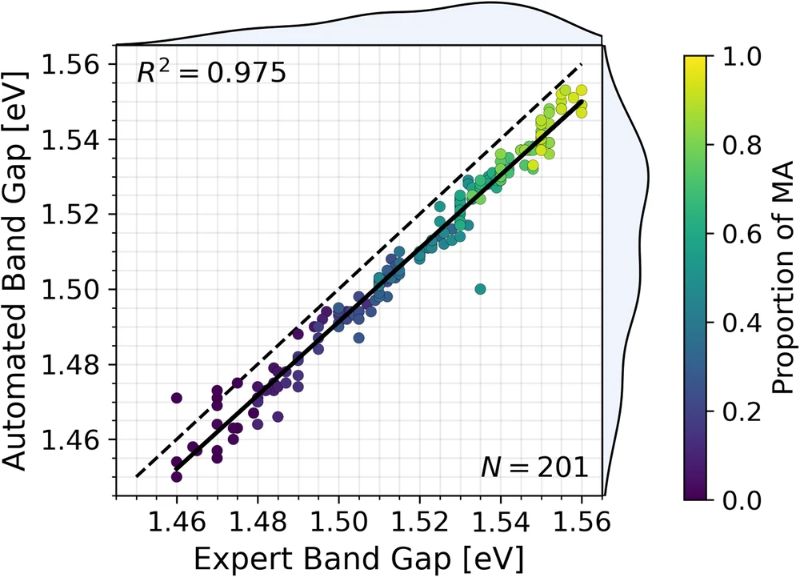
Automated system compared to domain experts. Image used courtesy of the authors
This speed leap in speed does not compromise accuracy. There was no tradeoff between efficiency and dependable results. According to the MIT team, the accuracy of the results compared to the standard domain expert was 98.5% for the band gap and 96.9% for the stability assessment of the materials.
These results show that the material testing process and analysis can be automated from start to finish. AI generates the composite, the physical samples are printed by machine, and the MIT algorithms can run the characterization testing to close the investigative loop. Even if a domain expert were ultimately brought in as a check and balance for materials proving promising, the speed of this process would be transformed.
This breakthrough has great promise not only for how engineers can advance solar cell material but also for improving the material investigation process for LEDs, transistors, and other equipment that will perpetually search for the next great material composite combination.