Facebook
 Google
 GitHub
 Linkedin
Subzero-Ready Renewables: Powering Science at the South Pole
Researchers will use a specialized hybrid renewable energy system to meet the South Pole’s unique energy demands, isolated location, and subzero climate.
A multi-resource renewable energy system could soon power complex physics experiments at the Amundsen-Scott South Pole Station, one of Earth’s harshest and most remote locations.
Such an installation must withstand the South Pole’s extreme winters, subzero temperatures, and dry climate at 9,000 feet above sea level. Most commercial renewable energy generation equipment cannot handle the region’s -56°F average annual temperature nor the record low -117°F. The lack of solid ground adds installation complications due to the 1.7-mile-thick ice sheet encompassing the station, which drifts by 33 feet annually.
Despite these challenges, researchers from the National Renewable Energy Laboratory (NREL) and Argonne National Laboratory are optimistic that a cost-effective solution is technically possible. Their recent techno-economic analysis favored combining 180 kW solar photovoltaic (PV) panels, six 100 kW wind turbines, and a 180 kW / 3.4 MWh lithium-ion battery energy storage system (BESS) integrated with the current diesel generators.
This setup would cut diesel consumption by 95% and avoid 1,200 metric tons of carbon emissions annually. The researchers’ next step is to test feasible plant designs.
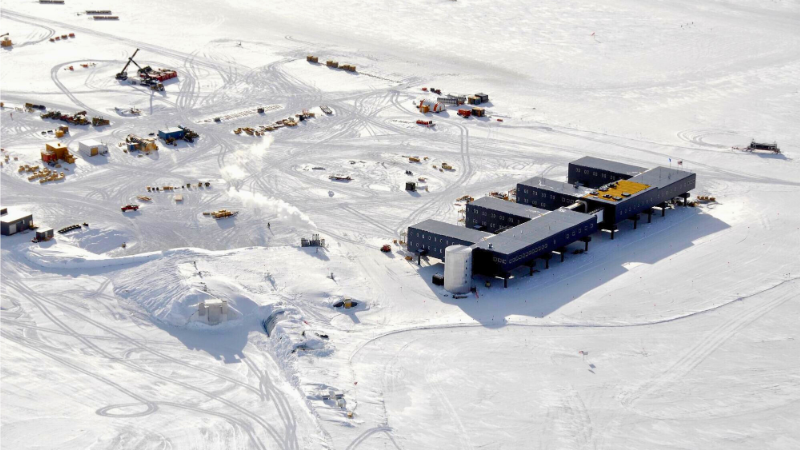
The Amundsen-Scott South Pole Station in Antarctica. Image used courtesy of the United States Antarctic Program/by Andrew V. Williams
Unique Power Needs
The National Science Foundation (NSF) operates the South Pole Station, which hosts high-energy astrophysics projects using complex equipment, such as neutrino sensors and cosmic microwave background telescopes.
Today, the station is powered by three diesel-fired reciprocating internal combustion engine generators—each with a 750 kW on-site prime power rating—along with a peaking unit of 239 kW. The plant has a 1 MW maximum capacity, though the average power consumption is only about 600 kW.
Several underground utility lines are connected to the station’s buildings and structures, the first ones being installed in 1974. The NSF’s draft master plan aims to reduce utility runs and distance for logistics, phase out diesel reliance, deploy remote energy monitoring devices, and switch to lower-energy tech like LED lights and high-efficiency appliances.
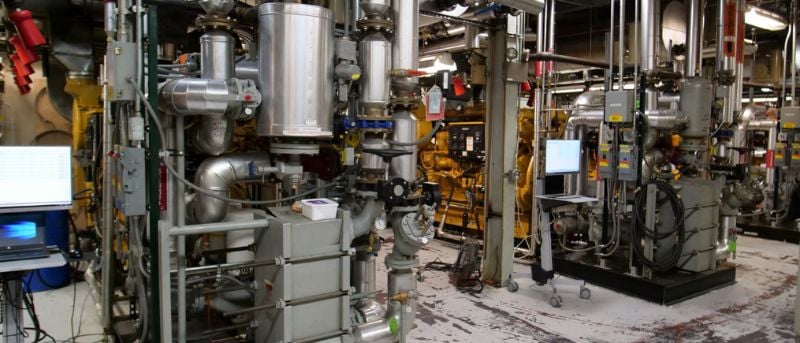
Power plant generators at the South Pole Station in 2021. Image used courtesy of the NSF (Page 19)
Several motivations underlie the NSF’s plan to transform the station’s energy profile. Per NREL and Argonne’s techno-economic assessment, powering the site with diesel incurs a levelized cost of energy of $4.09 per kWh, significantly higher than the $0.23 estimated for solar and $0.33 for wind.
Fuel transport challenges are also relevant. Situated 800 miles inland, the station must sustain operations between February and November without fuel resupply. Every year, the site receives about 300,000 gallons transported via three overland routes, while another 150,000 gallons are delivered by air.
A hybrid solar, wind, and storage system would save $57 million on fuel consumption over 15 years. Although it requires a $9.7 million capital investment, the installation would pay for itself in two years.
Vertical Solar Panel Arrangement
The South Pole experiences 24 hours of sunlight daily in the austral summer, seemingly ideal for solar power generation. However, the sun's angle presents challenges, only hitting the region six months a year with a maximum of 23.5° above the horizon.
Two housing and storage buildings at the South Pole Station have self-supporting solar systems. Still, production is low and mainly limited to the host buildings, with a small portion contributing to the grid.
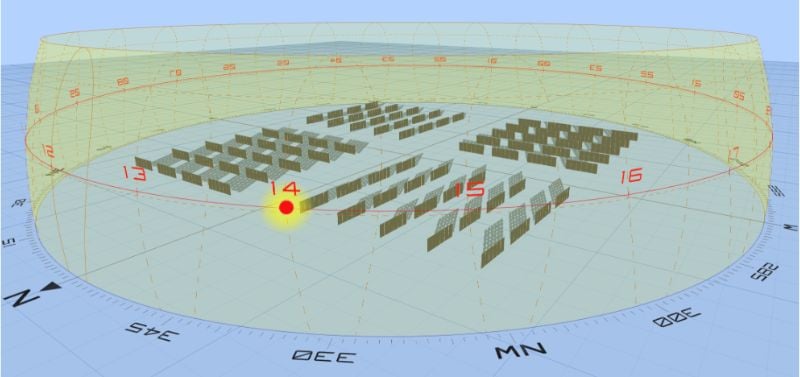
The proposed arrangement of solar panels at the South Pole. Image used courtesy of Argonne National Laboratory
Large-scale solar arrays must be designed to avoid snow drifts, common even with only 20 centimeters of snow accumulation each year. NREL and Argonne suggested a four-directional, bifacial solar array with vertical-oriented modules.
The study cited Longi’s monocrystalline bifacial module as a reliable example. The panels could be arranged into four subarrays, compass-oriented to capture solar radiation through each 24-hour cycle. Modules would be grouped into bays of vertically mounted modules within each row.
The concept was previously demonstrated at a 100 kW vertical bifacial pilot plant in Sweden, headed by Sunna Group.
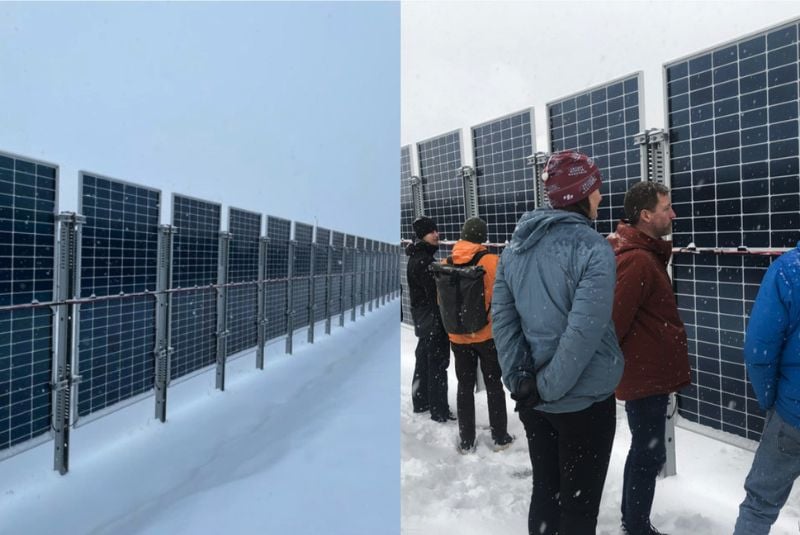
A research team visits a Swedish vertically arranged PV pilot plant in 2024. Images used courtesy of Sandia National Laboratories
Operating Wind Turbines in Subzero Temperatures
Wind is abundant at the South Pole, though speeds vary to an average of 12.3 miles per hour, according to the NSF. Durability will be a crucial design factor, as winter storm gusts could easily exceed rated cut-out speeds, over-torque the blades, and trigger shutoff mechanisms. Once static, the blades can become coated in ice, necessitating manual removal.
While wind turbines have been deployed elsewhere in Antarctica, the South Pole has only hosted small-scale turbines to power periodic research projects.
NREL and Argonne suggested adding six turbines totaling 570 kW, with ice-anchored foundations to counter the weak footing of the polar ice sheet. Some existing structures, including the South Pole Telescope, meteorological towers, and the elevated station building, already rely on ice-based foundations. However, the concept has only been demonstrated on a small scale for wind turbines.
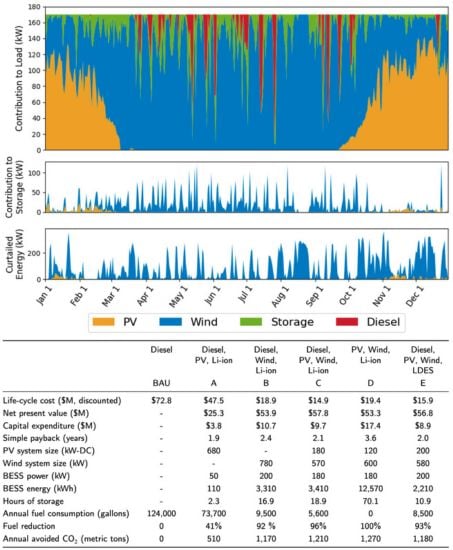
Contribution of different resources on the load (top graph); contribution of wind and solar to charging the BESS (middle); curtailed energy (bottom). The table summarizes the results. Image used courtesy of the study’s authors (Figure 6 and Table 6)
Operational temperature limits are another consideration. The study cited a 95 kW Arctic turbine initially designed to operate to -40°F before shutting down. However, other assessments found the turbine could technically still run at -94°F. Subzero operations may require lubricants and component heating.
Since wind turbines could produce electromagnetic interference, those implemented at the South Pole must include special safeguards to avoid impacting the radio-quiet Dark Sector, which hosts EMI-sensitive experiments.
Factors for Energy Storage Technology
In remote locations, energy density is a major consideration for storage technologies because it directly affects shipping costs and availability. The study considered lithium-ion batteries, which generally have a higher energy density than long-duration energy storage (LDES) technologies. Their 85–90% round-trip efficiency beats LDES at 45–60%.
Li-ion batteries remain stable at temperatures as low as -4 °F, while LDES is limited to 32 °F as many are aqueous-based and, thus, prone to freezing.
However, additional trade-offs make lithium-ion batteries less attractive, including their short life cycle and high capital costs. Flammability is also a concern with dire consequences for isolated, landlocked sites.
NREL and Argonne intend to track emerging non-flammable storage technologies and nascent LDES tech suitable for the South Pole Station.