Facebook
 Google
 GitHub
 Linkedin
Safe Passage: Innovative Hydro Turbines Do No Harm
Hydropower plants can negatively impact the ecosystem. Here’s how Natel Energy is helping negate some of these impacts.
Hydropower plants produce energy without carbon emissions, but they can negatively impact the local ecosystems. Damming or diverting natural water resources disrupts fish habitats and migration. Further, fish are killed when they swim through turbines and other underwater equipment.
How did eels fare when swimming through fish-safe turbines? Video used courtesy of Natel Energy
California-based Natel Energy has developed a turbine to greatly reduce fish deaths. The company claims its FishSafe Restoration Hydro Turbines (RHT) allow for 98-100% safe fish passage.

FishSafe turbine.
How Does the Technology Work?
Conventional hydro turbines often use screening to prevent fish from entering turbines. However, screens can be ineffective or trap fish so they can’t escape predators.
Instead, Natel Energy focused on redesigning the turbine blades. They created a curved blade with a thicker leading edge. The change pushes water to the front, creating a zone where it stays stagnant and allows fish to pass safely by the moving components.
Additionally, the curved blades prevent fish from taking direct hits even if they get too close. Natel Energy tested its technology with several species, finding that it worked better for protecting fish than similar designs.
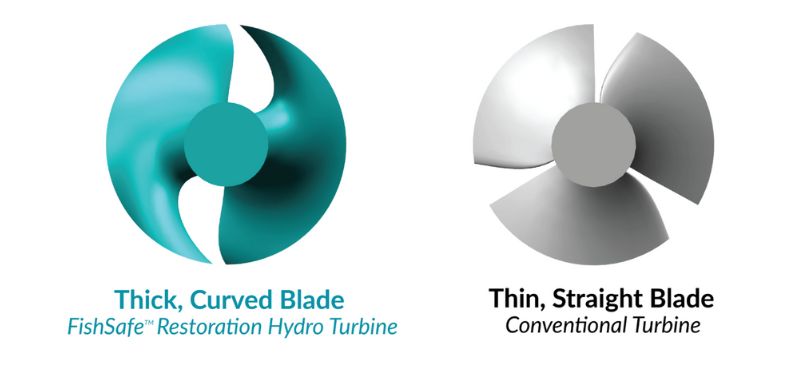
Natel’s blade vs. conventional blade.
However, the technology only applies to fish engaged in downstream migration. Additionally, the turbines are slightly less powerful than some conventional ones, which could make decision-makers less willing to use them.
The propeller is designed for any size hydro turbines in plants up to 40 m (130 ft) in head. Peak hydraulic efficiency measures over 90%. The blades are abrasion-resistant.
People familiar with fish-safe turbine designs say these options are critical at facilities without ramps or bypasses that are sometimes impractical to include due to insufficient space surrounding the hydropower system.
How Did the Fish-Safe Turbines Do in Tests?
Natel Energy tested the turbines in a real-life environment to examine how the Restoration Hydro Turbine affected American eels (13-26 inches long) and two sizes of rainbow trout (8-16 inches and 16-20 inches). Engineers observed how well the creatures could pass through the turbines and looked for signs of harm for 48 hours.
The American eel and smaller rainbow trout passed through with a 100% survival rate and no adverse effects. The other fish made it through with <1% delayed mortality. These outcomes showed an overall 99% passage rate for all fish in the study.
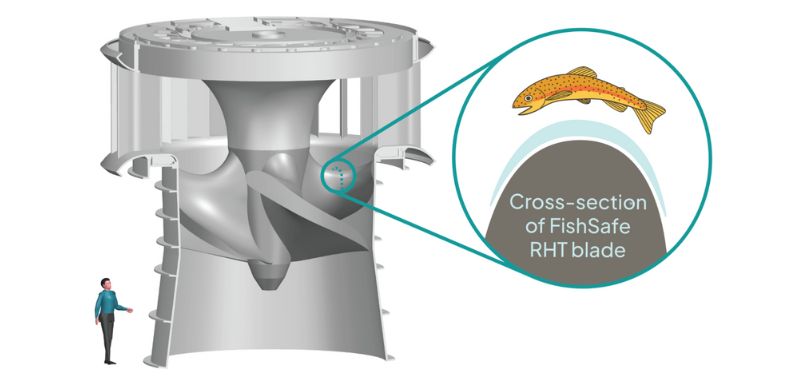
Cross-section of FishSafe RHT blade.
The Pacific Northwest National Laboratory validated the turbines with funding supported by the U.S. Department of Energy.
Natel Energy’s Restoration Hydro Turbine was the first design in the industry to safely enable passage for small and large fish. Additional research showed the equipment met high-performance metrics and aligned with standard installation configurations, which should help the turbines gain widespread notice.
A Push Toward Thoughtful Sustainability
The FishSafe RHT has been installed in Maine, Oregon, and Austria. Natel is also retrofitting the RHT on three dams in Louisiana owned by the U.S. Army Corps of Engineers.
Natel Energy’s work aligns with many efforts to pursue sustainability in designing technology to reduce or eliminate undesirable outcomes. Similarly, engineers are working on innovative wind turbine blades to reduce harm to birds. Rising awareness of these issues encourages engineers and other professionals to make more beneficial versions to lessen harm in reaching sustainability goals.
All images used courtesy of Natel Energy