Facebook
 Google
 GitHub
 Linkedin
Revved Up: EV Battery Charges in Under 5 Minutes
The 1246 kg Nyobolt concept features ultra-fast 350 kW charging and could soon be available for purchase
Electric vehicle manufacturers have long strived to overcome key challenges that hinder widespread adoption. Range anxiety, charging times, and battery longevity remain significant hurdles for consumers considering the switch to EVs. In the more niche area of electric sportscars, a challenge arises in balancing the added weight of large battery packs with the driving dynamics enthusiasts cherish.
British engineering firm Nyobolt has unveiled a sportscar prototype promising to transform EV technology with ultra-fast charging capabilities and exceptional durability. Nyobolt’s innovation could provide a solution to challenges facing the EV market.
Fast-charging technology. Video used courtesy of Nyobolt
EV Adoption Challenges
One challenge designers must overcome is range anxiety: the fear that a vehicle's battery will run out of charge before reaching the destination. Unlike refueling a conventional car, which takes only a few minutes, fully charging an EV can take hours with standard chargers. DC fast charging can provide 80% charge in 30-60 minutes, but high installation costs and grid capacity issues pose challenges. As a result, EV owners cannot drive with confidence that necessary charging infrastructure will be available to continue their trip quickly should a recharge be necessary.
Some limitations come from lithium-ion batteries’ intrinsic behavior. These batteries typically consist of multiple cells, each with a cathode, anode, and ion-conducting electrolyte. The conventional use of a graphite anode and metal oxide cathode gives most lithium-ion batteries energy densities around 100-300 Wh/kg.
However, battery weight is particularly problematic for sports cars, where agility is crucial. A typical EV battery pack can weigh up to 900 kg, which is at odds with vehicle dynamics. Moreover, lithium-ion batteries degrade over time, losing about 2-3% capacity annually under normal usage. These challenges have made it difficult for manufacturers to create electric sports cars that meet enthusiasts’ expectations.
Lightweight Powerhouse Challenges EV Norms
Nyobolt believes its prototype is a significant advancement in EV sportscar technology.
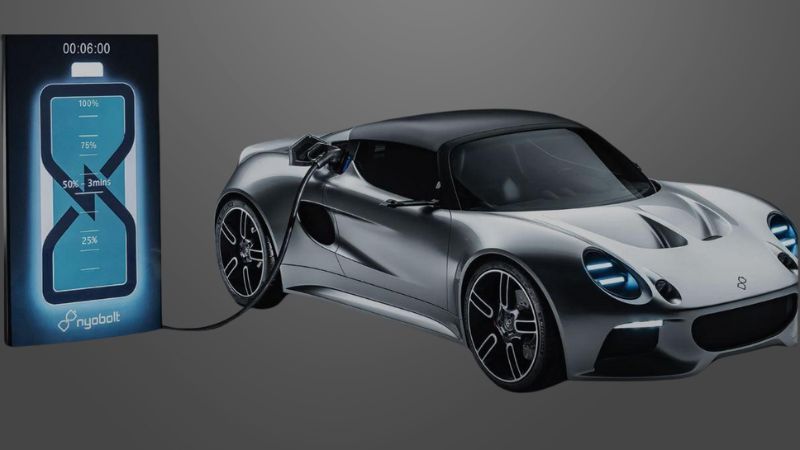
Depicting the performance of Nyobolt’s battery pack. Image courtesy of the Nyobolt
At the heart of this innovation is a novel battery system that addresses several key challenges of EVs. Specifically, Nyobolt claims its batteries leverage proprietary battery management systems and systems integration to safely handle high-power faster charging. In contrast, proprietary anode materials optimize the battery for fast Li+ transport with long life.
As a result, the prototype, based on the iconic Lotus Elise S1, boasts an impressive 470 brake horsepower while weighing a mere 1,246 kg (~2750 lbs). The 35 kWh battery used in the vehicle charges from 10% to 80% in just 4 minutes and 37 seconds using a 350 kW charger—a speed twice as fast as the current leading EVs. Additionally, it shows exceptional durability, with the battery retaining over 80% of its capacity after 4,000 full fast-charge cycles, equivalent to approximately 600,000 miles of travel.
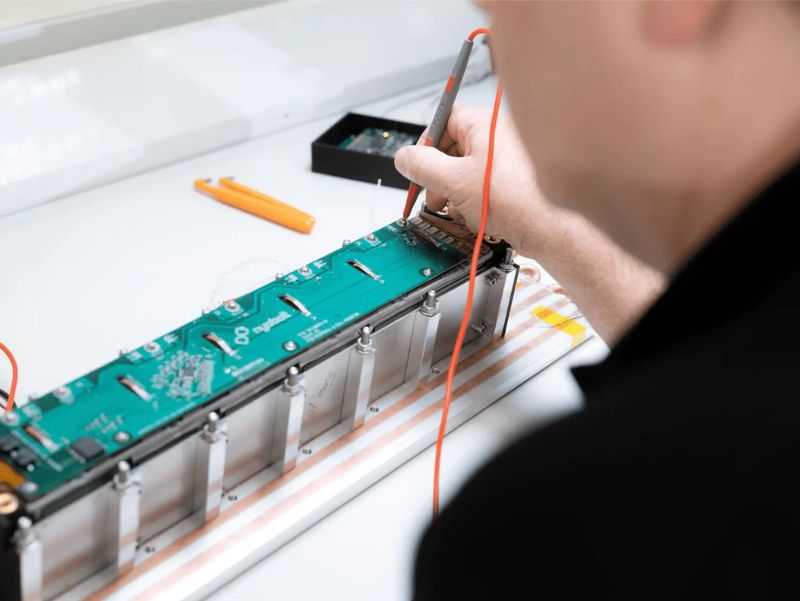
Nyobolt’s battery technology. Image used courtesy of Nyobolt
Charging Ahead
In the short term, Nyobolt plans to begin low-volume battery production this year and ramp up to 1,000 units next year. The technology's potential applications in off-highway vehicles and robotics suggest a broader impact beyond automotive. Analysts believe if Nyobolt can scale production to its target of two million units annually, it could genuinely reshape the EV landscape. However, the true test will be maintaining performance and durability at scale.