Facebook
 Google
 GitHub
 Linkedin
Light Metal? Cooling Innovation has Data Centers Foaming
Swiss startup Apheros believes metal foam is the solution for cooling data centers and other heat-generating tech.
As the global demand for data grows, driven by artificial intelligence, machine learning, and supercomputer applications, so does the power consumed by data center processors, which generate heat from their operations.
Can foam cool a data center? Video used courtesy of Apheros
For densely packed data center processors, the heat from their ongoing computational operations must be removed to ensure that processing hardware remains within its specified temperature range for safe and reliable operation.
Apheros, a female-owned deep-tech start-up based in Zurich, has patented technology to cool data centers with unique metal foam structures. This foam contains high porosity levels, providing an expanded surface area for better heat transfer and superior flow properties in liquid cooling systems.
Apheros has received $1.85 million in new funding to advance their innovative metal foam technology. Venture capital firm Founderful provided the pre-seed funding.
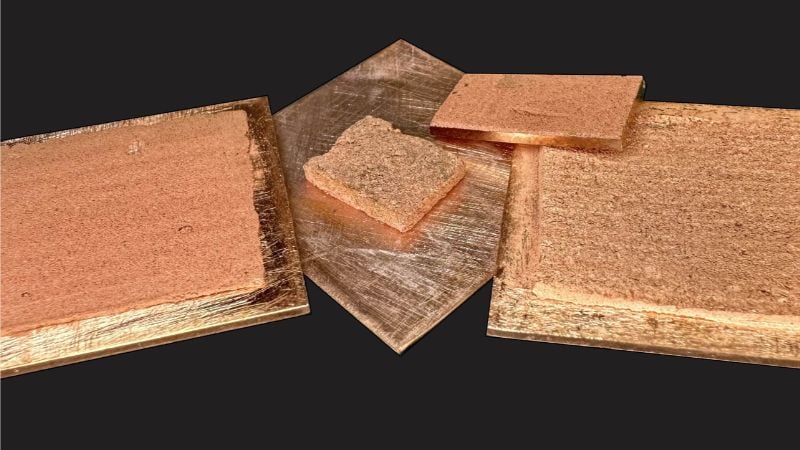
Metal foam. Image used courtesy of Apheros
Data Center Growth and Thermal Management Challenges
According to research from McKinsey & Company, data center energy use could grow by 10 percent annually through 2030. The power consumed by these data centers is projected to reach 35 GW by 2030, up from 22 GW in 2022.
The biggest data centers can consume as much power as 80,000 households, ultimately released to the environment as heat.
Liquid Cooling for Data Centers
Data center operators increasingly turn to liquid cooling to help with thermal management and keep their processing hardware within specified limits. Some data centers are constructed from the ground up using liquid cooling systems. Existing air-cooled centers can be converted to liquid cooling or future-proofed to support liquid cooling.
According to Vertiv, a leading digital infrastructure provider, the main types of liquid cooling systems used in data centers are heat exchangers, direct-to-chip liquid cooling, and immersion cooling systems.
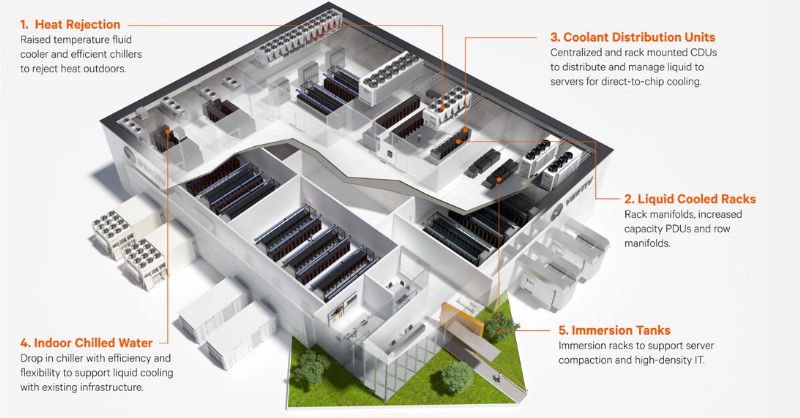
Data center cooling configurations. Image used courtesy of Vertiv
Metal Foam Technology
Apheros’ metal foam offers a material with a surface area that is 1,000 times larger than comparable products and can be applied to a wide range of applications, including cooling, lubrication, catalysis, and other applications.
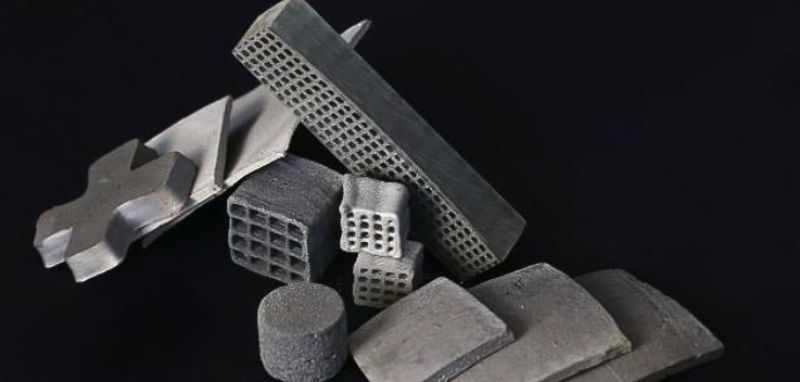
Metal foams with high porosity and surface area. Image used courtesy of Apheros
For data centers and other cooling system applications, the heating exchange system’s surface area is vital to its ability to quickly and efficiently remove heat. In fact, the heat transfer rate and surface area where the heat is conducted are directly proportional.
By offering material with more surface area, Apheros' technology enables a more efficient heat exchange process, resulting in cooling systems capable of higher heat removal rates, consuming less energy, and operating at a lower cost.
To ease adoption, Apheros’ metal foam technology can easily be integrated into existing liquid cooling systems.
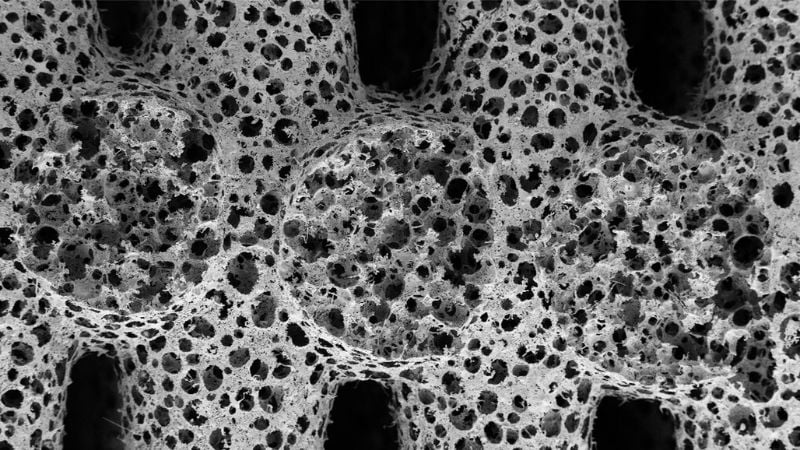
Foam technology creates more surface area for cooling. Image used courtesy of Apheros
According to Gaëlle Andreatta, Apheros co-founder and CTO, the company’s metal foams have superior heat exchange and fluid transport properties that can potentially transform thermal management for data centers and other applications.