Facebook
 Google
 GitHub
 Linkedin
GM and EnergyHub Partner for Off-Peak EV Charging
EnergyHub will integrate GM’s electric vehicles and home battery storage systems into its utility programs later this year.
Under a new partnership, New York-based EnergyHub is unlocking financial incentives for General Motors EV owners who enroll in demand response programs managed through the company’s grid-edge software platform. In return for supporting the grid during peak hours, participants will receive financial compensation.
Starting in 2025, owners of GMC, Chevrolet, and Cadillac EVs can enroll in EnergyHub programs via participating local utilities. Also joining the grid response effort is GM Energy’s PowerBank, a stationary home battery system launched last year to work with GM EVs, residential solar panels, and other distributed energy resources.
The partnership enables smart charging with optimized scheduling to help stabilize bulk and distribution grids, lending critical services like load shaping. Charging will be managed through EnergyHub’s Distributed Energy Resource Management System (DERMS). By coordinating charging during low-demand periods, the platform reduces grid strain and minimizes the need for expensive infrastructure upgrades. Such capabilities are becoming especially useful to utilities as EV adoption grows and electricity demand skyrockets due to AI and data center expansions.
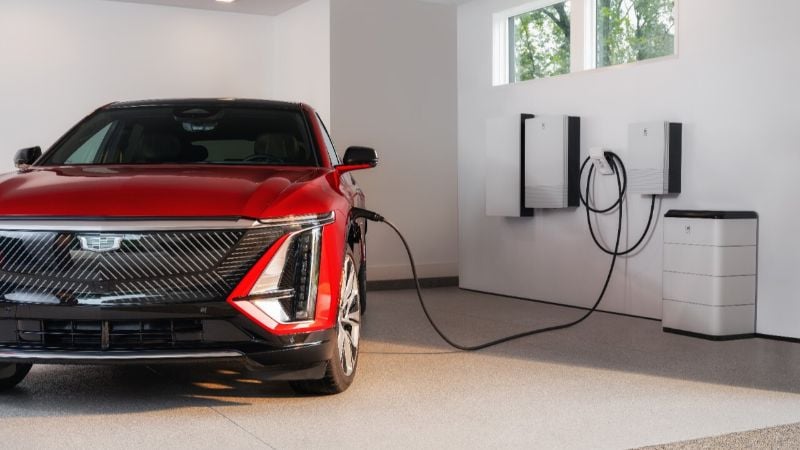
GM Energy’s home storage system connects to a Cadillac EV in a garage. Image used courtesy of GM Energy
Managed Charging Model
The PowerBank’s bidirectional capabilities support vehicle-to-home and vehicle-to-grid functionality, supplying backup power during outages or pushing energy to the grid when demand spikes. Offered in modular 10.6 kWh and 17.7 kWh configurations, the system can be scaled to meet customers’ needs. For example, two 17.7 kWh PowerBanks can provide 35.4 kWh—enough to power a home for up to 20 hours.
The GM-EnergyHub partnership is part of a broader industry trend: automakers are increasingly building software-defined functionality into their vehicles, making integration with managed charging services possible. Software-defined cars are expected to account for 90% of auto production by 2029.
Managed charging, still an emerging market, is gaining traction as automakers and utilities are motivated to avoid grid disruptions tied to uncoordinated EV adoption. Smart charging schedules allow utilities to optimize loads without needing to build new power lines to accommodate after-work surges in charging activity.
According to the U.S. Department of Energy, 64% of EV charging by 2030 is projected to occur at single-family homes. That makes GM’s home-centric PowerBank system a strategically positioned solution. Public DC fast-charging stations will likely support another 20%, leaving managed residential charging as a key lever for grid resilience as EV adoption reaches an expected 33 million units on U.S. roads by the decade’s end.
EnergyHub’s Edge DERMS
EnergyHub’s Edge DERMS software coordinates fleets of distributed energy resources (DERs), such as EVs, batteries, behind-the-meter devices, and solar inverters, across grid operations. The software supports dynamic load shaping to help utilities smooth out demand spikes.
The company claims it has more gigawatts under management and more devices connected than any other grid-edge DERMS. It currently works with over 70 utilities, 1.6 million DERs, and 2 GW of dispatchable capacity. EnergyHub’s partners include some of the nation’s largest utilities, such as Duke Energy, National Grid, and Eversource.
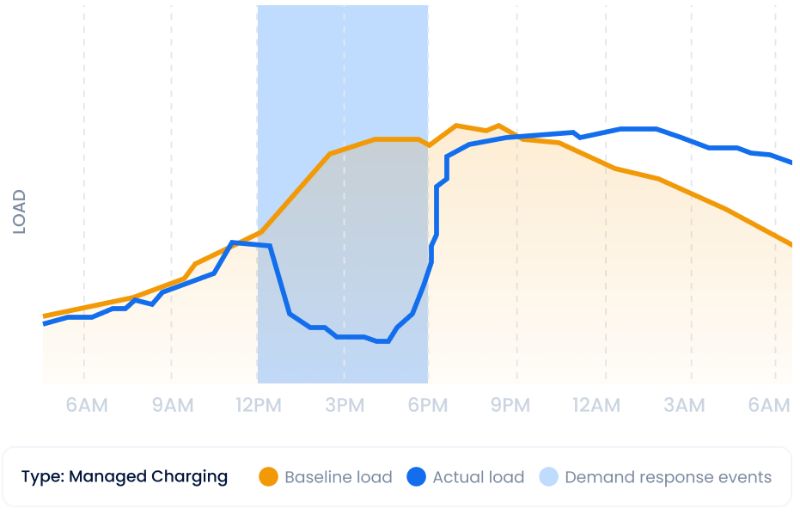
Edge DERMS provides event-based demand response for EV charging loads. Image used courtesy of EnergyHub
The company’s partner network also includes leading automakers like Toyota and Tesla, EV charging networks like ChargePoint, and residential solar firms like Sunnova. The company has 44 integrations with original equipment manufacturers (OEMs), working through more than 25 EV programs.