Facebook
 Google
 GitHub
 Linkedin
‘Floating Factory’ Makes Clean E-Fuels from Wind and Seawater
German researchers have created a floating platform that turns offshore wind, seawater, and air into synthetic fuels, marking a new phase in hydrogen and e-fuel innovation.
Heavy transport, shipping, and aviation depend on fossil fuels, despite growing pressure to decarbonize. These sectors aren’t easily electrified, and viable low-carbon alternatives remain scarce. Meanwhile, the energy transition is bumping into land constraints and grid limitations, making scaling hydrogen production onshore both costly and complex. Offshore wind holds immense promise, but its full potential for clean fuel production has remained untapped.
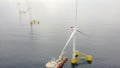
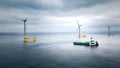
That’s starting to change. Germany has launched the first floating platform to produce synthetic fuels at sea, utilizing only wind, seawater, and air. Developed under the H2Mare hydrogen lead project and officially released in July 2025, the modular facility sits on a barge in Bremerhaven and will soon begin offshore operation near Helgoland. Designed by Karlsruhe Institute of Technology (KIT) with partners from TU Berlin and the German Aerospace Center (DLR), the project, called PtX-Wind, aims to show that clean fuels can be made off-grid, directly where wind energy is strongest.
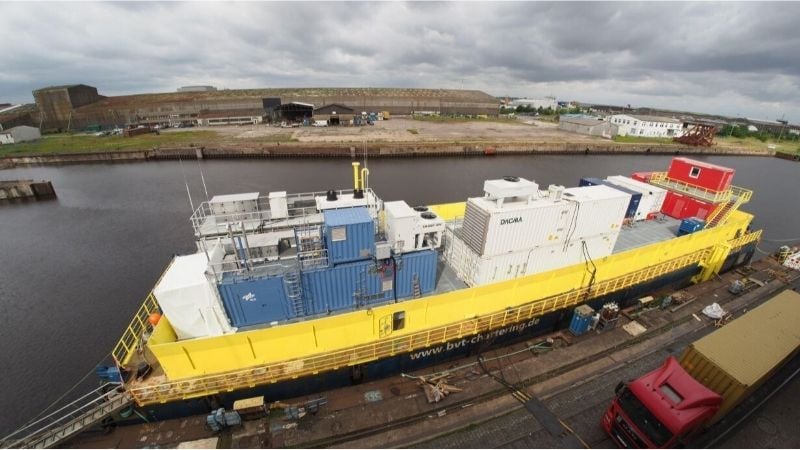
The floating platform is designed for the production of synthetic fuels offshore. Image courtesy of KIT
Floating Hydrogen Factory
The PtX-Wind platform isn't just a prototype for producing green hydrogen. It’s an entire floating factory. The barge features a direct air capture unit that extracts carbon dioxide from the atmosphere, a desalination system that converts seawater into freshwater, and a high-temperature electrolyzer that splits water into hydrogen using wind power.
The captured CO₂ and hydrogen are combined through Fischer-Tropsch synthesis to produce synthetic hydrocarbon fuels. The entire setup is modular and seaworthy, capable of running off-grid and flexibly responding to variable wind output.
Engineering the Offshore Electrolyzer
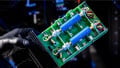
However, the platform is only part of a larger roadmap. The H2Wind subproject is focused on the heart of the system: a compact proton exchange membrane electrolyzer, engineered to operate directly on offshore turbines. Unlike conventional designs, this electrolyzer must endure salt-laden air, mechanical stress, and fluctuating load cycles. Engineers have reconfigured the components to reduce installation complexity and enhance at-sea maintenance, crucial factors when dealing with remote wind platforms.
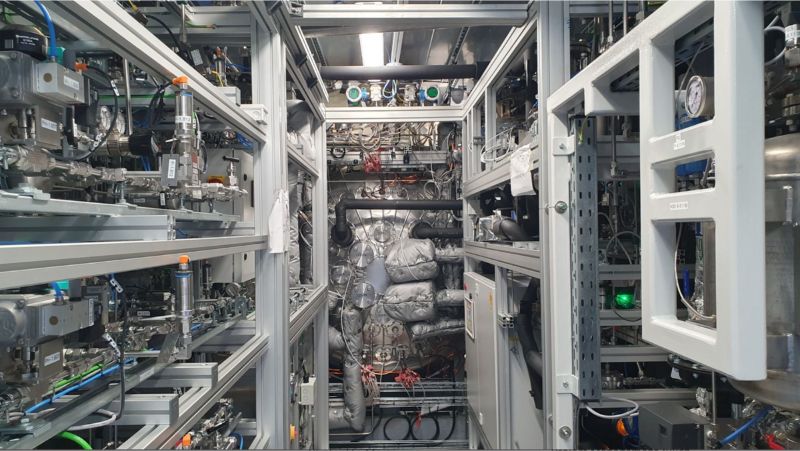
High-temperature electrolyzer. Image used courtesy of Federal Ministry of Research, Technology and Space
Researchers are also designing water treatment systems to supply the electrolysis unit and support downstream hydrogen storage. This holistic approach enables H2Wind to model profitability scenarios across a range of conditions, from energy output to extreme weather events.
While hydrogen is the central output, PtX-Wind takes the process further. By co-electrolyzing CO₂ and water, or potentially using direct seawater electrolysis if the system proves viable, researchers aim to eliminate the desalination step entirely, increasing overall efficiency. The produced hydrogen and CO₂ are converted into Fischer-Tropsch products, and future modules could expand into producing green methanol or ammonia. The raw materials (CO₂ and nitrogen) are extracted locally from seawater and air, allowing the plant to remain fully autonomous in fuel generation.
A New Direction for Energy at Sea
PtX-Wind represents a shift in thinking about energy production. It’s about turning abundant renewable energy directly into the fuels the world still relies on, and doing it in places rarely used.
Fossil-fuel-heavy industries urgently need alternatives, but onshore solutions face logistical and economic hurdles. With its floating synthetic fuel platform and the supporting technologies behind H2Wind and OffgridWind, Germany is demonstrating that offshore wind may not only power the grid but also serve as the foundation for clean fuel production at sea.