Facebook
 Google
 GitHub
 Linkedin
Struggling With EV Charger Design? Check Out This Development Kit
The EVCS-Cube kits from Phytec and Pionix can speed up the development of AC/DC electric vehicle charging stations.
Electric vehicle manufacturers face a significant challenge in developing and implementing reliable and compatible charging solutions. The rapid growth of the EV industry demands efficient and standardized charging infrastructure. However, the components' complexity often results in longer development times and increased costs. Ensuring interoperability between different systems and adhering to industry standards complicates the process further, making it difficult for manufacturers to keep pace with the fast-evolving market demands.
Phytec and Pionix have launched the EVCS-Cube, a comprehensive development kit that simplifies and accelerates the creation of AC/DC charging stations. This kit combines Phytec’s phyVERSO-EVCS charger controller with Pionix’s BaseCamp OS to provide a ready-to-use solution with all the necessary components and software. With the EVCS-Cube, developers can quickly prototype, test, and bring their products to market, ensuring compatibility with industry standards and future-proofing their solutions. This innovation may allow manufacturers to overcome the challenges of developing charging infrastructure, ultimately supporting the sustainability of the EV industry.

An electric vehicle charger using an EVCS kit. Image used courtesy of Pionix
EVCS-Cube Components and Features
The EVCS-Cube includes two kits: the EVCS-Cube Basic and the soon-to-be-released EVCS-Cube PoC. While both kits are beneficial during the development process, the PoC offers enhanced capabilities.
The Basic package includes power meters, contactors, residual current detection, charging indicators, and a stop button. However, it only supports AC charging, which can be a significant limitation. Manufacturers requiring DC charging will need to purchase the PoC kit when it’s released. The PoC kit includes a DC power supply unit, insulation monitoring, and a power meter, along with the capability for DC charging. Both modules can upgrade kits with expansions and additional features such as WiFi, LTE, displays, flight controllers, fans, or temperature sensors.
Pionix BaseCamp Integration
An evaluation license for Pionix BaseCamp is also included in the EVCS-Cube kits. Pionix BaseCamp is a subscription-based operating system specifically designed for EV chargers. It simplifies the development of charging stations by providing a standardized platform that ensures compatibility with the latest industry standards. This reduces the complexity and time required to bring new charging solutions to market. BaseCamp ensures that charging stations are compatible with various industry standards and protocols, such as OCPP (Open Charge Point Protocol) and ISO 15118, which is crucial for interoperability with different EVs and charging infrastructure components.
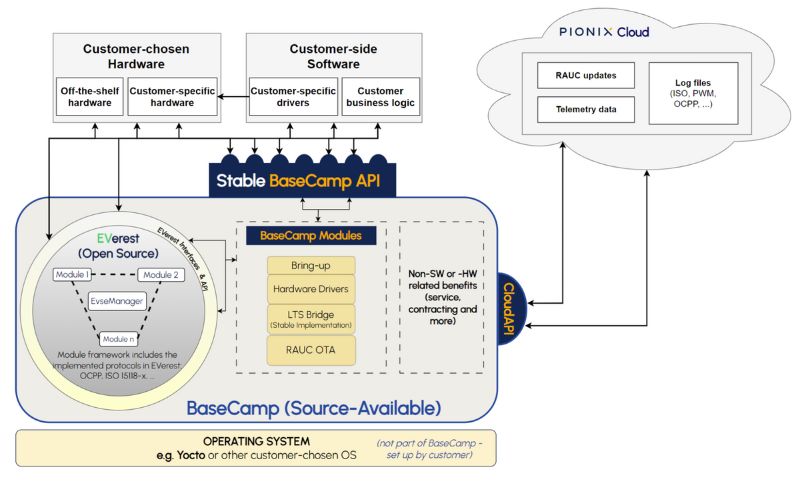
Pionix BaseCamp system. Image used courtesy of Pionix
Built on EVerest, an open-source software stack initiated by Pionix and now part of the Linux Foundation Energy, BaseCamp benefits from community-driven development and continuous updates. Phytec and Pionix also provide extensive support for both hardware and software, ensuring that developers have the assistance they need throughout the process. Regular updates and maintenance are included, ensuring that the software remains up-to-date with features and security standards. This is a major plus, providing engineers with ease of mind.
The EVCS-Cube offers a structured approach to developing EV charging solutions, integrating essential components with industry-standard software. Its modular design and compliance with key protocols provide manufacturers with a practical tool for improving the development process.