Facebook
 Google
 GitHub
 Linkedin
ABB’s Onboard DC Grid: The Engine Behind Washington’s Ferries
The U.S.’s largest ferry system selected ABB as its propulsion supplier for a new hybrid-electric fleet.
Washington State Ferries (WSF), the nation’s largest public ferry system with 21 vessels covering ten routes, has tapped Swiss equipment giant ABB as the single-source propulsion vendor for new hybrid-electric ferries.
Ferry electrification program. Video used courtesy of Washington State Department of Transportation
ABB will oversee development, bidding, and equipment delivery for five new ships carrying 160 vehicles and 1,500 passengers. It will also supply the complete system design and integration technology, including the engine, batteries, and propellers, to power the Olympic-class vessels.
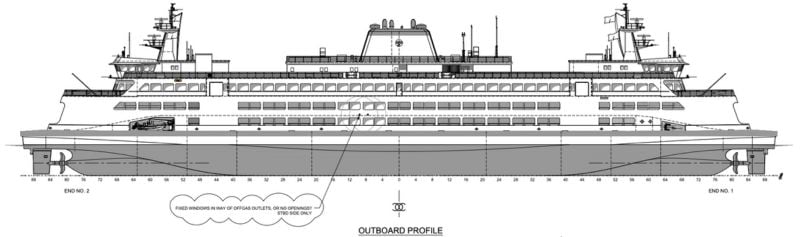
A preliminary drawing of the hybrid-electric ferry. Image used courtesy of the Washington State Department of Transportation
Constructing Hybrid-Electric Ferries
The Washington State Department of Transportation details the sheer volume of components needed for the project. ABB will use two electric engines, four propulsion motors, an energy storage system, diesel generators and alternators, two off-grid transformers, switchboards and other electrical components, medium-voltage AC shore power transformers, low-voltage AC distribution equipment, control automation, and remote diagnostics.
WSF recently opened construction bids targeting shipyards nationwide. The organization expects to award a contract to one or two shipbuilders early next year, with delivery of the first two slated for 2028 and the remaining three by 2030.
The five ferries will be the first of 16 funded through WSF’s $3.98 billion Ferry System Electrification Plan, which aims to reduce its greenhouse gas emissions and fuel consumption and have a zero-emission fleet by 2050.
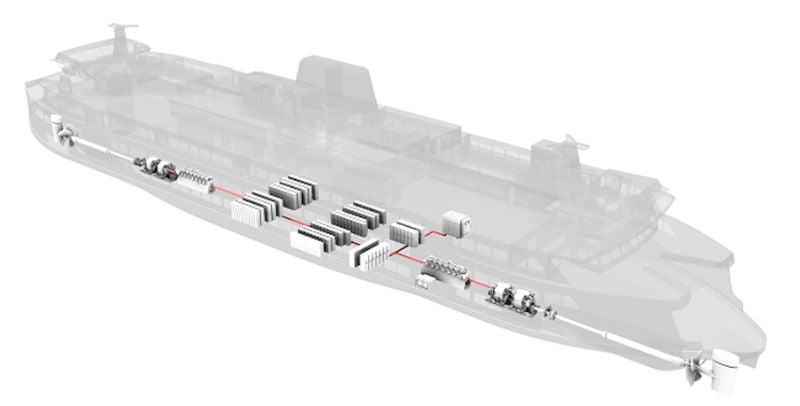
Rendering of a ferry electric propulsion system. Image used courtesy of WSF
ABB’s Ferry Tech
ABB will supply its Onboard DC Grid power distribution product, which includes advanced energy management, storage, and integrated automation.
Onboard DC Grid is a modular platform with sensors and communication systems to integrate energy loads and sources like batteries, fuel cells, variable-speed gensets, and shaft generators. It also has fault-tolerant features and an autonomous subsystem design for enhanced reliability.
The protection system combines fuses, breakers, isolators, and a converter control with enhanced safety for equipment and staff. Input circuits are divided into two protection zones with power distribution and a conventional multi-drive DC link.
ABB’s DC power system for the hybrid-electric ferries. Video used courtesy of ABB
Onboard DC Grid has been deployed in various maritime applications, from shuttle tankers to offshore support to cable-laying vessels. For ferries, it guides seamless energy storage integration for hybrid or fully electric platforms. For example, two diesel-to-battery electric ferry retrofit projects, Aurora and Tycho Brahe, used it to transition their AC plants into DC. Converting the pair, originally built in the 1990s, involved installing 4.1 MWh batteries, racks, and energy storage controls.
In addition to a highly controllable power plant with remote diagnostic and service, ABB’s Onboard DC Grid cuts 30% of the electrical equipment footprint. It’s also flexible to various vessel sizes and models. Ferries operating in zero emissions, where used energy passes through a battery before reaching the propeller, demand enhanced controllability and energy storage efficiency.
ABB has a long history in maritime power distribution, delivering its first Onboard DC Grid system in 2013. It recently announced it would supply a hybrid-electric propulsion and energy storage system for a ferry in Maine. Other recent contracts include Antarctica21’s polar expedition cruise ship and Nexans’ advanced cable-laying vessel.
Electrifying Maritime Vessels
WSF transported 18.7 million riders and 9 million vehicles in 2023. The latter is a critical function of the state agency, whose vessels are specially designed to handle commercial vehicles. However, operation and maintenance are significant challenges, as nearly half its fleet is over 30 years old. WSF is also the biggest greenhouse gas emitter among Washington government agencies, burning nearly 20 million gallons of diesel annually.
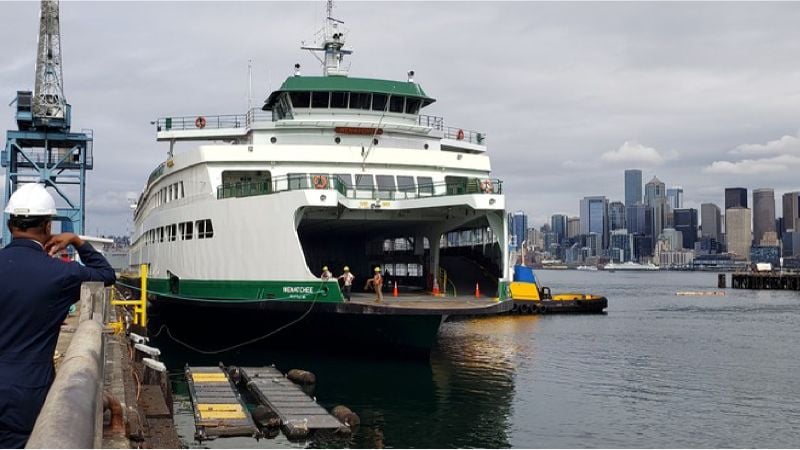
In 2023, Wenatchee was the first WSF vessel to convert to hybrid-electric. Image used courtesy of WSF (Page 8)
According to the Washington Department of Transportation, the five hybrid-electric ferries will save about 240 million gallons of diesel over their 60-year lifetimes. Systemwide emissions will be reduced by 75% from 180,000 metric tons to 45,000 annually.
WSF will add charging power to 16 terminals as part of its electrification plan. This overhaul is currently in the early planning and design phase. Lithium-ion batteries, converters, inverters, power distribution, and control systems will be installed below deck on the ferries, coupled with an above-deck rapid charging system attaching a robotic arm at each end of the ship. Terminals will feature a charging receptacle on the wing wall, medium-voltage equipment, and shoreside energy storage.
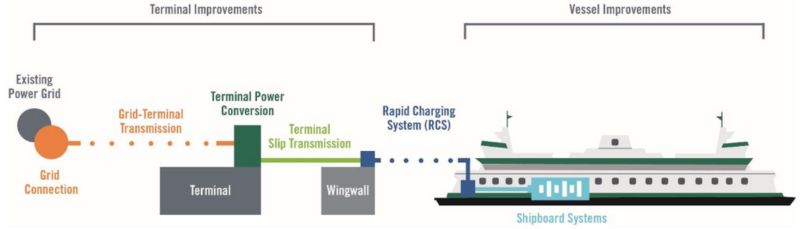
Hybrid-electric system components in WSF’s electrification plan. Image used courtesy of WSF (Page 25, Figure 7)
WSF will also convert six diesel ferries to hybrid-electric propulsion and retire another 13 diesel vessels. Last year, it began converting three Jumbo Mark II-class ferries to hybrid-electric and replacing old propulsion control systems. Jumbo Mark IIs are the biggest emitter in its fleet, accounting for about a quarter of greenhouse gas emissions.