Facebook
 Google
 GitHub
 Linkedin
XP Power Adds 320 W Baseplate-Cooled Full-Brick AC-DC Supplies
XP Power's ASB320 series packs seven DC output options, a built-in EMC filter, an AC fuse, and a bulk storage capacitor into one encapsulated 320 W brick
Sealing an industrial enclosure solves one problem but creates another. The ingress rating that keeps dust and coolant mist out of an industrial cabinet also keeps cooling air out, and a 320W supply still has to put its waste heat somewhere.
XP Power's answer is to route the heat into the baseplate. The company has extended its ASB range from 160 W to 320 W with the ASB320 series, a fully encapsulated full brick that cools by conduction and includes the EMC filter, AC fuse, and bulk storage capacitor already inside. Targets include industrial automation, communications, test and measurement, and analytical instrumentation.
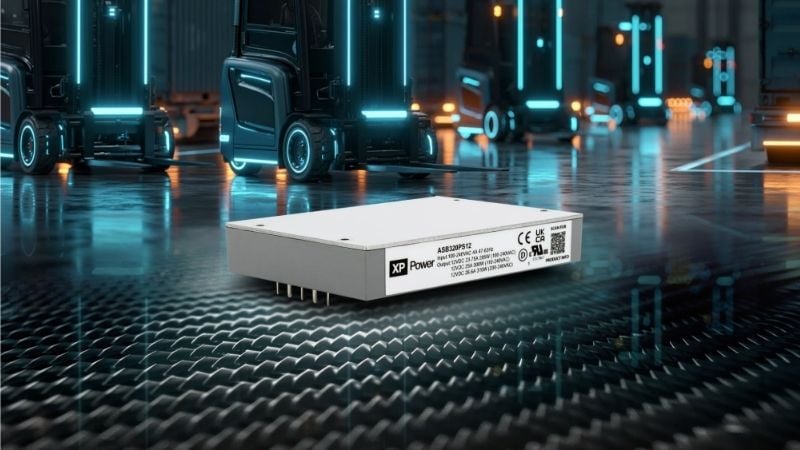
The ASB320PS12, one of seven output variants in the series, in an encapsulated full-brick package. Image used courtesy of XP Power
Filter, Fuse, and Bulk Cap Come Built In
Building a 320 W AC-DC stage around a bare converter usually means surrounding it with support hardware. It needs an EMC filter to get conducted and radiated emissions under the limit and a correctly rated input fuse. It also requires enough bulk capacitance to hold the output up when the mains dips.
Each component consumes board area, adds BOM lines, and complicates layout at exactly the point where high-current traces and switching nodes are already fighting for space.
The ASB320 series ships with all three inside the package. That matters most for compliance, because emissions performance depends heavily on filter placement and grounding. An OEM must get these details right on its own board, and often discovers they got them wrong in an EMC chamber late in the schedule.
XP Power validates the whole assembly instead, rating the series for EN55032 Class B conducted and radiated emissions and EN61000-3-2 Class A harmonic currents, with Criteria A immunity performance across ESD, radiated fields, EFT/burst, surge, and conducted disturbance.
Safety approvals cover UL, EN, and IEC 62368-1 plus CB, CE, and UKCA marks. The datasheet specifies 3000 VAC isolation from input to output. Power factor runs from 0.95 to 0.98 at 230 VAC full load, and no-load input power stays under 0.5W, which helps equipment that idles for long stretches but stays energized.
Thermal and Input Limits on Full Output
The ASB320 is fully encapsulated, but with conduction as the only heat path, rated output depends on the heatsink and mounting scheme rather than the enclosure's airflow.
The -40°C to +90°C figure is xcc (baseplate temperature), and the derating curves assume a 1.6°C/W or better interface. Efficiency runs between 92% and 94% at 230 VAC full load, depending on output voltage. Done properly, the result is a 320 W rail in a sealed enclosure with no moving parts to service.
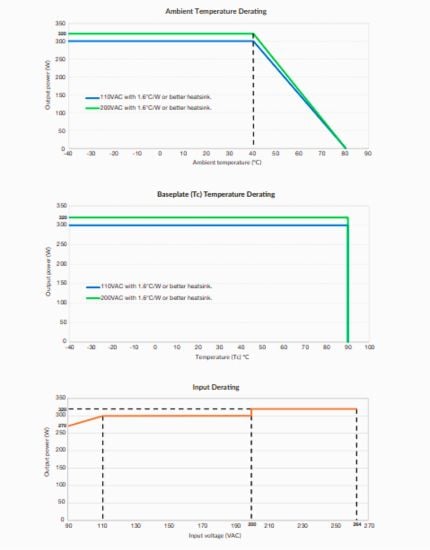
Three derating curves govern available output: ambient temperature, baseplate temperature (Tc), and input voltage. Image used courtesy of XP Power
The 90 to 264 VAC universal input covers global operation, but the full 320 W requires 200 VAC or above. On nominal 110 VAC supplies, the ceiling is 300 W, which matters for equipment destined for both North American and European installations.
Outputs, Headroom, and Protection
Seven single outputs—12, 15, 24, 28, 36, 48, and 54 VDC—cover most industrial rails directly, avoiding a downstream conversion stage for equipment that runs on a single voltage. Output currents range from 26.6 A at 12 V to 5.92 A at 54 V.
Peak capability matters more for sizing. The series delivers up to 360 W for 5s, enough margin for motor starts, capacitive inrush, or bursty communications loads without stepping up to a larger supply that then idles well below its rating for the rest of its life.
The protection set covers overload, short circuit, and over-temperature. Overload protection trips between 115% and 175%. Auto-resetting hiccup mode handles short circuits, and thermal shutdown is likewise auto-resetting. Hold-up runs 20–25 ms at full load, thanks to the bulk capacitor, enough to ride through a brief mains dropout.
Output voltage trims ±5% through an external resistor between the Trim pin and either output rail, useful for compensating cable drop at the load. No minimum load is required, so the supply stays regulated in standby.
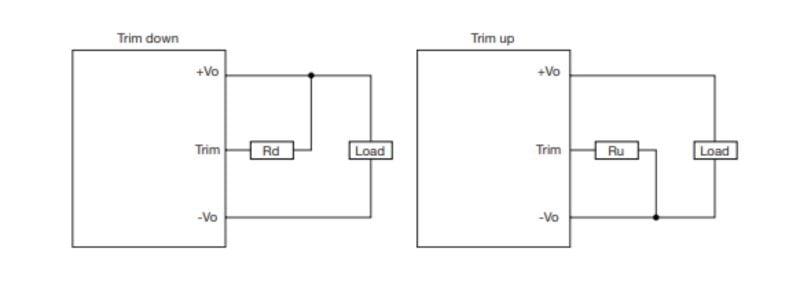
A single external resistor sets the output voltage: Rd between the Trim pin and +Vo to trim down, Ru between Trim and -Vo to trim up. Image used courtesy of XP Power
It is available now from Avnet Abacus, DigiKey, element14, Farnell, Mouser, RS, TME, or directly, with a three-year warranty.
Looking Ahead
The full-brick footprint is already standard, so the next density step is more likely to come from switching topology. Wide-bandgap devices would cut the loss budget that sets these derating curves in the first place.