Facebook
 Google
 GitHub
 Linkedin
Toshiba Intros 3-Phase Modular UPS Series for Edge Data Centers
The 40 kW to 200 kW chassis hits 96.5% efficiency with hot-swappable power modules and IIoT-based diagnostics.
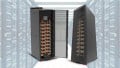
Toshiba International Corporation has introduced the 3000 TP Series, a three-phase modular uninterruptible power system aimed at edge data centers, enterprise IT, and commercial deployments. The Houston-based subsidiary of Toshiba Corporation said the UPS scales from 40 kW to 200 kW in a single 42U enclosure, runs at 96.5% efficiency, and is built around a six-shelf hot-swap power module architecture.
The 3000 TP offers five capacity points—40, 80, 120, 160, and 200 kW—within a 480V 60Hz platform using a voltage- and frequency independent (VFI) online double-conversion topology. Each of the six power modules is hot-swappable, allowing capacity expansion or component replacement without dropping the load, and the system supports N+1 redundancy. Fully front-accessible, the enclosure simplifies installation in space-constrained sites with no rear service clearance.
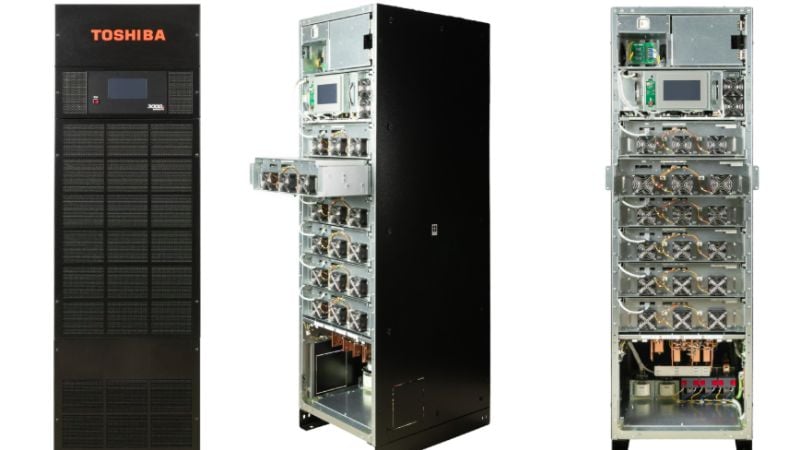
The 3000 TP. Image used courtesy of Toshiba
Modular Architecture and Serviceability
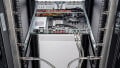
The six-shelf design lets operators populate the chassis incrementally, deferring capital expense as load grows. That approach has become standard across the modular three-phase segment, where buyers prefer to size to current demand and add modules as workloads scale. Toshiba ships the 3000 TP with conformal-coated printed circuit boards, which improve resistance to airborne contaminants in industrial or retail deployments.
The 96.5% efficiency rating is competitive with other modular three-phase products targeting the same edge segment, though not class-leading. Recent SiC-based three-phase UPS architectures from competing vendors have pushed online efficiency above 97% with similar capacities. Toshiba didn’t disclose battery configuration, runtime, pricing, or certifications beyond the IP20 enclosure rating, however.
The modular approach Toshiba has taken with the 3000 TP follows the broader industry shift away from centralized monolithic UPS designs. Centralized UPS units have slightly higher peak efficiency, but they suffer from single points of failure and require fully sizing the system to the ultimate load on day one.
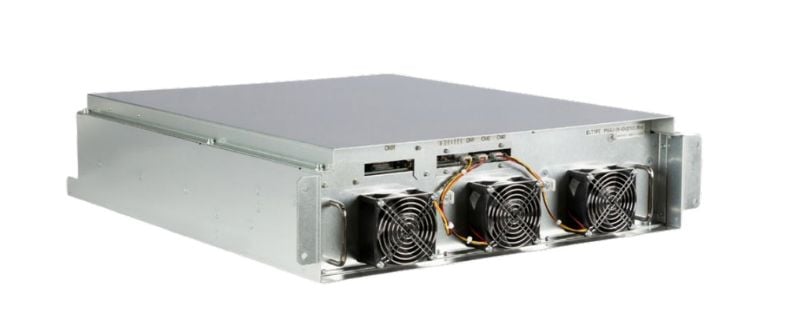
Modular design. Image used courtesy of Toshiba
Modular designs allow pay-as-you-grow expansion and concurrent maintenance, which is why operators of edge sites, hospitals, and mid-tier colocation facilities have moved decisively to the modular topology over the last decade.
Diagnostics Aimed at Predictive Maintenance
The 3000 TP ships with advanced diagnostics, including a Waveform Capture Tool, printed circuit board age detection, and the Toshiba RemotEye IIoT card. These features support the predictive maintenance workflows that colocation and hyperscale operators have increasingly standardized on, while the IIoT card enables remote monitoring and integrates with third-party data center infrastructure management platforms.
In addition, the age-detection diagnostic gives operators visibility into PCB-level degradation ahead of failure.
The unit ships with a three-year onsite warranty. That positions the product against competitors that bundle similar onsite service terms, including Schneider Electric, Eaton, and Vertiv.
The Waveform Capture Tool is a particularly useful inclusion for engineers troubleshooting input transient events, harmonic distortion, or load-side anomalies that would otherwise require connecting an external power quality analyzer. Combined with PCB age detection and the RemotEye card, the diagnostics suite gives field operators a path to remote fault triage and component-level replacement scheduling, which should shorten mean time to repair on the platform.
A Contested Market
The 40-200 kW edge segment is one of the most contested in the three-phase UPS market. The 3000 TP overlaps with Vertiv’s Liebert APM2, Schneider Electric’s Galaxy VS, and Eaton’s 9PX modular ranges, all of which target the same capacity envelope and the same buyer profile: enterprise IT teams, retail, healthcare, and edge data center operators sizing for sub-megawatt loads.
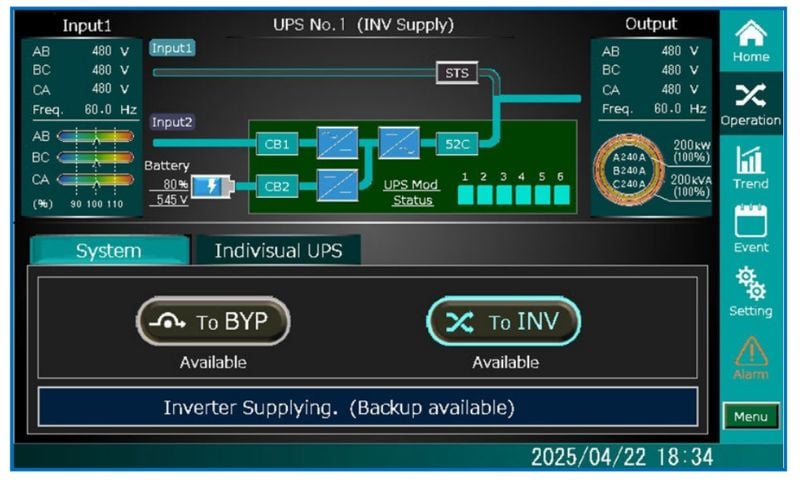
Touchscreen interface. Image used courtesy of Toshiba
Metro-edge buildout for latency-sensitive applications, including retail, healthcare imaging, and emerging inference workloads at the network edge, is driving demand for sub-megawatt three-phase UPS. AI training remains concentrated at hyperscale facilities, but inference is dispersing into smaller sites, increasing pressure on the 100-200 kW class of three-phase products.
With the 3000 TP, Toshiba expands its 480V 60Hz coverage in that segment without moving into the megawatt-class systems typically deployed at hyperscale builds.