Facebook
 Google
 GitHub
 Linkedin
Toshiba Extends CUZ Zener Diodes to 75 V for 48 V Power Rails
The CUZ56V, CUZ62V, CUZ68V, and CUZ75V target long-pulse switching surges and induced lightning events in data centers, networks, and industrial supplies.
Toshiba Electronics Europe has added four higher-voltage parts to its CUZ series of surge-protection Zener diodes: CUZ56V, CUZ62V, CUZ68V, and CUZ75V. The devices are positioned to protect 48 V and higher power lines in applications such as data centers, network equipment, and industrial power supplies, where designers are balancing higher distribution voltages against tighter protection margins.
As rack and system power climb, 48 V distribution reduces current by four times compared to 12 V at the same power, cutting distribution losses by a factor of 16 and easing copper and thermal constraints. With higher bus voltages becoming more common, engineers need clamps that sit above the normal operating window but still react predictably to surges longer than classic ESD events.
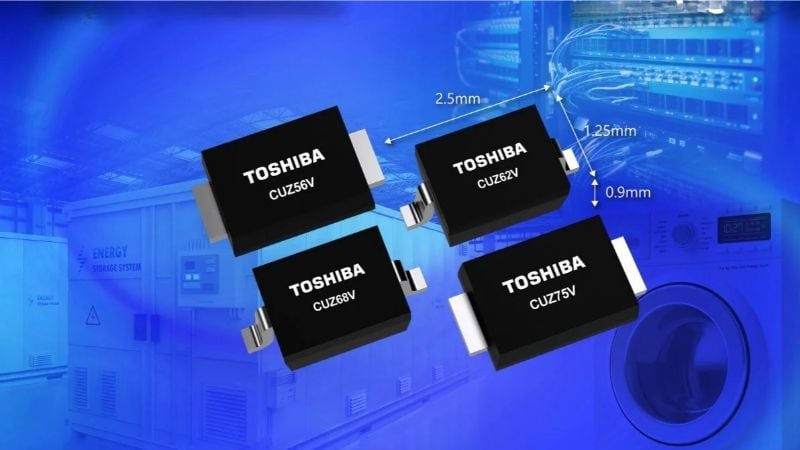
Zener diodes. Image used courtesy of Toshiba
Protecting 48 V Rails Means Handling Longer Surges
Toshiba draws a line between TVS diodes, typically chosen for fast ESD events, and Zener-based protection parts intended to absorb longer-duration stress. The CUZ additions are introduced to protect against long-pulse-width switching surges and induced lightning surges in the microsecond-to-millisecond range, as well as overvoltage pulses with characteristics close to DC.
That’s important in real systems because ESD protection often focuses on nanosecond-scale transients at connectors and user-accessible interfaces. Power-line stress is frequently slower and more energetic, coming from hot-plug events, inductive switching, fault recovery, or surge coupling from nearby lightning activity. A protection device that looks fine on an ESD chart can still run out of thermal headroom when the pulse stretches out, and the energy rises.
Toshiba also says that these new CUZ parts respond to rising adoption of 48 V supplies in data centers, network equipment, and industrial equipment to improve power efficiency.
CUZ56V to CUZ75V
Electrically, the four CUZ devices expand the “high side” of Toshiba’s protection Zener lineup. Toshiba says its existing protection Zener range covers typical Zener voltages from 5.6 V to 51 V, and this expansion extends the family to 75 V to better suit 48 V and above architectures.
Across the four new devices, Toshiba lists:
- Power dissipation (PD): 600 mW
- Peak pulse current (IPP): 5 A, tested to IEC 61000-4-5 with an 8/20 μs waveform
- Zener voltage (VZ): specified at IZ = 2 mA, with min/typ/max windows of
- CUZ56V: 52 V / 56 V / 60 V
- CUZ62V: 58 V / 62 V / 66 V
- CUZ68V: 64 V / 68 V / 72 V
- CUZ75V: 70 V / 75 V / 79 V
Toshiba also lists typical clamp voltage figures extracted using TLP methods at ITLP=16 A, landing in the 112 V to 120 V range, depending on the device, alongside typical dynamic resistance (RDYN) spanning 3.1 ohms to 4.0 ohms.
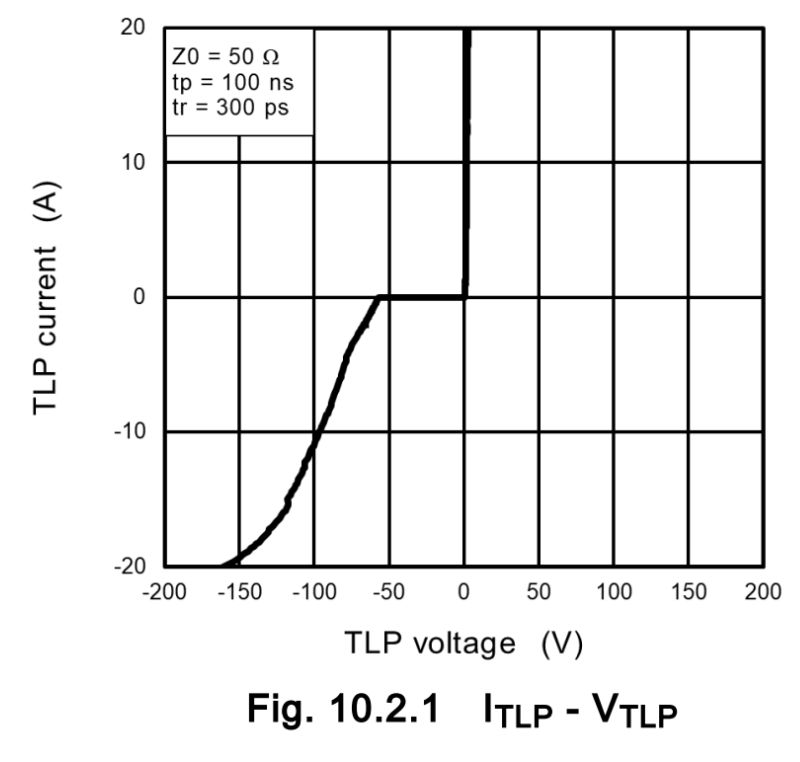
TLP voltage for the CUZ56V. Image used courtesy of Toshiba
Those clamp numbers are useful for designers because they define the “worst case” voltage domain the downstream silicon must tolerate during a surge event, after the Zener begins conducting heavily. In a 48 V system, the protection strategy is typically staged, with the primary clamp preventing a surge from escalating into destructive voltage, while downstream regulators and loads ride through the event within their own abs-max limits.
Toshiba also publishes ESD contact ratings (IEC 61000-4-2) for the new parts, ranging from +/-13 kV for CUZ56V to +/-23 kV for CUZ75V, with air discharge listed as 5 kV across the lineup. Toshiba expects them to cover both surge and a baseline level of ESD robustness on power lines.
Packaging and Footprint Continuity
All four CUZ parts use Toshiba’s SOD-323 (USC) package, with typical dimensions of 2.5 mm x 1.25 mm x 0.9 mm, and Toshiba emphasizes mounting compatibility with existing SOD-323 environments. That matters for power supply OEMs who want to revise protection schemes without reworking board real estate or AOI programming.
Another detail worth tracking is Toshiba’s roadmap for higher-stress headroom within the same voltage brackets. In the same lineup table, Toshiba lists CUHZ56V/62V/68V/75V as under development, using a SOD-323HE (US2H) package and stepping up to 1200 mW PD and 10 A IPP, with lower stated RDYN values than the CUZ parts. If those ship broadly, they would offer a cleaner migration path for designs that discover late-stage surge margins are tighter than expected, without jumping to a much larger package class.
Toshiba’s CUZ expansion is ultimately a practical addition for engineers designing around 48 V buses, offering more Zener voltage options that sit above the nominal rail. They are packaged for footprint continuity and specified with surge and TLP-derived behavior that can be plugged into a protection budget early rather than patched in after validation failures.