Facebook
 Google
 GitHub
 Linkedin
TDK Intros Rugged Industrial 3 kW Programmable Power Supplies
The compact HWS3000G units deliver up to 93% efficiency, MIL-STD-810G resilience, and digital control.
TDK has released its TDK-Lambda HWS3000G series of programmable AC-DC power supplies. The power supplies are rated at 3000 W, with programmable output voltages and currents, enhanced shock and vibration tolerance, and options for reverse airflow. The series is meant to extend TDK-Lambda’s portfolio into harsher and more demanding applications.
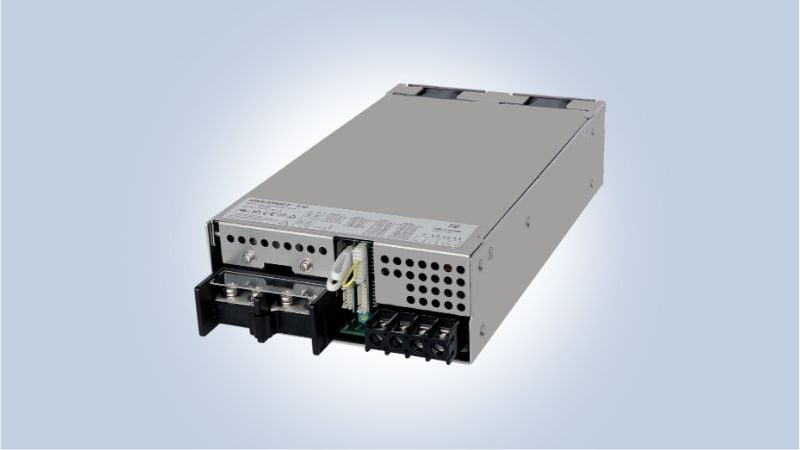
TDK-Lambda HWS3000G. Image used courtesy of TDK-Lambda
The HWS3000G Series
The HWS3000G series delivers 1500 W when operated from low-line single-phase input (85-132 VAC) and a full 3000 W at high-line (170-265 VAC). Available in four nominal voltage models (24 V, 48 V, 60 V, and 130 V), the supplies can be programmed across ranges of 0-28.8 V, 0-52.8 V, 0-66 V, and 0-156 V, respectively. Up to three units can be connected in series or as many as 10 in parallel to expand system capability.
Device efficiency reaches up to 93% across -20°C to +70°C, with full output sustained up to 50°C and derating thereafter. Safety isolation ratings are 3000 VAC input-to-output, 2000 VAC input-to-ground, and 1500 VAC output-to-ground. The units maintain leakage currents below 0.85 mA.
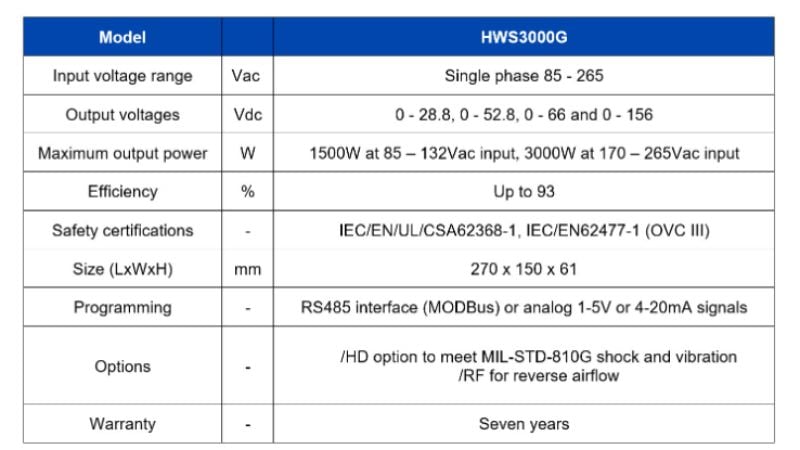
Data points for the HWS3000G. Image used courtesy of TDK-Lambda
For flexibility, output parameters are programmable through both analog inputs (1-5 V or 4-20 mA) and a digital RS-485 interface using the Modbus protocol. Engineers can set constant voltage or constant current modes, define slew rates, and retrieve operational data such as fault logs and cumulative run time without powering the supply on. The units also feature a dual-sided board coating option to meet MIL-STD-810G standards for shock and vibration, and an additional /RF option allows the reversal of cooling airflow to match enclosure layouts.
For system integration, the HWS3000G includes a 5 V, 2 A standby supply, remote on/off control, remote sense, and diagnostic signals including fan fail and power-good outputs. Certifications include IEC/EN/UL 62368-1 and IEC/EN 62477-1 (OVC III), along with CE, UKCA, and full EMC compliance (EN 55032A, EN 55011-A, FCC-A).
Shock and Vibration Standards
Industrial and military-grade electronics must contend with mechanical stresses far beyond those experienced in controlled laboratory settings. Shock and vibration testing, defined under MIL-STD-810G, provides standardized benchmarks to ensure equipment survives transport, installation, and operation in demanding conditions.
Shock events occur when equipment is subjected to sudden impacts such as drops, collisions, or abrupt accelerations. Consequently, power supplies exposed to these stresses must avoid cracked solder joints, fractured components, or misaligned assemblies. Vibration, by contrast, involves repeated oscillations that can fatigue solder joints, loosen fasteners, and degrade long-term reliability if unmitigated.
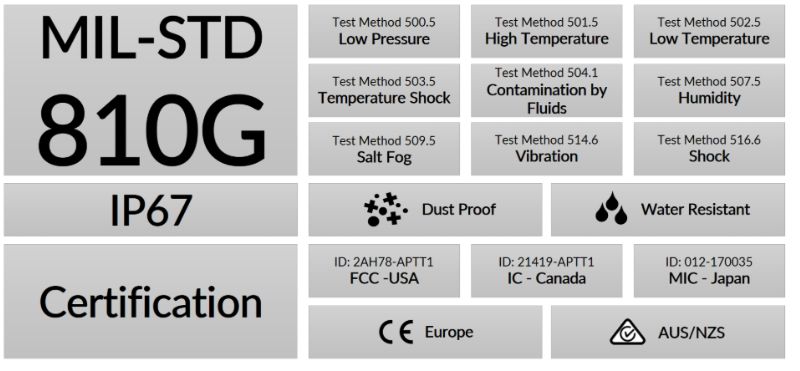
MIL-STD-810G and IP67 certification requirements. Image used courtesy of Custom Materials
To withstand these conditions, manufacturers use several design strategies. Dual-sided board coating provides a protective layer that prevents mechanical cracking, moisture intrusion, and particulate contamination. Component mounting techniques, including reinforced leads and adhesive staking, help maintain structural integrity under vibration profiles that simulate truck transport, aircraft operation, or factory floor conditions. Heat sinks and transformers may require mechanical damping or ruggedized fasteners to prevent resonance effects.
While compliance with MIL-STD-810G does not certify universal resilience, it does indicate that a device has been tested against specific profiles such as sine vibration sweeps or drop shock pulses. For engineers integrating power supplies into mission-critical systems, these qualifications reduce uncertainty about long-term durability and field service demands.
Rugged Power for Demanding Applications
Applications including RF amplification, laser processing, and semiconductor tools all require power supplies that deliver consistent, monitored, and environmentally tolerant performance. By meeting MIL-STD-810G for shock and vibration, supporting reverse airflow configurations, and maintaining high efficiency across its operating range, the HWS3000G could be a powerful solution for engineers in these spaces.