Facebook
 Google
 GitHub
 Linkedin
TDK Intros Non-Isolated 12.5 kW 3-Phase Power Supplies
The 12.5-kW TPF12500-385 is a non-isolated three-phase supply delivering 385 VDC at 97.5% efficiency to feed isolated DC-DC converters and DC microgrids.
TDK has launched the TDK-Lambda TPF12500-385 series, a non-isolated three-phase power supply delivering a regulated 385 VDC at 12.5 kW nominal and 13.1 kW maximum, with 97.5% typical efficiency.
The series is built for distributed power architectures, supplying isolated high-voltage DC-DC converters or DC microgrids in semiconductor manufacturing equipment, data centers, radar RF power amplifiers, industrial automation, and burn-in and test systems.
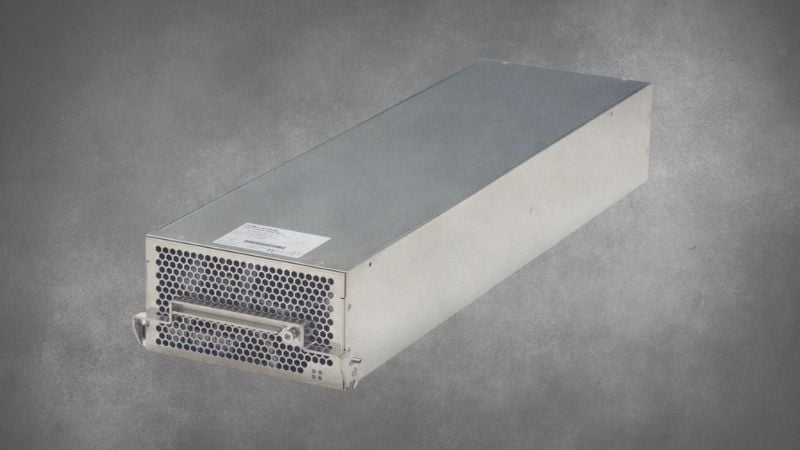
The TPF12500-385 delivers 12.5 kW at a regulated 385 VDC from a 360-528 VAC three-phase input, in a 3U-compatible enclosure measuring 202.6 × 111.1 × 711.2 mm.
360–528 VAC In, 385 VDC Out
The TPF12500 accepts 360-528 VAC three-phase at 47-63 Hz, wired as either Delta or Wye. That covers 400, 440, and 480 V mains on both 50 and 60 Hz supplies, so you can specify a single model across sites worldwide without an external transformer.
The output is fixed at 385 VDC, rated 12.5 kW and holding 13.1 kW at the top end. At 97.5%, it loses less than 350 W in conversion. That thermal load is small enough for two internal fans to manage, which keeps the TPF12500 out of liquid-cooling territory. Water cooling at this power level means a pump, a loop, a heat exchanger, and a maintenance schedule, none of which the design has to accommodate.
Rack and System Integration
The unit measures 202.6 × 111.1 × 711.2 mm at 12.7 kg, fitting 3U racking. Board-to-board connectors replace cabled interfaces, freeing cabinet space and cutting the joints that fatigue or loosen under vibration.
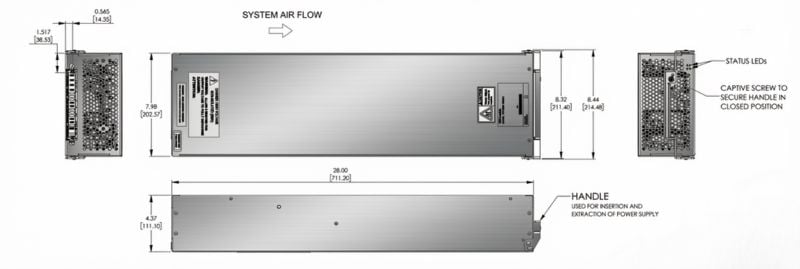
Outline drawing and pinout for the TPF12500-385.
The series supports RS-485 monitoring, giving remote real-time visibility of input voltage, output current, internal temperature, fan status, and on/off state without a site visit. Discrete DC OK, dropped-phase, and overtemperature signals report fault conditions to the system controller without polling the bus. A 13 V, 0.2 A standby rail holds control and monitoring alive while the main output is down, so a rack can be interrogated before it is brought up.
The supply carries SEMI F47-0706 at 480 VAC to Criteria C, which defines its behavior through line dips and is what allows it into semiconductor fabs. It is also MIL-STD-810H-compliant for shock and vibration. Isolation is rated at 2 kVAC from input to ground and from output to ground. Remaining approvals are routine: IEC/UL/CSA/EN 62368-1, CE and UKCA marking, EN 55032 Class A emissions in the end system, and IEC 61000-4 immunity.
Operating Envelope
Power factor is 0.93 typical at rated load. With no output adjustment, load voltages come from the downstream isolated converters rather than the front end, which is how a distributed architecture is meant to work.
Two units can run in parallel using droop-mode current sharing, taking a system to roughly 25 kW without an external controller or any communication between supplies. Full-load operation runs from -10°C to +40°C, with cold start down to -20°C.
Full specifications for the TPF12500-385 series are available in TDK's datasheet.
Where This Sits in TDK's Range
The approach is not new at TDK-Lambda. The TPF45000-385 arrived in 2021 with the same non-isolated 385 VDC design at 45 kW and 98% efficiency, in a 30 kg chassis.
The TPF12500 gives up a little efficiency and thermal headroom for a package weighing 12.7 kg, and switches monitoring to RS-485 in place of PMBus and USB. It fills in the low end of a line that already existed.
Where it leads is the more interesting question. Distributed power architectures let a designer do the heavy conversion once at the mains and leave final regulation to converters sitting beside the loads. A 12.5 kW front end makes that approach available to systems that could never justify a 45 kW one, which is how an architecture stops being a specialist choice and becomes an ordinary one.
All Images used courtesy of TDK-Lambda.