Facebook
 Google
 GitHub
 Linkedin
TDK Adds 12, 48, 72 V DIN-Rail Power Supply Models
TDK has added 12 V, 48 V, and 72 V variants to its D1SE DIN-rail power supply series, extending into networking, motor drive, and low-voltage sensor applications.
Industrial environments are electrically hostile. Voltage spikes, conducted noise, and load transients are constants, not exceptions. TDK-Lambda's expanded D1SE series is built for that reality, rated to 4 kVAC asymmetrical surge and compliant with IEC/EN 61000-6-2 immunity standards across a lineup that now spans 12 V, 24 V, 48 V, and 72 V output variants.
The D1SE series was originally introduced as a single-phase DIN-rail supply optimized for essential functionality without sacrificing performance or quality. The initial rollout covered 120 W, 240 W, and 480 W ratings—all at 24 V—targeting general-purpose control cabinet and machinery applications. The latest expansion retains the same power ratings across the new voltage options, extending the platform's reach into adjacent industrial segments.
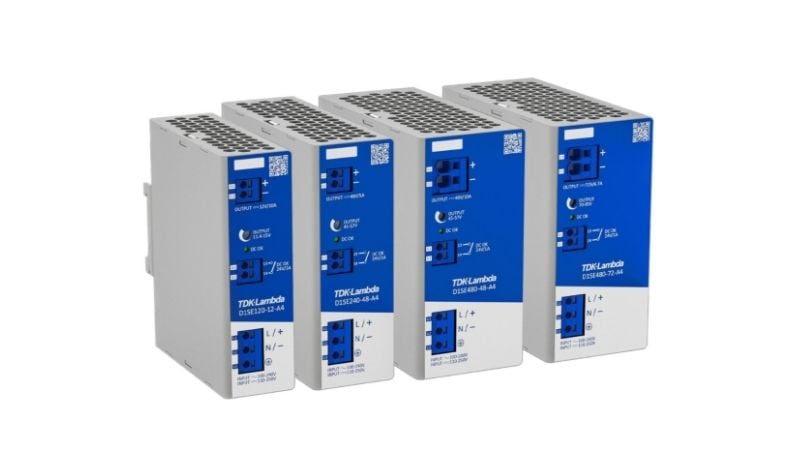
Variants of the D1SE DIN-rail mount power supplies. Image used courtesy of TDK Lambda
New Voltage Options and Target Applications
Each of the three new output voltages is aimed at a distinct market segment:
- 12 V models are geared toward PLCs, sensors, robotic arms, and security systems, applications where 12 V remains the standard supply rail.
- 48 V models are designed with industrial networking and Power over Ethernet (PoE) applications in mind, responding to the growing deployment of PoE infrastructure in factory automation and smart building environments.
- 72 V models target DC motor and drive systems, where higher bus voltages improve efficiency and reduce current draw in motion control applications.
Input Flexibility, Efficiency, Boost Capability, and Installation
The new models accept a wide AC input of 85-264 VAC and are also safety-certified for DC input operation from 93 to 300 VDC, covering both DC bus and battery-fed architectures. This gives designers flexibility without separate product qualifications for different power sources.
The D1SE delivers up to 96% efficiency across the range, cutting internal heat generation and reducing thermal stress on components such as electrolytic capacitors. Lower operating temperatures directly extend component and product service life, a meaningful advantage in installations where unplanned downtime carries a high cost.
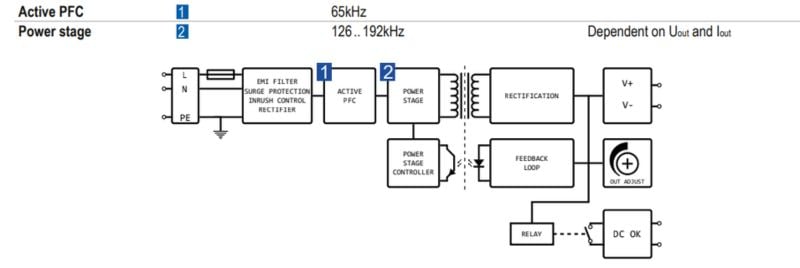
Block diagram of the D1SE480-72-AX. Image used courtesy of TDK Lambda
The D1SE series supports transient loads at up to 150% of rated output power, providing headroom for inrush events and load spikes without requiring an oversized supply. This also simplifies system retrofits where peak demand occasionally exceeds steady-state ratings.
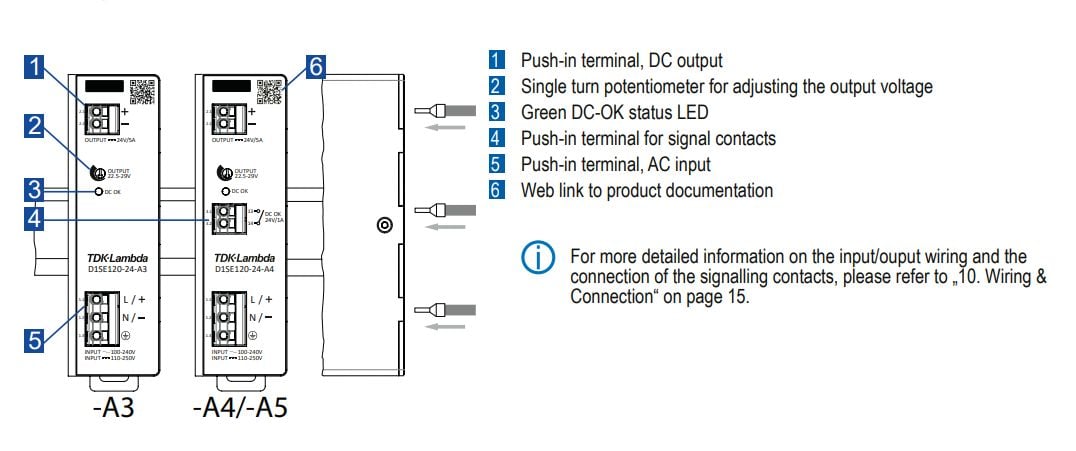
D1SE120-24-AX: Description of user elements. Image used courtesy of TDK Lambda
For installation, the series uses push-in wire terminations that reduce wiring time and support automated robotic harness insertion, a useful feature for high-volume panel assembly. For installations in harsh or high-humidity environments, a protective PCB coating option (A5) is available, which also adds a DC OK closed-contact relay for supply-status monitoring.
The series uses a compact metal chassis measuring 38 mm wide for 120 W models, 44 mm for 240 W units, and 60 mm for 480 W versions. The reduced footprint helps maximize available cabinet space for additional equipment and wiring.
Certifications and EMC Compliance
The series is certified to IEC/EN/UL/CSA 61010-1, 61010-2-201, 62368-1 (Ed. 3), and IS 13252-1 standards, while carrying CE and UKCA markings for the Low Voltage, EMC, and RoHS Directives.
It also meets EN 55011-B and CISPR 11-B conducted and radiated emissions limits. Additional compliance includes EN 61000-3-2 Class A for harmonic current emissions, IEC/EN 61000-6-2 for immunity, and IEC/EN 61000-4-5 with a 4 kVAC asymmetrical surge rating (L-PE).
All models are convection-cooled and are rated for operation in ambient temperatures from -25 to +70°C, with derating above 55°C.
Applications
The D1SE series is targeted at industrial control panels, stand-alone machinery, factory automation systems, ICT and networking equipment, Power over Ethernet (PoE) installations, renewable energy systems, and EV charging infrastructure.
The ordering information and the product datasheet are available via TDK-Lambda.
Looking Ahead
Industrial panel designs increasingly mix voltages, driven by PoE adoption, the electrification of motion systems, and the rise of distributed DC architectures. Using multiple, separately certified supply families for a single cabinet adds qualification cost and supply chain complexity. Extending a single, already-certified platform across the common industrial voltage rails is a practical response to that pressure, and one that competing vendors are likely to follow.
Whether TDK-Lambda extends the D1SE further into higher power levels or additional voltage options remains to be seen, but the current expansion positions the series as a more complete solution for mixed-voltage industrial builds.