Facebook
 Google
 GitHub
 Linkedin
Rohm Unwraps PFC + Flyback Control Reference Design
Hybrid analog-digital control design yields efficient 24 V power conversion for industrial and consumer applications.
Rohm has released its latest reference design, the REF67004, part of the company’s LogiCoA family, which integrates analog-digital hybrid control to improve efficiency and reliability in AC-DC conversion.
Analog-only supplies, long valued for simplicity and low cost, have historically struggled to provide fine-grained control and reliability. Fully digital power control, while precise, typically consumes more power and carries a higher cost. Hybrid architectures, such as LogiCoA, can provide a balance by leveraging analog-controlled MOSFET power stages while incorporating digital microcontroller-based parameter management.
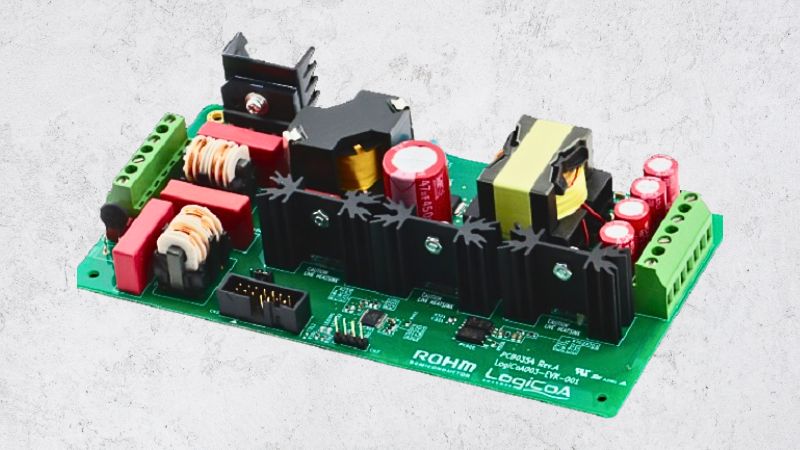
LogiCoA REF67004. Image used courtesy of Rohm
A Deep Dive into the REF67004
The REF67004 design is for a compact power solution combining critical conduction mode power factor correction (PFC) with a quasi-resonant flyback stage. It begins with a boundary conduction mode (BCM) PFC stage that boosts the AC input. This is followed by a quasi-resonant flyback converter, which provides galvanic isolation and regulates the 24 V output. The evaluation board LogiCoA003-EVK-001 supports output currents up to 4 A (≈96W) while maintaining compliance across the 85–264V AC input window.
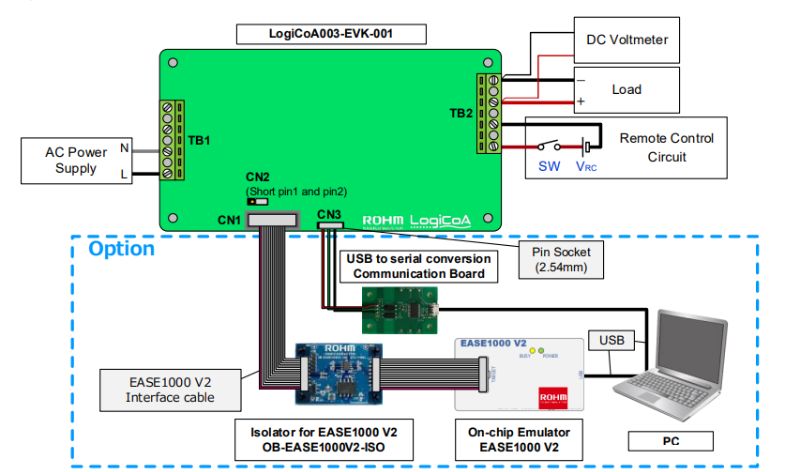
LogiCoA003-EVK-001 connection diagram. Image used courtesy of Rohm
A main feature is the hybrid control scheme. Rohm’s LogiCoA MCU (ML62Q2035) manages voltage configuration and overcurrent protection while allowing parameter adjustments via UART communication. Calibration functions account for component tolerances, offer tighter design margins, and enable the selection of smaller inductors and passives. This reduces PCB area and system cost without compromising performance.
Operational data such as voltage, current, temperature, pre-shutdown state, and cumulative runtime can be stored in non-volatile memory. This logging capability supports fault analysis and predictive maintenance strategies, and developers can access and modify control parameters through a PC interface using sample programs and the RMOS real-time micro operating system. Debugging is supported by Rohm’s EASE1000 V2 emulator with isolation safeguards to prevent high-voltage faults from reaching connected PCs.
Understanding Boundary Conduction Mode PFC
Boundary conduction mode, also known as critical conduction mode, is a technique for power factor correction that operates between continuous and discontinuous conduction. In BCM, the inductor current returns to zero at each switching cycle’s end, which minimizes switching losses compared to continuous conduction mode.
One advantage of BCM is its reduced electromagnetic interference (EMI), as the zero-current switching transition lowers voltage stress on components. The technique also simplifies current sensing since the inductor current waveform naturally reaches zero, allowing precise detection of cycle boundaries. However, BCM requires variable-frequency operation, which can complicate EMI filter design and acoustic noise management.
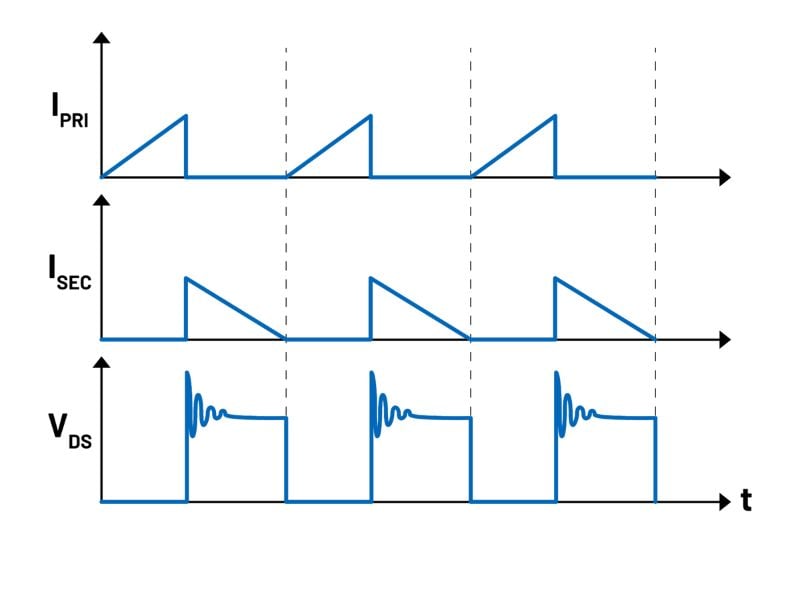
BCM waveforms. Image used courtesy of Analog Devices
In AC-DC supplies for applications under a few hundred watts, BCM PFC is frequently combined with downstream isolated converters, such as flyback topologies. This pairing supports high efficiency at light to medium loads while keeping control circuitry relatively simple. Quasi-resonant flyback converters enhance efficiency by adjusting the switching frequency in response to the load to reduce conduction and switching losses.
Hybrid Power Control in System Design
The REF67004 reference design demonstrates how hybrid analog-digital approaches can address the limitations of purely analog or digital systems. By embedding calibration, logging, and configurable protection in a low-power MCU while retaining efficient analog-controlled stages, this architecture creates new opportunities for compact and intelligent power modules.
The LogiCoA003-EVK-001 evaluation board is now available for order through online distributors, including DigiKey, Mouser, and Farnell.