Facebook
 Google
 GitHub
 Linkedin
Nexperia Debuts ESD Diodes Optimized for 48 V EV Communication
Nexperia’s first AEC-Q101 ESD protection diodes for 48 V automotive networks preserve signal integrity and save PCB space in electric and hybrid vehicle systems.
In electric and hybrid vehicles, 48 V power systems are replacing the legacy 12 V and 24 V setups of internal combustion engines. But while vehicle voltages are rising, many onboard communication protocols like CAN, LIN, and FlexRay are not. These are still operating at legacy signal levels. Protecting these data lines from electrostatic discharge (ESD) in a higher-voltage environment is challenging.
Nexperia has released a line of AEC-Q101 qualified ESD diodes purpose-built for 48 V automotive board nets, making it easier for designers to protect data lines without compromising signal integrity or increasing component count. With reverse working voltages up to 72 V and ultra-low device capacitance, these diodes offer robust protection for protocols like CAN-FD while reducing PCB footprint and simplifying designs.

The ESD diodes enable reliable 48 V automotive data line protection without compromising speed, size, or signal integrity. Image used courtesy of Nexperia
ESD Protection for the 48V Transition
While 12 V and 24 V systems dominated earlier vehicle generations, the push for better power efficiency in EVs and HEVs is making 48 V board nets more common. These networks now carry power for motors and accessories and support proven data protocols like CAN, CAN-FD, LIN, and FlexRay. The catch? Traditional ESD protection diodes often fall short at 48 V, leaving those communication lines exposed to potential failure.
_and_LIN_(right).jpg)
Single device protection system architectures for CAN (left) and LIN (right). Images used courtesy of Nexperia
Nexperia’s diode family directly addresses this issue. In the past, designers had to implement workarounds such as using additional 12 V rails or paralleling 36 V diodes, which added cost and complexity. These new devices are available in 54 V, 60 V, and 72 V VRWM variants.
Optimized for High-Speed Automotive Data Lines
The diodes achieve ultra-low capacitance levels to 3.4 pF, which is critical for preserving signal integrity in high-speed communication interfaces like CAN-FD. In modern EV architectures, they’re responsible for real-time functions such as advanced driver-assistance systems, dynamic battery management, and multi-sensor data fusion. In these applications, even minor signal distortion can lead to miscommunication between modules or degraded performance over time.
Despite their low capacitance, the devices don’t compromise on robustness. Each ESD diode in the lineup is rated for up to 30 kV contact discharge protection, tested to IEC 61000-4-2 standards. This protection level guards against routine static discharges and more severe ESD events caused by maintenance or environmental factors. In addition, the portfolio meets ISO 7637-2 standards for automotive transient immunity, with ratings of ±300 V for pulse 3a/3b and up to +100 V for pulse 2a. This ensures stability even in noisy automotive environments where voltage spikes and dips are common.
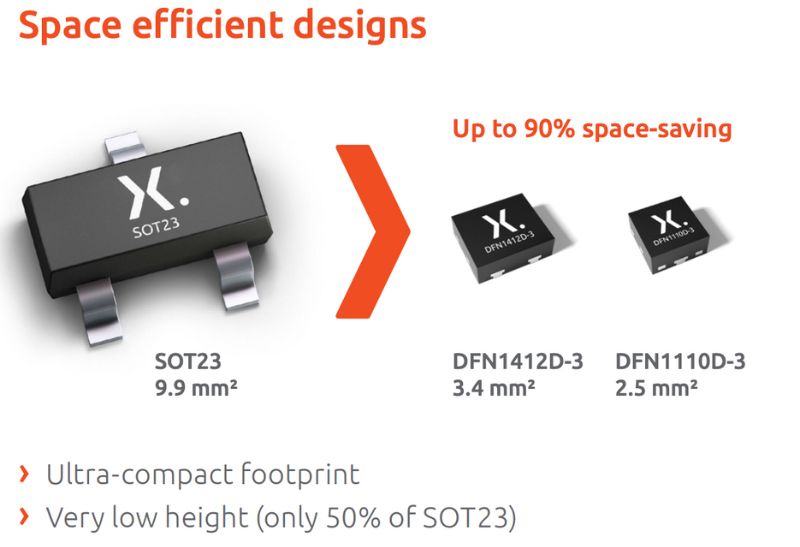
A compact SOT23 package is ideal for space-constrained automotive ECUs. Image used courtesy of Nexperia
Physically, the diodes are offered in the compact SOT23 footprint, a proven standard across automotive platforms. This helps engineers save PCB real estate, particularly in densely packed electronic control units, while still meeting strict layout and creepage requirements. The small size, combined with high electrical performance, makes these diodes especially well-suited for distributed network protection across a 48 V vehicle architecture.
Designed for EVs, Backed by Automotive-Grade Reliability
All six devices in the lineup are AEC-Q101 qualified and optimized for automotive reliability. Thanks to their higher reverse working voltage, these diodes are a strong fit for 48 V EV systems and can protect data lines reliably across a range of protocols, whether it's CAN, LIN, or FlexRay.
From CAN/CAN-FD and LIN to FlexRay and SENT, the diodes can be deployed across the board for ESD protection in battery management systems, control units, and gateway modules. They’re also forward-compatible with the growing complexity of in-vehicle networking brought on by electrification and software-defined vehicles.
As automakers shift toward 48 V architectures to support more efficient power distribution in EVs and hybrids, protecting sensitive communication lines becomes more complex. Nexperia’s latest ESD diodes give engineers a practical fix for a growing problem: protecting 48 V communication lines without overcomplicating the design. Instead of stacking lower-voltage components or adding an extra power rail, designers now have a clean, purpose-built option. These parts are small, fast, and robust, which makes it easier to keep legacy networks like CAN and LIN running smoothly in modern EV systems.