Facebook
 Google
 GitHub
 Linkedin
MOSFET Advances Sweep the Automotive Power Electronics Industry
These advancements aim to reduce the footprint of MOSFETs while increasing power density and efficiency.
As automotive systems become more advanced, there is heightened demand for components that can deliver higher performance in smaller, more efficient designs. Applications such as electric motors and advanced driver assistance systems (ADAS) require reliable power management solutions to minimize heat and power loss.
Advancements in semiconductor technologies, particularly MOSFETs, are a central tenet of meeting the evolving demands of automotive power electronics. The industry has made numerous breakthroughs to make MOSFETs more power-dense, efficient, and affordable.
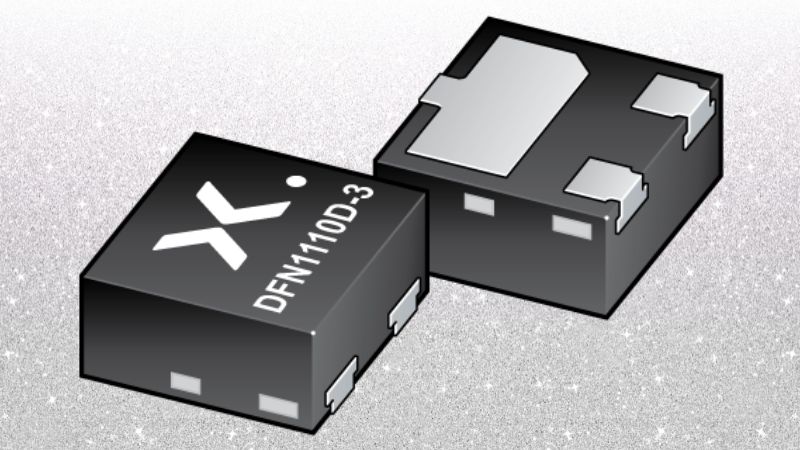
Nexperia’s DFN1110D-3 package. Image used courtesy of Nexperia
Nexperia’s Thermal Efficiency in a 1 mm Package
Nexperia announced automotive-qualified small-signal MOSFETs in the DFN1110D-3 (1.1 mm x 1 mm) and DFN1412-6 (1.4 mm x 1.2 mm) packages.
The challenge spurring this invention was the need for smaller, more efficient MOSFETs in high-density automotive circuits where space and heat dissipation are critical. To this end, the DFN packages feature significantly reduced thermal resistance, up to 50% lower than traditional packages like SOT23, while decreasing size by up to 80%. Moreover, the DFN1110D-3 package incorporates side-wettable flanks, which improves reliability in automated optical inspections and reduces assembly costs.
These MOSFETs are part of Nexperia’s Q-portfolio, meaning they meet AEC-Q101 standards while offering extended service life with a guaranteed longevity of more than 10 years. With over 100 products available in DFN1110D-3 and 43 in DFN1412-6, Nexperia claims to hold the industry's largest portfolio of devices in these formats.
Magnachip's MOSFETs for Modern Automotive Motors
Magnachip Semiconductor has introduced four 40 V MXT MV MOSFETs optimized for automotive applications.
These MOSFETs are packaged in Power Dual Flat No-Lead (PDFN) 33, reducing their area by more than 60% and weight by approximately 75% compared to the standard PDFN56 package. According to Magnachip, this miniaturization results in better space utilization and enhances fuel efficiency.
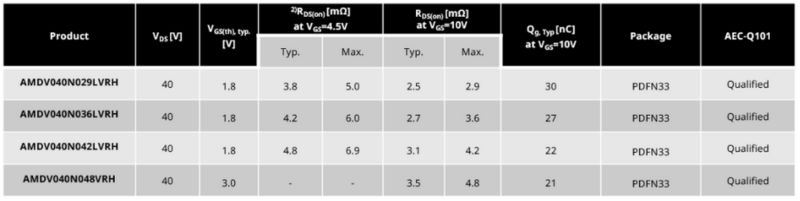
Magnachip’s automotive 40 V MXT MV MOSFETs. Image used courtesy of Magnachip
Along with minimal on-state resistance (as low as 3.8 milliohms), a notable feature of these MOSFETs is their low gate threshold voltage of 1.8 V. Such a low threshold and on-resistance combination equates to improved energy consumption via reduced conduction losses and the ability to efficiently switch between on and off states.
Flagship models in the family include the AMDV040N029LVRH, a solution boasting 40 V voltage operation, 2.9 mΩ on-state resistance, and 80 A sustained currents.
Infineon’s Latest MOSFETs for Industrial Use
Infineon Technologies has expanded its StrongIRFET 2 power MOSFET portfolio with the 30 V series.
Designed to address mass-market applications requiring high efficiency and robustness in industrial switched-mode power supplies, motor drives, battery-powered systems, and uninterruptible power supplies, the MOSFETs offer a 40% improvement in RDS(on) and a 60% reduction in gate charge (Qg) compared to previous StrongIRFET generations. The 30 V StrongIRFETs are available in TO-220 packages, with additional packaging options like DPAK, D²PAK, PQFN, and SuperSO8 to be released by the end of 2024.
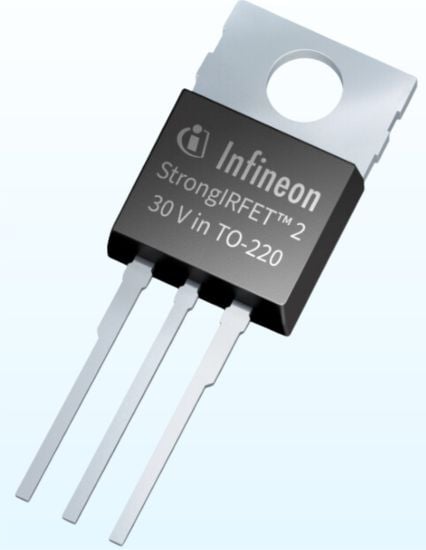
Infineon’s StrongIREFT MOSFET in TO-220 package. Image used courtesy of Infineon
ROHM’s Low On-Resistance MOSFETs
Finally, ROHM has launched a series of N-channel MOSFETs with higher mounting reliability for automotive applications.
The FETs, the RF9x120BKFRA/RQ3xxx0BxFRA/RD3x0xxBKHRB, include 10 models at launch. With 40 V, 60 V, and 100 V, these MOSFETs employ a split-gate structure that partitions the FET’s gate into multiple parts to control the current flow through the device more precisely. The result is improved reliability and speed of operation.
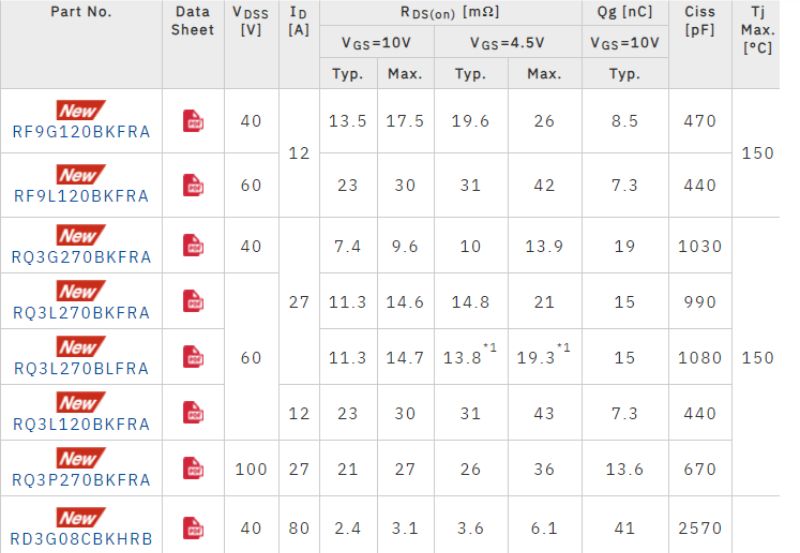
ROHM’s product lineup. Image used courtesy of ROHM
The products in this family are all qualified under the AEC-Q101 reliability standard and come in three package types: the compact DFN2020Y7LSAA (2.0 mm × 2.0 mm) and HSMT8AG (3.3 mm × 3.3 mm) for space-constrained systems like ADAS, and the larger TO-252 (6.6 mm × 10.0 mm) for higher-power automotive applications.
Mass production of the DFN3333 (3.3 mm × 3.3 mm) and HPLF5060 (5.0 mm × 6.0 mm) packages is set for October 2024, with 80 V models following in 2025. Future releases will include P-channel MOSFETs.
Future Implications
The ongoing refinement of MOSFET technology is a clear shift in how power electronics will evolve to meet the demands of next-generation vehicles. As automotive systems become more interconnected and power-intensive, engineers will increasingly rely on smaller, more efficient solutions to maintain performance without compromising space or thermal management. These developments hope to address current challenges and open the door to more sophisticated power management techniques that can support the future of fully autonomous and electric vehicles.
Related Content