Facebook
 Google
 GitHub
 Linkedin
Microchip’s Industrial Midspan Unlocks PoE for Legacy Networks
The PoE solution injects IEEE 802.3bt power onto existing Ethernet runs and operates from -40°C to 75°C, targeting factory and outdoor deployments where switch upgrades are impractical.
Microchip Technology has released the PD-9601GCI, an industrial-grade Power over Ethernet midspan that delivers up to 90 W under the IEEE 802.3bt standard while passing 10/100/1000 Mbps data over a single Ethernet cable.
The company positions the single-port unit as a plug-and-play way to power industrial IoT equipment in factories and outdoor sites without replacing or upgrading existing network switches.
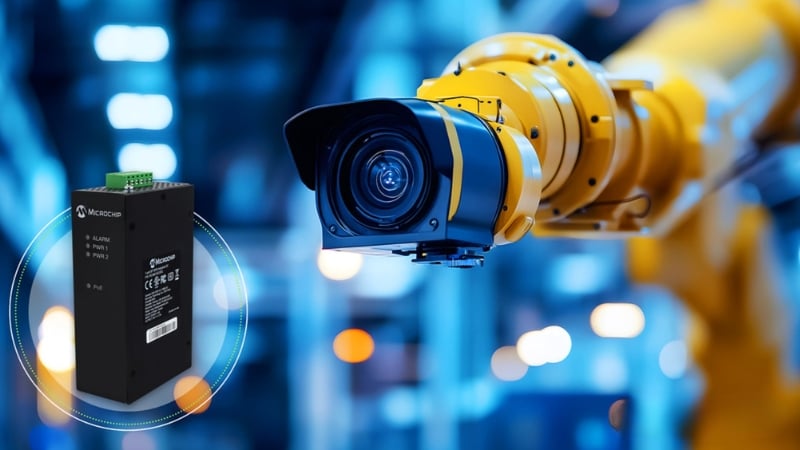
Microchip designed the single-port PoE solution to remotely power high-power indoor applications. Image used courtesy of Microchip
Power Injection Without Switch Upgrades
A midspan device sits between the network switch and the powered device, injecting DC power onto the Ethernet line. This allows a single cable to carry both power and data to the endpoint.
The approach solves a common deployment problem: many installed networks run on switches that were never provisioned for PoE, and swapping them out to power a handful of new devices is costly and disruptive. Inserting a midspan on only the ports that need power leaves the rest of the network untouched, and it spares the alternative of pulling dedicated AC circuits to each endpoint, which requires an electrician, conduit, and often a local outlet where none exists.
The Merits of Midspan
Under 802.3bt, the highest PoE power class delivers power over all four pairs of the Ethernet cable. This is how the standard reaches 90 W at the power sourcing equipment, where the earlier 802.3af and 802.3at standards topped out at 15.4 W and 30 W. The midspan negotiates power delivery with the connected device, so standard lower-power endpoints such as sensors and IP phones remain safe to connect.
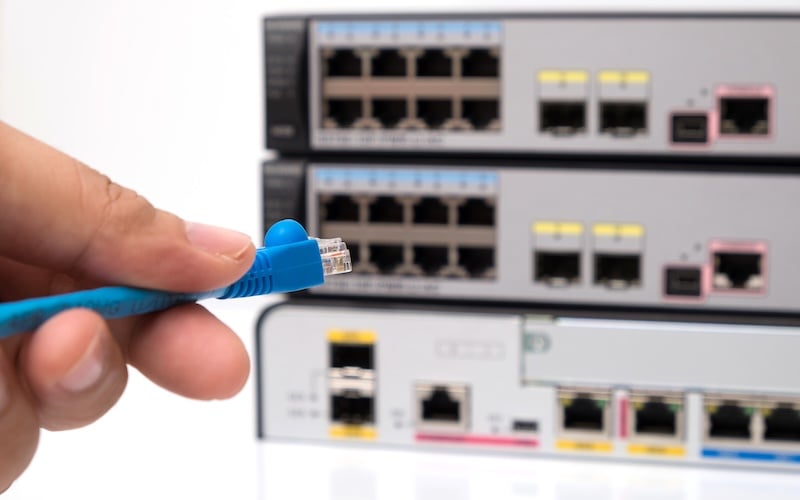
The new 90-W midspan enables device deployment without switch replacements or upgrades. Image used courtesy of Adobe Stock
The PD-9601GCI extends Microchip's existing range of single- and multi-port PoE solutions—spanning PSE chipsets, PD chipsets, and complete PoE systems. The company has worked in PoE for more than 25 years and helped standardize IEEE 802.3af, 802.3at, and 802.3bt. The new unit is distinguished from Microchip's existing single-port indoor midspan, the PD-9601GC, by its industrial-grade construction and environmental ratings.
At 90 W, the midspan operates at the top of the 802.3bt power range—enough headroom for things like pan-tilt-zoom cameras with motorized assemblies, industrial wireless access points, displays, and edge computing devices that earlier 30-W and 60-W PoE classes couldn’t support.
Built for Industrial Temperatures
The industrial designation rests on a specific set of hardening measures. The electronics sit in a sealed, vibration-resistant metal enclosure rated IP30. The unit sustains operation across a -40°C to 75°C temperature range, covering unheated factory floors, outdoor cabinets, and enclosures that bake in direct sun. Enhanced surge protection guards against the voltage spikes common on industrial power and cabling infrastructure.
Power input is notable for the segment, with the midspan accepting dual DC inputs across a 20-V to 60-V range, allowing it to run from the 24-V and 48-V DC supplies already standard in industrial control cabinets and providing input redundancy if one supply fails. That distinguishes it from typical AC-powered indoor midspans, allowing integrators to treat the unit as another DIN-rail component fed from the cabinet's existing power distribution. Mounting options include DIN rail, wall, and panel configurations.
Features for Streamlined Deployment
Microchip also performs compatibility testing with industrial automation devices, which the company says reduces integration and reliability issues for equipment manufacturers. In practice, PoE interoperability failures tend to surface only after deployment, when a powered device and power source disagree over classification or inrush behavior; pre-validated pairings carry real weight in installations that are expensive to revisit.
As for private label, that points toward OEMs bundling the midspan with their own equipment. A machine vision camera or access point vendor can ship the unit under its own brand, turning a product that would otherwise require an electrician into a single-box, single-cable installation. For remote or challenging factory and outdoor locations, this reduces both deployment cost and the downtime and support issues that follow from custom electrical work.