Facebook
 Google
 GitHub
 Linkedin
Intepro Intros 4U DC Power Supplies With 12.5 kW/U Power Density
The new series of programmable 4U DC power supplies combines auto-ranging source capabilities with an energy-recovering electronic load to maximize rack space and efficiency.
Intepro Systems has announced its ANEVH(F) Series programmable bidirectional DC power supplies. The primary engineering milestone of this hardware family is its industry-leading power density, which packs up to 50 kW of bidirectional capacity into a standard 4U rack-mount chassis.
By yielding a power density of up to 12.5 kW per rack unit (kW/U), the instruments significantly compress the required floor space and rack infrastructure for high-capacity industrial, commercial, and laboratory test environments.
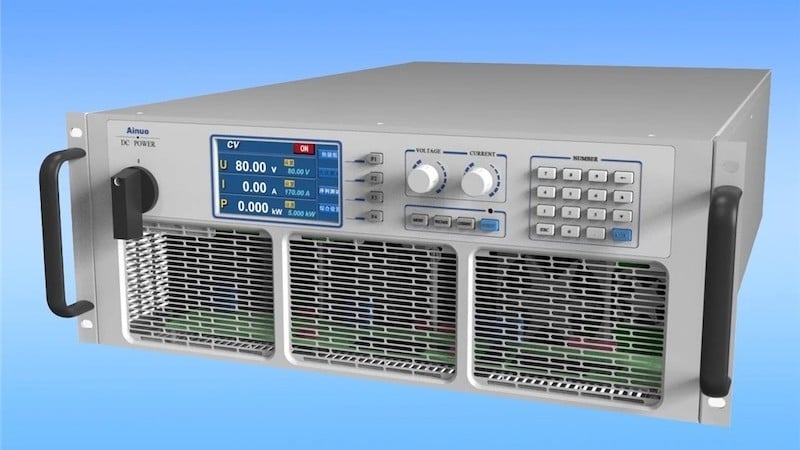
Intepro's Aniuo ANEVH bi-directional, programmable power supply
Bidirectional Topography and Grid Regeneration
The ANEVH(F) Series integrates a fully programmable digital DC power source and a regenerative electronic load into a unified two-quadrant system architecture. Unlike conventional test setups that demand individual sourcing and sinking instruments—adding complex multi-chassis routing, high parasitic impedances, and thermal management overhead—this unified topology handles both roles seamlessly. Built-in energy flow controls execute automatic, seamless switching between forward (source) and reverse (sink) current states, with transition times clocked as low as 1.4 ms.
When configured as a sink to mimic an electronic load, the device utilizes a blend of high-frequency PWM rectification and bidirectional DC-DC conversion to filter and return absorbed power cleanly to the local three-phase AC grid.
The architecture achieves a regenerative feedback efficiency of up to 95% and maintains a power factor of ≥0.99 under rated power conditions. This design minimizes the total thermal dissipation inside the testing laboratory, dropping localized HVAC cooling costs and lowering utility demands during long-duration duty-cycle testing.
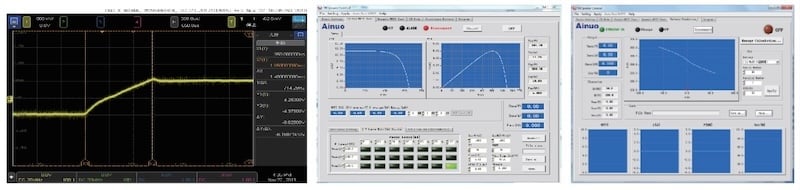
The ANEVH(F)’s switch time from maximum reverse current to maximum forward current is as low as 1.4 ms.
The high-frequency PWM design significantly mitigates the audible noise typical of heavy-duty power equipment, qualifying it as a quiet-operating instrument (≤65 dB(A) at a 2-meter measuring distance). More information can be found in the ANEVH(F) data sheet.
Voltage Configurations and Parallel Scalability
To meet the operating requirements of next-generation higher-voltage batteries and industrial microgrids, the ANEVH(F) architecture spans seven broad voltage tiers up to an industry peak of 2250 V. The 4U chassis segment comprises several standalone models optimized for high power and high current density:
- ANEVH80-680(F): 80 V / ±680 A / 20 kW
- ANEVH80-1020(F): 80 V / ±1020 A / 30 kW
- ANEVH300-450(F): 300 V / ±450 A / 50 kW
- ANEVH500-390(F): 500 V / ±390 A / 50 kW
- ANEVH750-300(F): 750 V / ±300 A / 50 kW
- ANEVH1000-150(F): 1000 V / ±150 A / 50 kW
- ANEVH1500-130(F): 1500 V / ±130 A / 50 kW
- ANEVH2250-100(F): 2250 V / ±100 A / 50 kW
For macro-level multi-megawatt evaluations, Intepro’s high-voltage series connection technology is paired with standard master-slave parallel operations. Test engineers can link multiple units together to scale up total system power to a maximum of 1 MW.
It’s important to note that scaling the hardware does not dilute its high precision. The series maintains a programming accuracy voltage setup error of ≤0.05% F.S. and a read-back measurement accuracy of ≤0.05% F.S. for voltage and ≤0.1% F.S. for current.
Embedded Simulation Modes and Interconnectivity
Beyond linear sourcing and sinking, the ANEVH(F) includes an integrated arbitrary function generator capable of generating complex, custom voltage and current profiles. The system features built-in automotive test standards, including pre-programmed voltage curves for DIN 40839, ISO 16750-2, and ISO 21848 protocols. These features permit drop-in simulation of automotive transients, making it highly applicable for testing EV powertrain controllers, battery management systems (BMS), and on-board chargers (OBC).
For green-energy testing, the instruments feature dedicated solar array simulation software. The system can map out solar battery I-V curves under variable temperature and illumination conditions to accurately verify the Maximum Power Point Tracking (MPPT) performance and conversion efficiency of grid-tied photovoltaic inverters. Battery simulation functionality is similarly integrated, allowing engineers to load custom output curves that emulate specific battery chemistries during charge and discharge validation.
The electronic load operating mechanics support eight distinct modes: constant voltage (CV), constant current (CC), constant power (CP), constant resistance (CR), and complex multi-mode matrices such as CV+CC, CV+CR, CC+CR, and a fully combined CV+CC+CP+CR mode.
System monitoring and adjustments are executed via a front-panel 4.3-inch color LCD touch interface or remote orchestration software. Hardware interconnectivity features standard RS232, RS485, CAN, LAN, and USB interfaces, with an optional GPIB card available for integration into legacy Automated Test Equipment (ATE) racks. Hardware protection features include over-temperature (OTP), over-voltage (OVP), over-current (OCP), and over-power (OPP) parameters.
Intepro says the ANEVH(F) Series is priced starting at $8,730 with availability of 6-8 weeks.
All images used courtesy of Intepro Systems.