Facebook
 Google
 GitHub
 Linkedin
Design and Sustainability Strategies for Advanced High Power IGBT Modules
IGBT modules must optimize losses and reliability to meet green energy demands, using sustainable, lead-free manufacturing and high-density trenchgate architectures.
This article is published by EEPower as part of an exclusive digital content partnership with Bodo’s Power Systems.
The global transition toward renewable energy and electric mobility is driving unprecedented demand for high-performance power electronics. As system designers strive to meet growing demand, power semiconductor suppliers must deliver innovative solutions that not only enhance system performance but also address sustainability challenges.
Power electronic converters used in rail traction, renewable energy generation, electrified transport and industrial applications are increasingly required to operate at higher current densities while maintaining high efficiency and predictable lifetime. Rising DC link voltages, more challenging thermal demands and extended mission profiles mean that semiconductor losses, junction temperature and robustness under abnormal conditions all have a direct influence on the overall system performance.
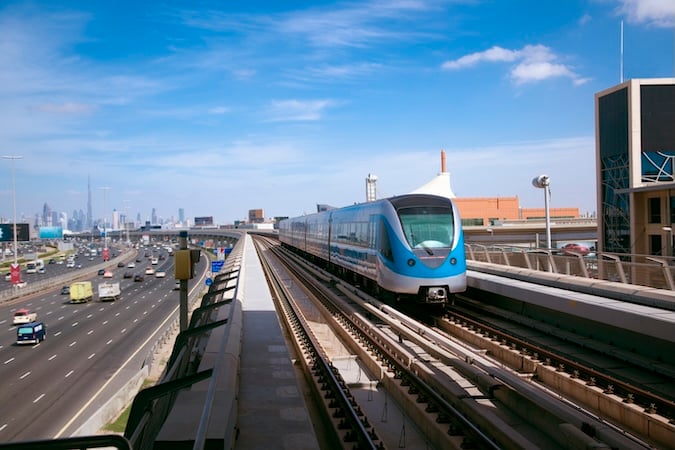
Image used courtesy of Freepik
IGBTs remain the dominant switching technology in the medium and high-power range; however, device selection is no longer driven solely by voltage and current ratings. Instead, designers must consider application losses, cooling requirements, overload capability, and long-term reliability together at the system level.
This article discusses typical technical challenges encountered in high-power converter design and illustrates how these can be addressed using modern IGBT module technologies.
Losses and Thermal Behavior in Rail Traction Applications
Rail traction inverters represent one of the most demanding applications for IGBT modules. In addition to high continuous power and repetitive thermal cycling, devices need to be able to withstand voltage disturbances, overload conditions, and challenging ambient temperature and humidity.
Figure 1 shows simulation results for a 2.1 MW three-phase traction inverter using a 3.3 kV / 1500 A IGBT module. The Dynex module is compared against two equivalent modules from other suppliers under identical operating conditions. The resulting loss analysis indicates lower total power dissipation for the Dynex module across the examined switching frequency range.
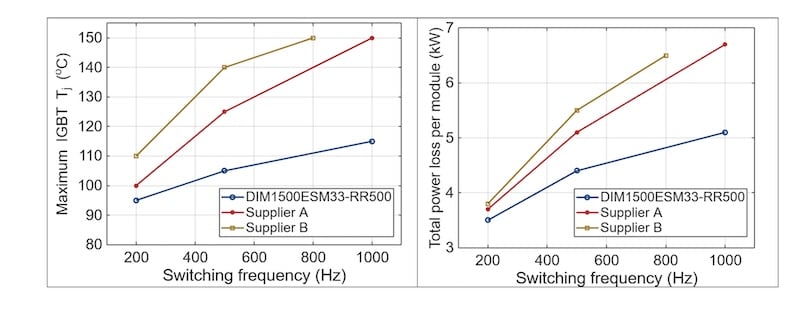
Figure 1. Simulated total losses and junction temperature for a 2.1 MW rail traction inverter using 3.3 kV / 1500 A IGBT modules. Image used courtesy of Bodo’s Power Systems [PDF]
From a practical design standpoint, reduced losses translate into lower peak junction temperatures or, alternatively, reduced cooling requirements for the same operating point. In both cases, increased thermal margin supports improved reliability and longer service intervals, which are primary objectives in rail systems. In addition, the lower losses translate into reduced energy wastage, providing a more sustainable and lower running cost solution.
From Planar to Advanced Trench Architectures
Advances in IGBT chip design have a significant impact on converter performance, particularly at high power levels. Traditional planar IGBTs offer proven robustness but are limited in achievable current density. More recent trenchgate structures have made available reduced conduction losses while increasing current density.
This advancement is illustrated in Figure 2 through comparison of a 3300 V / 1500 A fourth-generation planargate module with a Dynex fifth-generation trenchgate 3300 V / 2400 A module in the same 2.1 MW traction inverter.
Simulation results show a reduction in total losses of approximately 18 %, corresponding to an overall drivetrain efficiency improvement of more than 0.7 %. For the system designer, these gains can be used to increase converter output power, leading to lower system cost per MW, or operate at lower average junction temperature, leading to improved lifetime and reduced running costs.
Environmental and Manufacturing Considerations
In parallel with performance requirements, environmental compliance has become an integral part of semiconductor design and manufacturing. Lead-free assembly, in particular, presents challenges in maintaining mechanical robustness under high thermal cycling conditions.
For example, all Dynex semiconductor products manufactured in the UK are lead-free, while maintaining compliance with reliability and lifetime expectations in demanding applications. Manufacturing processes are supported by ISO 14001 and ISO 50001 certified environmental and energy management systems. Investments in on-site photovoltaic generation, lighting upgrades and energy-efficient infrastructure reduce manufacturing energy intensity and contribute to overall product sustainability.
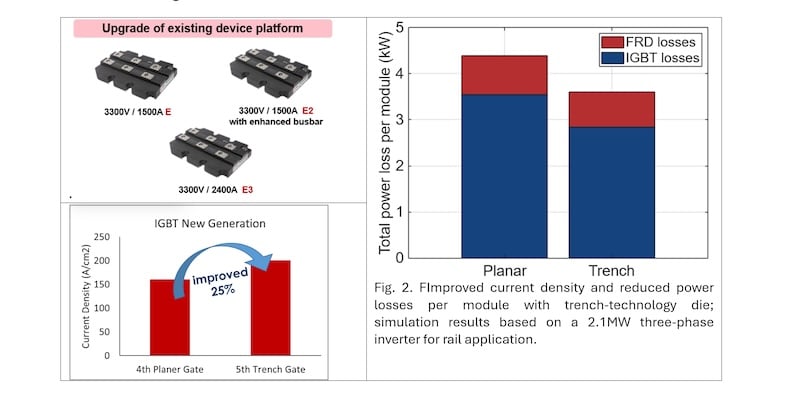
Improved current density and reduced power losses per module with trench-technology die; simulation results based on a 2.1MW three-phase inverter for rail application.
Figure 2. Comparison of planar and trenchgate IGBT modules in a 2.1 MW traction inverter. Image used courtesy of Bodo’s Power Systems [PDF]
Conclusion
The design of modern high-power converters requires careful optimization of semiconductor losses, thermal behavior and reliability within increasingly constrained system environments. Developments in trenchgate IGBT technology, higher temperature capability and functional integration provide additional tools for addressing these challenges.
By evaluating device performance within the context of realistic application requirements rather than focusing solely on isolated component parameters, IGBT modules can be selected and utilized in a way that optimizes the balance between efficiency, robustness and lifetime.
This article originally appeared in Bodo’s Power Systems [PDF] magazine.