Facebook
 Google
 GitHub
 Linkedin
Infineon, STMicro Improve MOSFET SOA
The MOSFETs are targeted for automotive and industrial power electronics.
Safe operating area (SOA) defines the permissible limits of voltage, current, and power dissipation that a device, such as a MOSFET, can handle without failure. In high-power systems, MOSFETs face continual electrical stress due to switching at high currents and voltages. Reliable operation on the system level necessitates individual components with robust SOA, especially in harsh environments like automotive and industrial systems.
In response to these challenges, STMicroelectronics and Infineon Technologies have introduced MOSFET advances to improve performance and SOA.
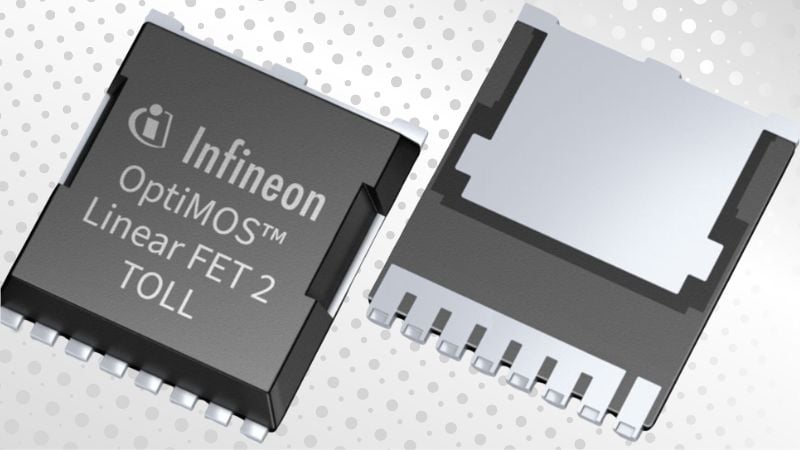
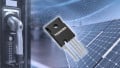
OptiMOS LInear FET 2. Image used courtesy of STMicroelectronics
ST’s STripFET F8 MOSFETs
STMicroelectronics has introduced the industrial-grade STL300N4F8 and automotive-grade STL305N4F8AG MOSFETs. Built from ST’s STripFET F8 technology, the devices combine enhanced trench gate technology with superior noise immunity to deliver outstanding performance in power applications while maintaining a robust SOA.
Both devices support 40 V drain-source voltage, around 300 A of current, exhibit a low RDS(on) of 1.1 mΩ, and offer a high thermal tolerance, with a maximum junction temperature of 175°C. The devices support a total power dissipation of 167 W and a single pulse avalanche current of 60 A. SOA analysis for both devices reveals that with a pulse width of 1 microsecond, they can handle approximately 1,000 A at 0.1 V and about 10 A at 100 V.

SOA for the STL300N4F8 and STL305N4F8AG. Image used courtesy of STMicroelectronics
ST claims that these devices offer an industry-leading figure of merit and that the STripFET F8 technology allows a smaller die size. For these reasons, ST states the devices are best suited for applications like DC-DC converters, motor drives, and emission control systems.
Infineon’s Linear FET 2 MOSFETs
In linear-mode applications like hot-swap, where electronic components are connected to a live system without interrupting its operation, the MOSFET’s switching is intentionally slowed to limit the inrush current. During the switching phase, the simultaneous presence of high drain current and substantial drain-source voltage leads to considerable power dissipation within the MOSFET, necessitating wider SOA and perfect linear-mode operation. Once the switching phase is complete, the MOSFET transitions to continuous operation in the ON state.
To ensure overall efficiency (in switching state and ON state), MOSFETs used in such applications must combine robust linear-mode performance with exceptionally low RDS(on) to minimize power loss during steady-state operation. However, modern trench MOSFETs with low RDS(on) usually have narrower SOA. On the other hand, the planar MOSFET technology features a wider SOA but lower values of RDS(on).
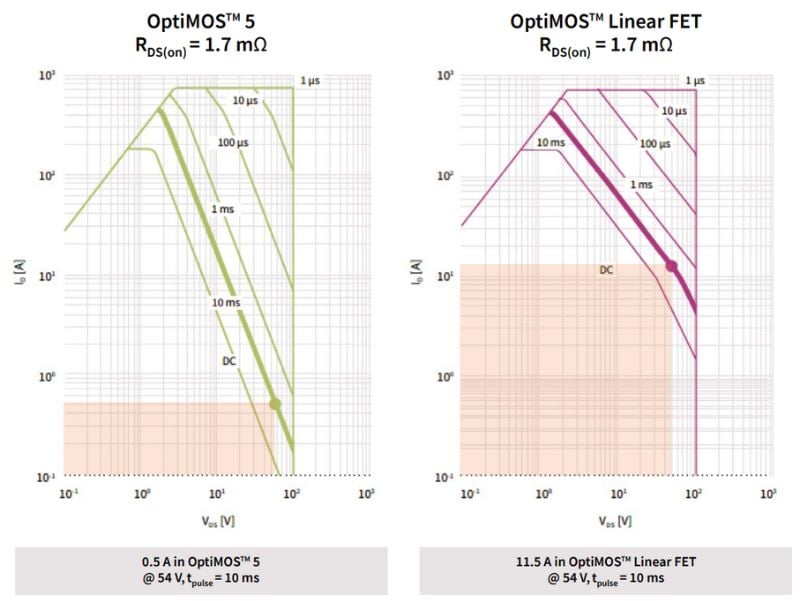
Comparing SOAs of Infineon’s old and new MOSFET technologies. Image used courtesy of Infineon
Infineon’s OptiMOS 5 Linear FET 2 is engineered for hot-swap and battery protection applications by balancing trench MOSFETs' low RDS(on) with the broad SOA of planar MOSFETs.
According to the company, this 100 V device, available in a TO-leadless package, delivers a 12 times higher SOA at 54 V (10 ms) and a 3.5 times improvement at 100 µs compared to similar RDS(on) devices. Moreover, wider SOA and enhanced current-sharing capability help designers reduce the need for parallel components by up to 60%. With reduced gate leakage, better power density, better thermal performance, and design flexibility, the design may be best suited for applications like e-bikes, forklifts, and battery-powered vehicles.
SOA Improvements
SOA is an instrumental metric for power MOSFETs, and Infineon and ST are pushing their boundaries with their new releases. By providing safer operation without sacrificing performance, the companies’ MOSFETs might be a component of choice for power electronics engineers.