Facebook
 Google
 GitHub
 Linkedin
Infineon Intros 1300 V SiC Module Capable of 205°C Continuous Operation
A new automotive silicon carbide power module pushes thermal boundaries to enhance electric vehicle traction inverter density and streamline cooling system demands.
Infineon has introduced a new 1300 V silicon carbide module within its HybridPACK Drive family, marking a significant milestone in power electronics for electric vehicle traction inverters. The primary advancement of this module is its ability to support continuous operation at junction temperatures up to 205°C.
Traditional silicon carbide power module designs typically cap continuous operation at 175°C. Pushing this thermal threshold higher allows automotive manufacturers and tier-one suppliers to extract greater performance from existing inverter footprints.
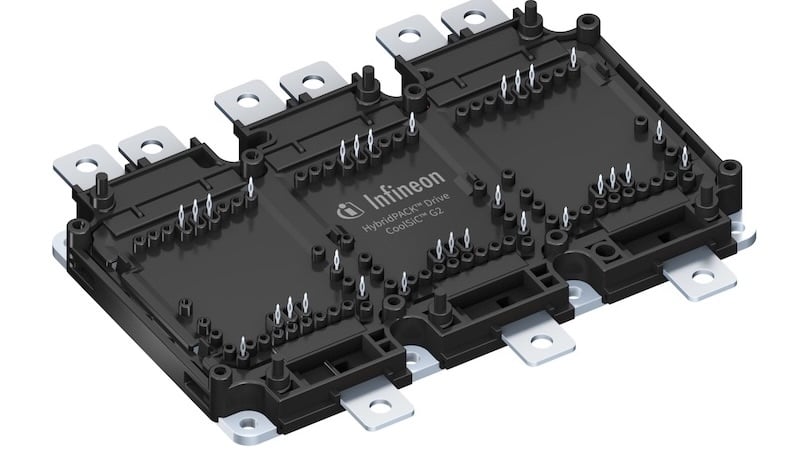
Infineon’s 1300 V HybridPACK Drive SiC module with 205°C operating temperature
Operating at elevated temperatures directly impacts the current-carrying capability of the semiconductor switches. By validating the module for continuous operation at 205°C, the device can deliver up to a 15 percent increase in output current compared to standard 175°C designs.
This current expansion translates directly into higher power density within the inverter assembly, giving engineers the flexibility to output higher peak and continuous power without increasing the overall physical size of the system.
Voltage Architecture and Drop-In Compatibility
In addition to its thermal robustness, the module introduces a 1300 V blocking voltage rating to the HybridPACK Drive family. This blocking capability is tailored to satisfy the requirements of next-generation electric vehicle architectures operating beyond 900 V battery systems. The increased voltage headroom improves the overall efficiency, safety margins, and robustness of high-voltage inverter topologies, ensuring reliable performance under strenuous switching conditions.
A critical engineering benefit of the new module is its drop-in compatibility. The module—product name FS01M9R13A7MA2B—maintains the exact size, physical footprint, and electrical interfaces of existing products within the HybridPACK Drive portfolio. This allows automotive design teams to integrate the high-temperature module into current inverter platforms seamlessly.
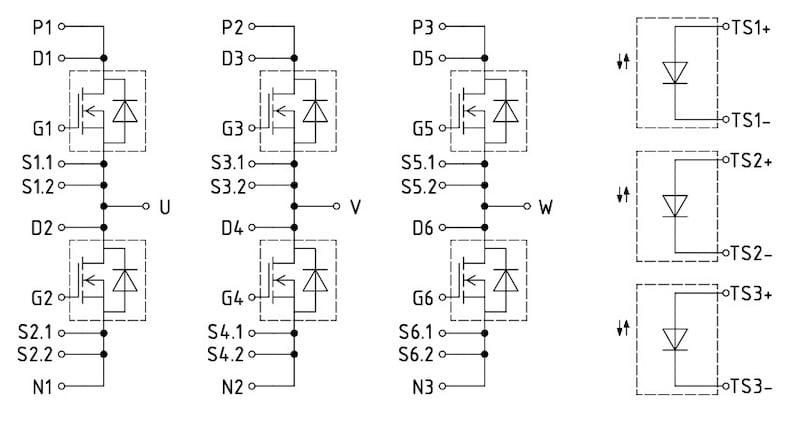
Circuit diagram of the 1300 V HybridPACK Drive SiC module
By avoiding costly mechanical redesigns and protracted development cycles, original equipment manufacturers can accelerate their time-to-market while utilizing proven, automotive-grade manufacturing and qualification standards. More information can be found in the FS01M9R13A7MA2B data sheet.
Streamlining Vehicle Weight and Cooling Demands
The capacity to tolerate higher junction temperatures alters the design trade-offs associated with thermal management. Because the power module can run hotter without compromising reliability, the constraints placed on the vehicle's cooling loop can be relaxed. Thermal engineers can optimize the system by utilizing smaller, lighter, or less mechanically complex cooling mechanisms, which directly lowers total system costs and drops overall vehicle weight to boost driving efficiency.
In conventional power electronics design, maintaining a junction temperature below 175°C requires an aggressive thermal management strategy, often necessitating dedicated low-temperature radiator loops, high coolant flow rates, and bulky heat exchangers.
Raising the allowable continuous operating temperature to 205°C significantly increases the thermal gradient between the silicon carbide dies and the liquid coolant. This larger temperature differential allows for more effective heat rejection per unit area, meaning the heat exchanger can be physically downsized while still managing the thermal losses of the inverter under peak load conditions.
Reducing the dependency on oversized cooling structures has a cascading positive effect on the entire vehicular architecture. Heavy aluminum cooling plates, high-capacity fluid pumps, and extensive plumbing add parasitic weight and consume valuable structural space within the drivetrain chassis.
By mitigating these requirements, automotive engineers can shave critical pounds off the vehicle's total curb weight. The resulting reduction in mechanical mass directly enhances the overall energy efficiency of the vehicle, lowering the energy consumption per mile and maximizing the practical driving range from the onboard battery pack.
New Integration Options
This thermal flexibility also opens up new possibilities for system integration. Inverters utilizing these high-temperature modules can potentially share cooling resources with other high-power components, such as the electric motor itself, or operate reliably in environments with higher ambient temperatures.
The ability to simplify the cooling topology not only curtails structural weight but also eliminates potential points of failure within the liquid cooling network, thereby reinforcing long-term system reliability in demanding automotive environments.
According to Infineon, this power module represents a highly compelling step forward for electric drivetrain design. It is fascinating to see how lifting the thermal ceiling to 205°C opens up immediate performance upgrades for high-voltage platforms without requiring complete architectural overhauls.
Moving forward, this hardware is ideally suited for high-power electric vehicle traction inverters, commercial and agricultural transport systems, and multi-kilowatt motor drives looking to maximize power density while shedding excess cooling weight.
All images used courtesy of Infineon.