Facebook
 Google
 GitHub
 Linkedin
Hybrid Supercaps Offer Higher Energy Densities for Tight Spaces
Tecate Group’s lithium-ion capacitors have higher energy density and wider capacitance range for board-level backup power and energy storage applications in space-constrained systems.
Tecate Group is expanding its portfolio of lithium-ion capacitors with the TPLCE product series. The capacitors offer higher energy density cells with a wider capacitance range for board level back-up and pulse power applications demanding a small form factor and an extended, maintenance-free operating life.
The TPLCE series of LICs features volumetric energy densities twice that of Tecate’s current TPLC series. The hybrid supercapacitors are rated at 3.8 VDC and available with nominal capacitance values ranging from 3 F to 1,400 F.
UL-recognized and ROHS compliant, the TPLCE cells operate over extended temperature ranges of -25°C to +70°C and demonstrate only modest ESR (equivalent series resistance) increases at lower temperatures.
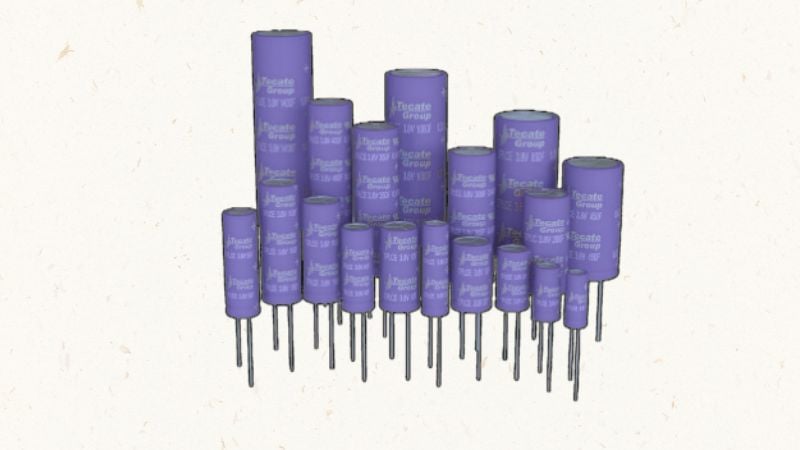
TPLCE series lithium-ion capacitors. Image used courtesy of Tecate
Lithium-Ion Capacitors
Lithium-ion capacitors (LIC), called hybrid supercapacitors, are like ultracapacitors but can store significantly more energy within the same volumetric area. Like an ultracapacitor, LICs have an activated carbon anode. However, LICs use a lithium-doped carbon material for its cathode, allowing for much greater energy densities.
LICs do not have as much energy density as lithium-ion battery technologies in applications like electric vehicles. However, they offer a significantly longer cycle life and a much wider operating temperature range. LICs are safer to operate than lithium-ion batteries since they are not prone to thermal runaway events.
In addition to higher energy densities, LICs have a lower self-discharge than ultracapacitors, allowing them to retain their stored energy over extended periods.
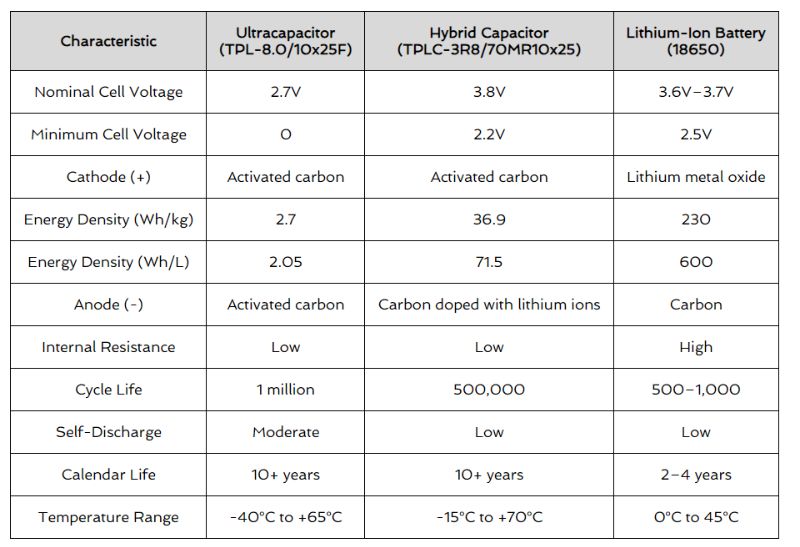
Ultracapacitors, hybrid capacitors, and lithium-ion batteries. Image used courtesy of Tecate
Hybrid Supercapacitor Applications
LICs are the ideal energy storage solution for applications operating for extended periods in remote and rugged environments, where lithium-ion batteries are not a good fit due to cost, operating life, or safety concerns.
With high energy densities, hybrid supercapacitors work well as a short-term energy reservoir for primary power sources to mitigate voltage sags during peak power draw. Maintaining a well-regulated power source is vital for critical loads found in chemical plants, semiconductor manufacturing, and data centers, where even minor disruptions in power can negatively impact operations.
With the TPLCE series’ higher energy densities, less board area is required to meet backup energy storage requirements, saving space and reducing system costs.
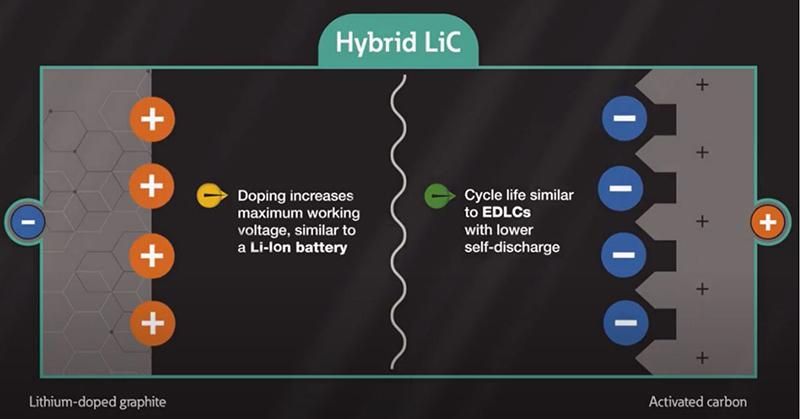
Hybrid supercapacitor construction. Image used courtesy of DigiKey
Designing With Lithium-Ion Capacitors
The TPLCE series’ largest model has a nominal capacitance of 1400 F and comes in a through-hole mounted cylindrical package that is 18 mm in diameter and 60 mm in length. With its high energy density, the device can deliver up to 7 A of rated current with short-term current bursts (3 seconds or less) up to 31 A.
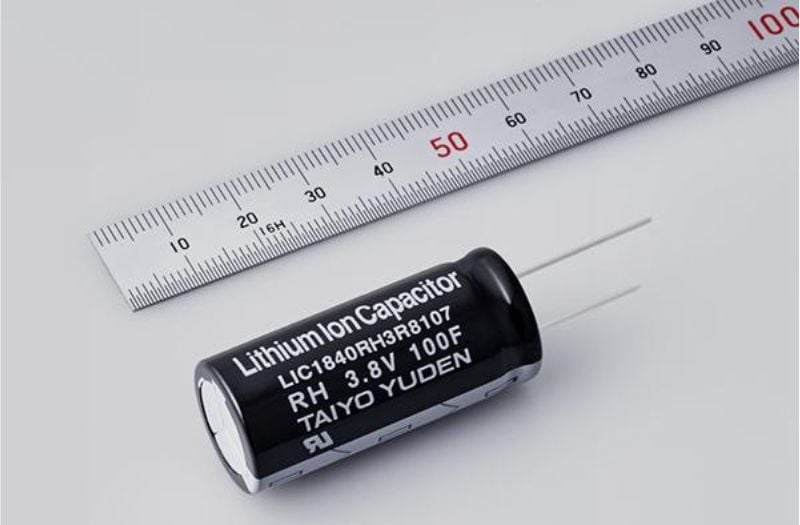
Hybrid supercapacitor dimensions. Image used courtesy of DigiKey
The TPLCE series operates at a nominal voltage of 3.8 VDC but can deliver power at voltages as low as 2.2 VDC. The output voltage will drop linearly as the capacitor discharges its stored energy, so for applications requiring a regulated supply, a boost converter or other regulating circuit can be used in tandem to maintain a constant output voltage.
The TPLCE series has a projected life cycle of 250,000 cycles, maintaining a capacitance of +/- 30% of its minimum specified value over its operating life.