Facebook
 Google
 GitHub
 Linkedin
Hioki Targets EV Thermal Testing With Thermistor Modules
Hioki’s modules bring fast, scalable thermistor-based temperature measurement for its LR8450 data logger series.
Measuring temperature across dozens of channels in an electric vehicle battery pack is straightforward in principle: thermistors are already embedded in the system. However, getting that data fast enough to be useful is the hard part.
At the 2026 APEC conference, EEPower was able to visit with the Hioki E.E. Corporation team. They introduced two new modules to address that thermistor data rate problem: a plug-in thermistor module U8557 and the wireless thermistor module LR8537. Both are designed for the LR8450 and LR8450-01 Memory HiLogger series.
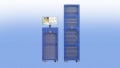
_and_wireless_thermistor_module_LR8537_(right)_1.jpg)
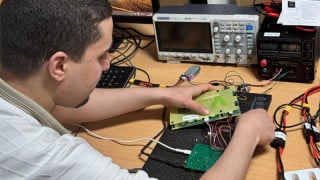
Ivan De Guzman, Regional Sales Manager for Hioki (right), explains how their new thermistor modules integrate with the LR8450 Memory HiLogger.
The Problem With Conventional Bench Instruments
In battery development, temperature isn't just a safety check; it's a core performance variable. Engineers tracking how heat distributes across a battery module under load, or trying to correlate thermistor readings with battery management system (BMS) behavior, need data that updates fast enough to capture what's actually happening.
A bench digital multimeter (DMM) typically sweeps channels one at a time, and the sequential scan slows as the channel count rises. At 10 or 20 channels, it's manageable. At 60 or more, the data is already stale by the time the sweep completes. That makes it difficult to catch transient thermal events or time-align measurements with other system signals.
Two Form Factors for Different Environments
The U8557 is a wired plug-in for the LR8450. The wired U8557 configuration supports up to 60 simultaneous channels. Terminal blocks use a push-button mechanism that simplifies connections when wiring up a large number of sensors.
The LR8537 is the wireless counterpart, designed for the LR8450-01. It supports AC or battery power, enabling cable-free deployments inside vehicle cabins, on rotating machinery, or anywhere a wired harness is impractical. In a wireless configuration, allowing up to 165 thermistor channels to be logged simultaneously.
Thermistor module U8557 (left) and wireless thermistor module LR8537 (right). Image used courtesy of Hioki
Both modules share the same core measurement architecture: 15 thermistor and resistance input channels, a 50 ms data update interval, and 16-bit A/D resolution. The 50 ms update rate is more than 10× faster than typical bench DMMs. That speed matters when engineers need to capture how a battery module heats up under a dynamic load profile, or when correlating thermistor readings against BMS behavior before the BMS is even installed.
Moreover, they can support resistance measurement across multiple ranges, 2 kΩ, 20 kΩ, and 200 kΩ, which provides flexibility to accommodate a wide range of NTC thermistor types and operating conditions.
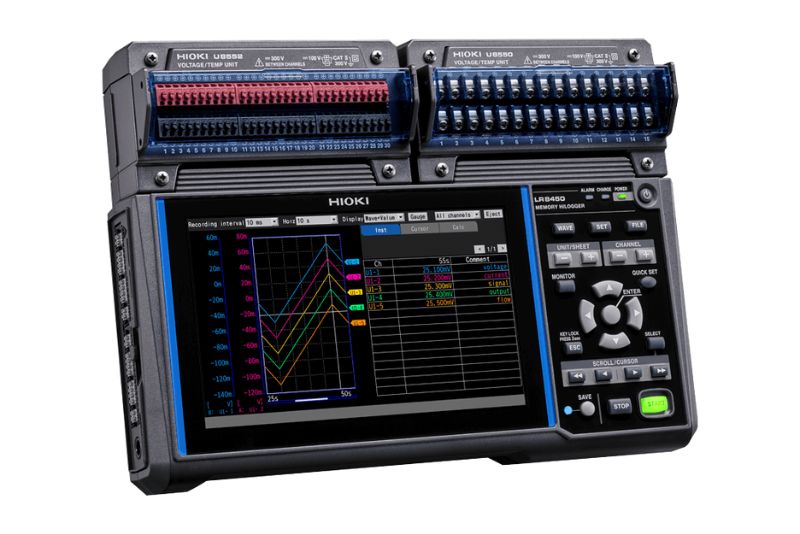
Memory HiLogger LR8450-01. Image used courtesy of Hioki
The modules also let engineers register a thermistor's resistance-temperature curve directly into the LR8450. The logger then converts raw resistance to temperature in real time. Multiple curves can be active at once, so a single test setup can handle different thermistor types across different parts of the system under test.
These two can operate alongside other LR8450 module types, including thermocouple modules, within the same chassis. That makes it possible to mix sensor types: monitoring battery cells with thermistors while simultaneously measuring motor winding temperatures with thermocouples on a single platform.
More information on both modules is available on Hioki's product pages.
What Comes Next
The demand for high-channel, high-speed thermistor measurement isn't going away. Battery packs are getting more complex, charge rates are increasing, and the thermal behavior of cells under dynamic load is becoming harder to characterize with slow instruments.
Looking further out, the same measurement challenge will intensify as solid-state batteries and 800 V EV architectures become more common. Both introduce new thermal dynamics that will require denser, faster sensor networks during development. Hioki's modular approach, where the same logger chassis accepts new input module types as requirements change, puts it in a reasonable position to serve those workflows without a full platform replacement.