Facebook
 Google
 GitHub
 Linkedin
GaN Motor Inverter Packs Power in Small Spaces
EPC’s compact EPC91120 GaN motor inverter offers power, sensing, and control for robots, e-mobility, and drones.
As humanoid robots get more nimble, the electronics inside their joints haven’t always kept pace. Motors may be shrinking, but the surrounding control hardware often clings to old dimensions, eating up space and adding weight in all the wrong places. Anyone who has seen a robot arm move with a slight lag knows how much those extra grams can change the path of their robots.
EPC’s EPC91120 reference design tries to give those joints some much-needed relief. The BLDC motor inverter, built around the company’s EPC23102 eGaN power stage IC, bundles power delivery, sensing, and motion control into a compact, 32-mm circle that fits directly inside a joint motor. Think of it as giving each joint its own “nervous system” instead of relying on bulky, centralized electronics.
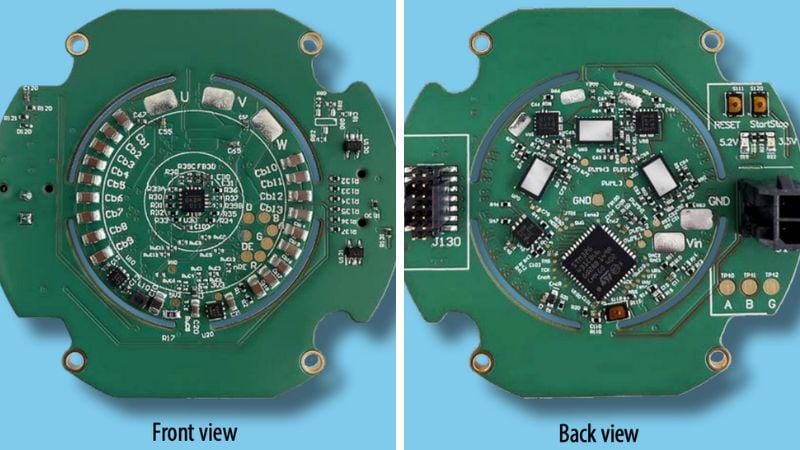
The EPC91120 evaluation board. Image used courtesy of EPC
Bringing Power Electronics Closer to the Muscle
The EPC91120 utilizes the EPC23102, a GaN monolithic half-bridge device engineered to switch quickly and efficiently. Because GaN handles higher frequencies with lower losses than traditional silicon, the system can run at a 100 kHz PWM switching frequency with only 50 nanoseconds of dead time, which translates into faster response, cleaner torque output, and smoother motion in demanding applications like humanoid limbs or compact UAV propulsion.
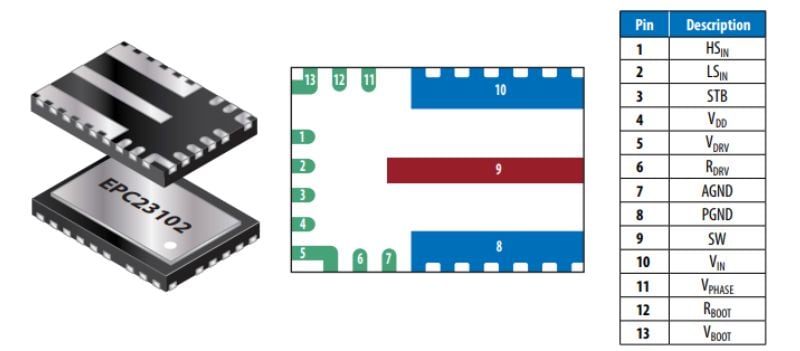
Pin out diagram of the EPC23102 ePower Stage IC that the EPC91120 will utilize. Image used courtesy of EPC
Heat Without a Chunky Heatsink
Thermals are always the party crasher in small robotic joints, and EPC clearly knew it. Under natural convection at around 26°C, the board delivers about 7 ARMS per phase with no heatsink at all. When tucked inside the motor casing, where the metal housing doubles as a heat spreader, it pushes up to 15 ARMS continuously and 30 ARMS in short bursts. In tests, the system delivers total efficiencies above 80% from DC input to mechanical output.
The circular 32 mm inverter sits inside a 55 mm mounting frame, which can be adapted for different mechanical layouts. That flexibility matters. Humanoid robots rarely follow a standard template, and a slightly different bolt pattern can be the difference between a clean integration and a weekend spent machining shims.
Useful Beyond Humanoid Robots
While the EPC91120 is tuned for humanoid joint motors, the broader applications are hard to ignore. Drones benefit from lightweight, high-frequency motor control that reduces audible noise and improves responsiveness. Small mobility platforms, anything from robotic assistive devices to compact delivery robots, gain from having distributed control electronics that free up internal space. Even industrial equipment with tight kinematic envelopes can use the board as a drop-in testing platform thanks to the included encoder interface and communication options.
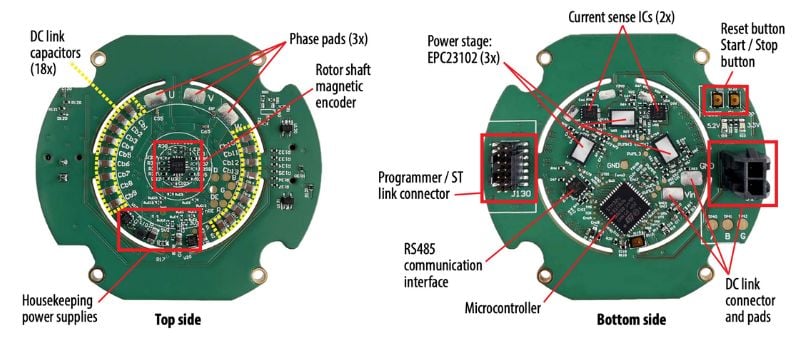
Details of the EPC91120. Image used courtesy of EPC
The EPC91120 includes a microcontroller, current and voltage sensing, a magnetic encoder interface, regulated auxiliary rails, and RS-485 communication. It arrives as a fully functional motor-drive brain rather than a collection of parts that still need a home. EPC intentionally shaped the layout to match the dimensions of the Unitree A1 joint motor, making evaluation more real-world than benchtop.
The design aims to leverage tightly integrated GaN power stages to make robots more responsive. The EPC91120 is a unique reference design engineered to double as a mechanical component, which allows it to be integrated directly inside a robot joint instead of being mounted externally.
The Path Ahead
EPC also offers the design files, suggesting future customization or hybrid development. As humanoid robots edge closer to consumer markets, modular electronics that simplify joint construction may become less of an engineering luxury and more of a necessity.
Humanoid robotics has long struggled with bulky electronics that slow down motion and complicate joint design, but this reference inverter gives the hardware a chance to catch up with ambitious mechanical expectations. By embedding power, sensing, and control right where the torque is created, EPC’s EPC91120 helps joints move the way designers may imagine.