Facebook
 Google
 GitHub
 Linkedin
Found in Space: Ametek’s Solar Power Simulator Mimics Solar Panel Behavior
The Elgar Advanced Solar Power Simulator offers precise and rapid solar power simulation to accurately mimic real-time solar panel behavior for efficient satellite power management.
Traditional solar power simulation methods often struggle to match fast-paced satellite dynamics in satellite power conditioning and distribution units (PCDU). This creates challenges in replicating the real-time behavior of solar panels and ensuring optimal performance in space applications. PCDUs necessitate precise and rapid solar power simulation technology that can accurately mimic real-time solar panel behavior for efficient satellite power management.
For this purpose, Ametek Programmable Power has introduced the Elgar Advanced Solar Power Simulator (ASPS). The ASPS could offer a solution to challenges in satellite solar panels.

Elgar ASPS. Image used courtesy of Ametek
How Solar Panels Keep Space Tech Running
Satellite applications operate in the void of space, so they cannot be tethered and must use batteries for power. The challenge becomes how to keep these batteries charged, given that it’s not feasible to access the satellites to recharge or replace them.
For these reasons, solar panels are used extensively on satellites. In space, where direct sunlight is abundant, solar panels provide a consistent and efficient energy source. However, solar panels produce varying power levels depending on their orientation and sunlight exposure. Satellite subsystems also have non-linear power draw, posing variable power demands caused by operational activity fluctuations, such as communication transmissions, data processing, and scientific experiments. Power optimization techniques are needed to address these challenges and meet these fluctuating power demands.
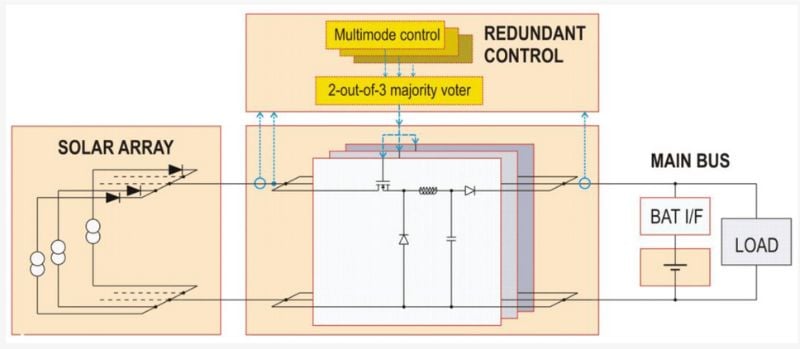
Solar array with MPPT regulator. Image used courtesy of Schirone et al.
In this context, peak power trackers optimize the voltage level of PV systems to operate at the maximum power point. This effective power management ensures stable satellite operations, conserves battery life during eclipses, and maintains performance despite changing environments.
Key techniques of power management include sequential shunt series regulator (S3R) and maximum power point tracking (MPPT) regulation. In S3R systems, the solar array is divided into sections connected to a power bus with blocking rectifiers, with shunt switches controlling power flow in each section. The system balances power needs by activating a specific number of sections and fine-tuning with a shunt switch for precise control. Moreover, MPPT converters optimize PV output for the battery or utility grid, transforming high-voltage DC into lower voltage (and higher current) for efficient battery charging.
Advanced Solar Power Simulator
Ametek Programmable Power has launched the Elgar Advanced Solar Power Simulator (ASPS), a state-of-the-art tool to enhance satellite power management.
The ASPS series offers two independent 600 W channels or a single 1200 W channel, providing flexibility for various applications. Its key innovation is the industry-leading two-microsecond shunt switching recovery time, enabling the optimal power transfer for fast PWM shunt switching in satellite PCDUs.
Shunt switching recovery time is vital in solar power management as it enables quick transitions between shunt states to efficiently regulate power flow from the solar array. This rapid response minimizes power losses, prevents overheating, and improves performance and lifespan. The ASPS, controlled by a digital signal processor, can be operated via SCPI commands through Ethernet or Ametek SAS software. It includes peak power tracking, primary and secondary overvoltage, overcurrent protection, over-temperature protection, and an output electronic circuit breaker. Safety and efficiency (80%) are enhanced with a fault data recorder, power on self-test, and active power factor correction (0.99 typical). The color touch panel offers intuitive control and diagnostics, indicating channel state with background colors: gray for idle, green for conducting, blue for shunted, and red for a fault state.
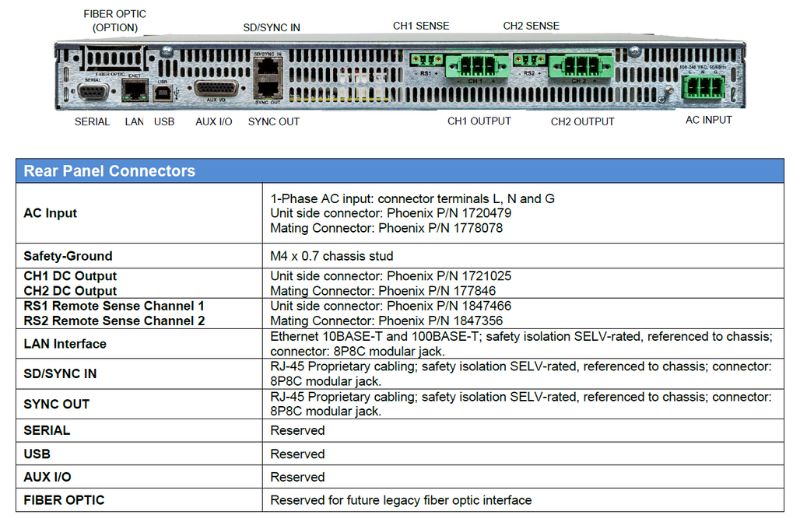
The rear panel view of ASPS. Image used courtesy of Ametek
The ASPS supports various power management strategies such as S3R, S4R, direct connection, and MPPT (200 Hz tracking speed), making it a versatile solution for satellite applications. It can simulate eclipses, store up to 32 IV curves and segments, and provide fast electronic circuit breaker protection, ensuring optimal satellite performance and longevity. Eclipse simulations can be set up for any scenario with segments lasting up to 4.66 hours. During these simulations, virtual IV curves are smoothly interpolated and executed up to 100 times per second, enabling seamless transitions.
Lighting the Path for Next-Gen Satellite Power
Ametek’s ASPS marks a significant advancement in solar power management for space applications. With features like eclipse simulation and peak power tracking, ASPS improves energy handling and longevity in satellite systems. As technology progresses, this innovation could play a key role in future satellite designs by offering more precise and adaptive power management.