Facebook
 Google
 GitHub
 Linkedin
Festo Valve Terminal Streamlines Electrodes With Controlled Pneumatics
Festo's VTEP for dry-room electrode production could improve electric vehicle battery performance.
Festo is becoming the electric vehicle industry’s one-stop mechatronics shop. It has presented solutions for recycling valuable materials while producing EV batteries, automated degassing, and now, dry-room electrode production. Dry-room electrode production is significant because moisture can negatively impact the quality of battery electrodes.
The display simulates making electrodes, including unrolling, cutting, aligning, and layering processes of anodes and cathodes. They accomplished this by releasing the first high-precision proportional valve terminal on the market. The VTEP utilizes controlled pneumatics.
Controlled pneumatics is an advanced air control technology combining several high-tech components to make machinery more efficient and precise. It uses piezo-electric valve cartridges, which are fast, durable, and energy-efficient, to control the airflow. These valves work alongside sensors that detect changes in the system and control algorithms that adjust the system based on the sensor data. This combination allows precise machinery control, making producing electric vehicle batteries more reliable and cost-effective.
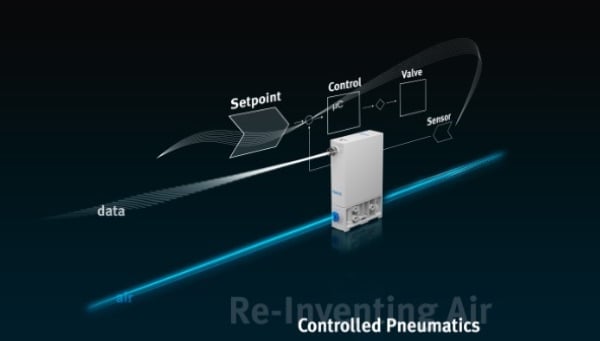
What are controlled pneumatics? Image used courtesy of Festo
Closed-Loop Control
Materials like anodes and cathodes are often handled in large rolls during the production of electric vehicle batteries. Maintaining the proper tension on these rolls is crucial because it ensures the materials are processed smoothly and accurately, directly affecting the batteries' quality. By utilizing the previously stated technology and closed-loop control method, the VTEP is perfect for keeping the correct roll tension in the automated production of battery electrodes.
Closed-loop control is a system that constantly monitors and adjusts to maintain a desired state or output. It’s like having a thermostat in your house that keeps the temperature exactly where you set it by turning the heating or cooling on and off as needed. First, the user sets a target or desired value. For example, in the case of the VTEP, this could be a specified air pressure. The system then uses sensors to measure the current state and compares the current state to the target. If there is a difference, the VTEP adjusts to bring the current state closer to the target. This process of measuring, comparing, and adjusting happens in a loop, which is why it is called a “closed loop.” The system continuously checks and corrects itself to stay on target.
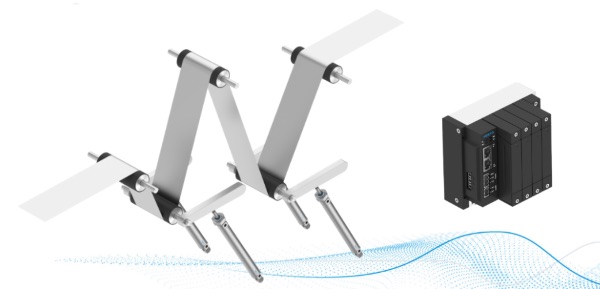
VTEP utilized for the web control of battery foils. Image used courtesy of Festo
Flexibility
The Festo automation platform I/O is designed to make machines work faster and more efficiently by quickly handling large amounts of data and processing tasks in under 100 milliseconds. It uses components called CPX-AP-A and CPX-AP-I to communicate at very high speeds. Changing the bus module component allows this system to work with different communication protocols like EtherNet/IP and PROFINET. This flexibility is great for manufacturers because they can easily switch control systems without replacing the entire setup.
The VTEP also offers parts free of copper and zinc, which are better for environments where corrosion needs to be avoided, such as in battery production. These parts are marked with F1A in their model numbers and include components such as valve manifolds and actuators. This ensures that the production process remains clean and efficient.
Festo’s VTEP solution represents a significant advancement in automating dry-room electrode production for EV batteries. Festo ensures efficient and precise manufacturing processes by integrating high-precision proportional valve terminals and controlled pneumatics. The closed-loop control system maintains optimal roll tension, enhancing the quality of battery electrodes. Additionally, the Festo automation platform I/O's flexibility and corrosion-resistant components further improve production, making Festo a comprehensive provider for the EV industry’s mechatronics needs.