Facebook
 Google
 GitHub
 Linkedin
Advanced Energy Adds Ultra-High-Density Power Supplies
The enhanced lineup reduces voltage ripple and improves connectivity and power density.
The demand for efficient, compact, and versatile power supply solutions has risen sharply in the industrial and medical sectors, where space constraints and tight performance requirements dominate design priorities. Applications like imaging systems depend on power supplies that deliver consistent performance under varying load conditions. This translates to designing power supplies with high power density and minimum voltage ripple, as devices require stable outputs to maintain accuracy and functionality.
Advanced Energy has introduced an expanded lineup of NeoPower power supplies designed to integrate high power density, precise regulation, and flexible configurations in a single compact package. The lineup addresses key parameters of power supply design.
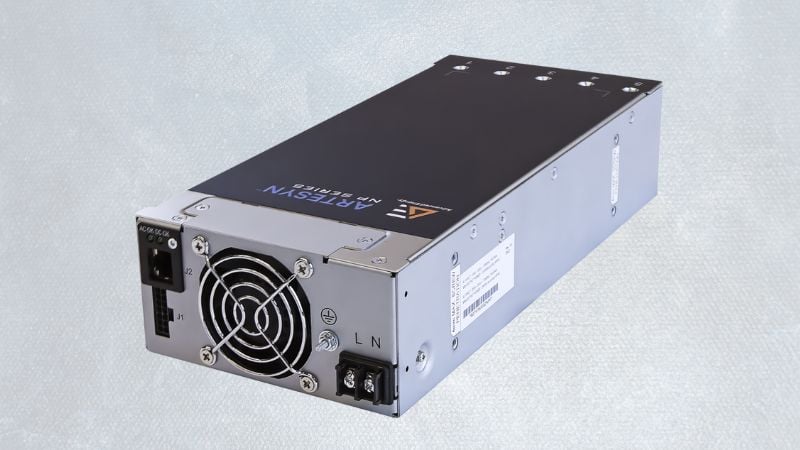
NeoPower power supply. Image used courtesy of Advanced Energy
Power Supply Performance
Many modern applications require compact and configurable power supplies that offer high power outputs without compromising on voltage regulation performance and connectivity features. Power density, defined as the amount of power delivered per unit of volume, is a central metric in power supply design, especially in space-constrained environments. Achieving high power density often demands sophisticated thermal management and compact designs, but these constraints can lead to challenges such as increased heat generation and reduced product reliability.
The voltage ripple at the output is the unwanted AC fluctuation in a power supply's DC output after conversion from AC power, generally defined as a percentage value. Low ripple is a major requirement in sensitive applications, such as medical imaging and precision measurement systems, where electrical noise can degrade performance or compromise accuracy. For example, in MRI systems, ripple-induced noise can distort the gradient magnetic fields or interfere with the radio-frequency coils, resulting in image artifacts or reduced contrast resolution. These distortions can compromise diagnostic accuracy by obscuring important anatomical details or creating false-positive signals.
Here, the main challenge lies in minimizing ripple while maintaining a high level of power efficiency and compactness. These requirements ultimately require precise control over power conversion characteristics while managing size, efficiency, and electrical noise.
Advanced Energy’s NeoPower Family
Advanced Energy has expanded its NeoPower family of ultra-high-density configurable power supplies by introducing models optimized for industrial and medical applications. Among the latest additions is the NP05, which delivers 2.4 kW of power within a 2.5-inch form factor for a power density of p to 17.45 W/in3. Advanced Energy claims that this power density is four times that of conventional solutions.
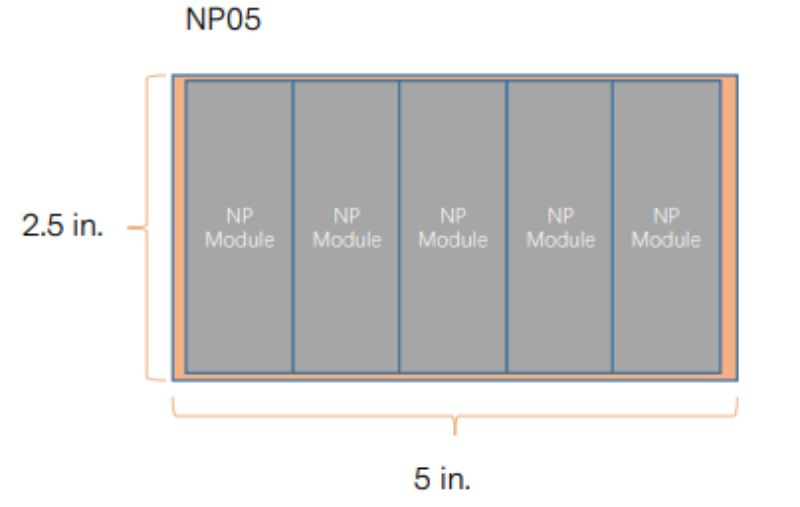
The NP05 chassis dimensions. Image used courtesy of Advanced Energy
A notable feature of the NP05 is its capability to minimize common-mode and differential voltage ripple. Operating within an input voltage range of 90 to 264 VAC and integrating five modular slots for flexible configuration, each module in the NP05 can support outputs ranging from 1.0 to 57.6 V with a maximum power of 400 W per module. The design emphasizes precise voltage regulation with ripple and noise levels limited to 1% of the nominal output or 10 mV RMS. Moreover, including a PowerPro Ethernet adapter and support for MODBUS TCP monitoring and control enhances its connectivity for compatibility with IoT systems.
The Way Forward
The NP05 converts one AC input into five DC outputs, thereby minimizing footprint, interference, and current leakage issues compared to discrete solutions. Advanced Energy aims to achieve the right balance between high power density and noise management requirements in fields that need space-efficient, IoT-ready industrial and healthcare equipment.