Facebook
 Google
 GitHub
 Linkedin
US Lab Research Boosts Batteries, Power Modules, Grid Security
National laboratories have discovered solutions for solid-state batteries, smart power modules, and grid cybersecurity.
Energy progress depends on steady technological advances, from the tiniest component or chemical to system-wide functions. As power electronics become more demanding and complex, scientists seek innovative solutions to ensure performance, dependability, and security.
Researchers at U.S. national laboratories often make discoveries that advance the science behind essential technologies. Three recent breakthroughs at national labs focused on solid-state batteries, smart power modules, and grid cyber-physical security.
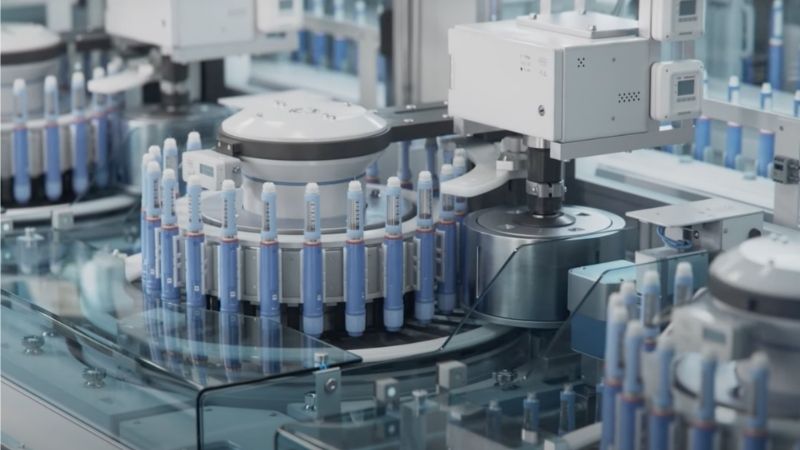
Research tools at the National Renewable Energy Laboratory. Image used courtesy of NREL
Atomic Coating Stabilizes Solid Electrolytes
Argonne National Laboratory (ANL) researchers have developed a method to coat sulfide-based solid electrolytes to improve chemical stability. The atomic layer deposition (ALD) process physically protects the electrolyte and changes its electronic structure to create more stable materials for oxygen and moisture. The discovery could lead to longer-lasting and better-performing solid-state batteries.
Although solid-state batteries offer promise for electric vehicles and other power applications, the solid electrolytes within them tend to degrade when exposed to humidity and oxygen. To combat this, ANL scientists zeroed in on the sulfide-based electrolyte surface and structure.
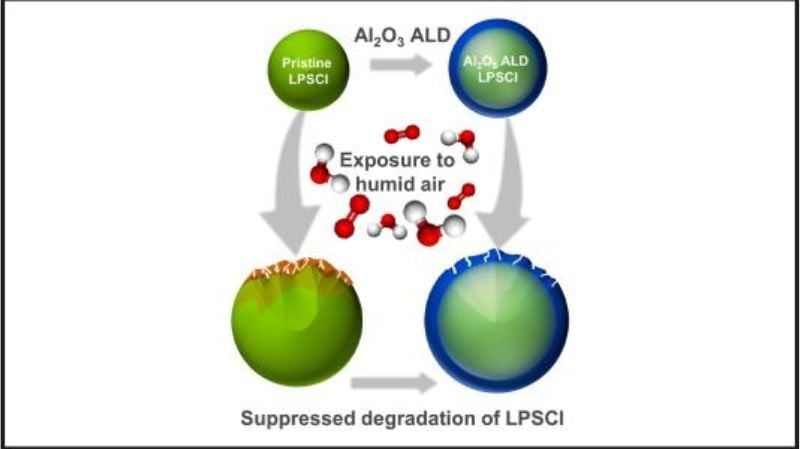
Research focused on adding a thin coating to the electrolyte. Image used courtesy of Argonne National Laboratory/Taewoo Kim
The ALD process, also used in computer chip manufacturing, applies a layer of aluminum oxide to electrolyte particles. This aluminum oxide, which shares properties with glass, forms a protective layer thinner than one atomic layer. The coating suppresses degradation and enables the lithium-ion flow needed for battery performance. In tests, the coated electrolytes showed significantly better stability and less degradation.
The ALD coating can also simplify battery manufacturing and costs. The study was published in ACS Materials Letters.
The researchers are working with a commercial partner to scale the method and demonstrate its use on larger batteries.
NREL Creates Super-Fast and Efficient SiC Power Module
The National Renewable Energy Laboratory (NREL) has developed a silicon-carbide-based power module that may be the world’s fastest. The ultra-low inductance smart (ULIS) power module, using silicon carbide (SiC) semiconductors, achieves five times the density of previous designs. The result is a compact, lighter, more efficient module.
The ULIS boasts a seven to nine times lower parasitic inductance than any other state-of-the-art SiC power module. This ultrafast and ultra-efficient switching enables ULIS to get more usable power from the electricity supply.
_power_module.jpg)
NREL’s ultra-low inductance smart (ULIS) power module. Image used courtesy of National Renewable Energy Laboratory/Brooke Buchan
Unlike conventional brick-like housing, the ULIS design houses the semiconductor in a flat, octagonal disc with circuits wound around it. The shape allows a higher density of devices within a smaller space, resulting in a smaller and lighter package. The current routing enables maximum magnetic flux cancellation, contributing to low-loss electrical output and ultrahigh efficiency.
For electricity conduction and heat dissipation, instead of using rigid copper sheets bonded to a ceramic base, ULIS bonds copper to a flexible polymer called Temprion. The material bonds easily with copper using only heat and pressure. The design preserves the compact, light design and allows quick, inexpensive fabrication because it can be machined with available equipment.
ULIS can operate wirelessly as a standalone unit and does not require cables for control or monitoring. The modular design makes it easy to integrate into various machinery. The 1200 V, 400 A power module is suitable for power grids, data centers, microreactors, and heavy-duty vehicles.
‘Brain-Inspired’ AI Detects Power Grid Problems and Cyberattacks
Sandia National Laboratory researchers have developed an artificial intelligence algorithm to protect the power grid from physical issues and cyberattacks. The “brain-inspired” neural-network AI monitors the grid for disruptions while operating on single-board computers or smart grid devices.
Sandia collaborated with Texas A&M to tackle the challenging task using data fusion to extract signals from physical and cyber data within the grid. They used an autoencoder neural network, which allowed them to detect disruptions and identify whether the information comprised normal behavior or indicated abnormalities. The method enabled the researchers to classify the problems as physical, cyber, or a combination.
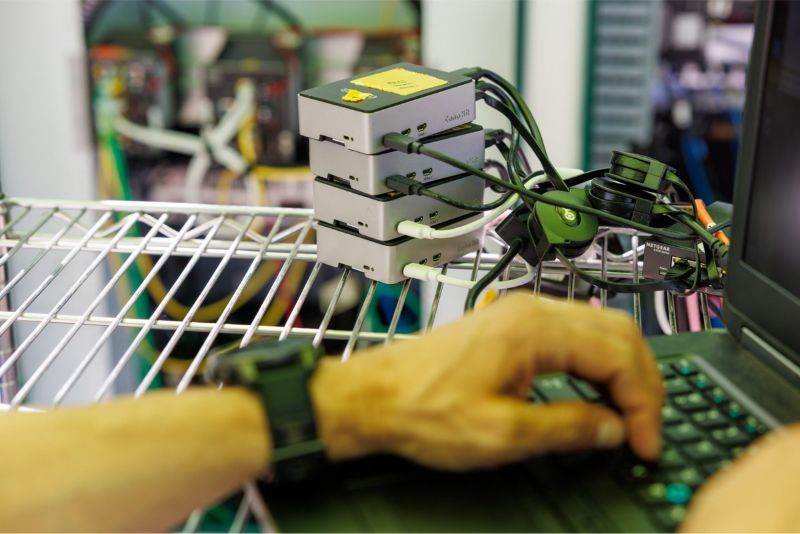
Sandia connected its neural-network AI to the Public Service Company of New Mexico’s test site. Image used courtesy of Sandia National Laboratories
During hardware-in-the-loop testing, researchers linked the physical hardware with the software that simulates disruptions or attack scenarios. The autoencoder processed the data faster than other simulation methods, researchers stated.
The researchers have filed a patent application and are seeking corporate partners.