Facebook
 Google
 GitHub
 Linkedin
The LM3914: Turning a Voltage Into a Row of Lights
National Semiconductor reduced the analog bar-graph display to a single IC, a handful of LEDs, and one resistor. The level meter was never the same.
When National Semiconductor introduced the LM3914 in 1980, it did something that sounded trivial—until you tried to build it from scratch. It turned an analog voltage into a row of lit LEDs. Feed the chip a voltage, and it drove ten LEDs in proportion, either as a single moving dot or as a filling bar, with the choice between the two set by a single pin.
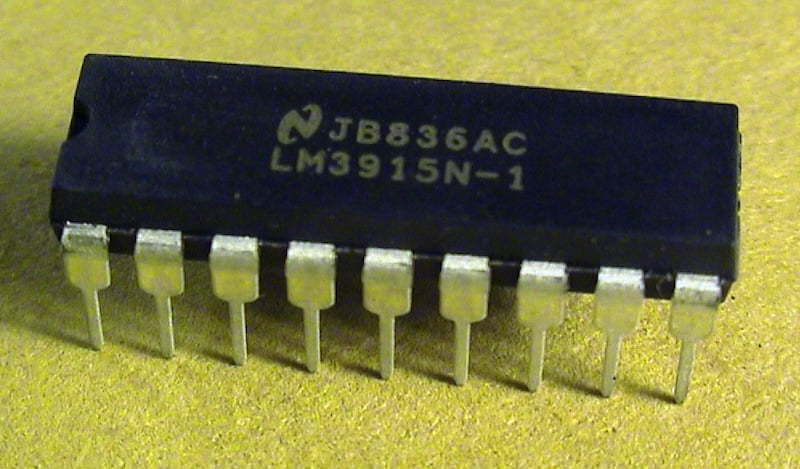
The LM3915 IC in a DIP-18 package. Image used courtesy of Vmsa via Wikimedia Commons (CC BY-SA 4.0)
Before a part like this existed, an engineer who wanted a ten-segment level display faced a board full of comparators, a precision resistor ladder, and a current-limiting resistor for every LED. The LM3914 folded all of that into one 18-pin package, and, in doing so, made the bar-graph meter a casual design choice rather than an arduous project in its own right.
10 Comparators on a Ladder
Inside the LM3914 is a precision 10-step voltage divider that feeds 10 individual comparators. The input voltage, buffered on the way in, is presented to all the comparators at once. Each one trips as the input climbs past its tap on the ladder, and the result appears on 10 outputs that light LEDs directly. A single pin selects the display mode: in dot mode, only the LED corresponding to the current level is lit; in bar mode, every LED up to that level turns on, producing the familiar climbing bar of a level meter.
A few design touches made the part genuinely easy to use. First, it contained its own adjustable voltage reference, nominally 1.2 V and settable upward, which set the full-scale point of the display without external precision parts. Second, the LED current is programmed by a single external resistor, ranging from a couple of milliamps to around 30 mA, with the chip regulating that current on every output, so the individual current-limiting resistors disappear from the schematic entirely.
The part also runs from a single supply that can sit below 3 V and ranges up toward its 25-V maximum. Its inputs shrug off voltages well beyond the supply rails without producing false readings, and multiple chips can be chained together to build displays of 20, 30, or even 100 segments when 10 is not enough.
VU Meters and Battery Gauges
The LM3914 was the linear-scale member of a closely related trio, and the differences among them explain why each ended up where it did. The LM3914 spaces its ten steps evenly, which suits voltmeters, battery and fuel gauges, and any quantity that the eye reads naturally on a linear scale. Meanwhile, the LM3915 spaces its steps logarithmically, 3 dB per step across a 30-dB range, which is exactly what an audio level meter wants because loudness itself is logarithmic. The LM3916 uses a third scale tailored to the specific markings of a standard VU meter.
Sharing one die and differing only in the internal divider, the three parts let a designer pick the response curve by choosing a part number. It’s exactly that flexibility that put the family into an enormous range of gear.
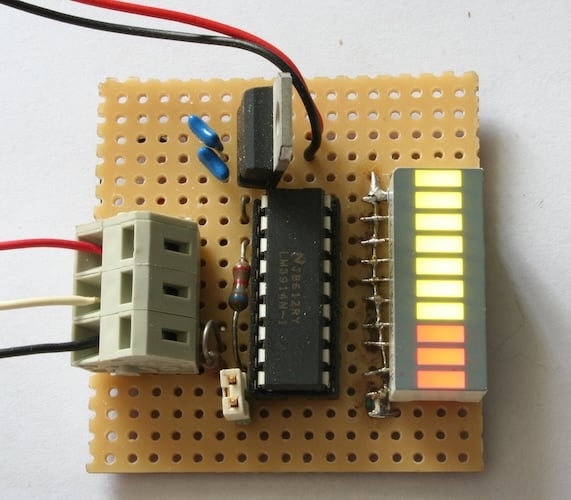
An LM3914 driving an LED bargraph display. Image used courtesy of Michael Frey via Wikimedia Commons (CC BY 2.5)
The linear LM3914 lit up battery-level indicators, analog gauges, and expanded-scale voltmeters in instrumentation and automotive panels. The logarithmic LM3915 became the default behind LED VU meters in audio equipment, where its dB-per-step scaling matched the way the ear hears level. It gave a generation of stereos, mixers, and effects units their glowing column of green, yellow, and red. The same chips drove the sequential and chase-light effects that hobbyists loved, since the dot mode steps cleanly from one LED to the next as the input swept.
No Code, No Clock, and No Programming Environment
Decades later, the LM3914 and its siblings remain in production, which says something about how completely they solved their problem. A modern designer could replicate the function in firmware using a microcontroller and an analog-to-digital converter. For a product that already has a processor, that’s often the sensible path. But the LM3914 needs no code, no clock, and no programming environment. A voltage in, ten LEDs out, one resistor to set the current, and the behavior is fixed in hardware and visible on the schematic.
That self-contained simplicity is why the part outlasted the era that produced it. It took a job that used to mean a cluttered board of comparators and resistors and reduced it to a single chip that a beginner could wire up in an afternoon. The row of climbing lights it produces is so familiar now that it's all too easy to forget someone had to make it easy, and the LM3914 is what did.
Do you have any fond memories of putting the LM3914 to work? Tell us about it in the comments below.