Facebook
 Google
 GitHub
 Linkedin
Stormy Space Weather: Exposing the Power Grid’s Weaknesses
Solar storms disrupt the power grid and cause outages. Oregon State University researchers have a tool to predict vulnerable areas and prevent problems.
Researchers from Oregon State University just finished mapping the properties of the Earth’s crust and mantle, which provides critical information for understanding how electromagnetic pulses can disrupt utility grid function.
A solar storm is usually only noticed when it produces beautiful effects in the sky, like the northern lights. While these sights might delight, space weather can cause serious disruptions in power grid functionality.
Did you see the July 2024 solar storms? Video used courtesy of Tamitha Skov
When the Sun's activity leads to eruptions of solar material and energy, a solar storm can form. These storms include solar flares and coronal mass ejections (CMEs), which are large plasma expulsions and magnetic fields from the Sun's corona. As these solar emissions interact with Earth's magnetic field, they can cause geomagnetic storms, disrupting satellite communications, power grids, and other technologies. Ignoring space weather as a mere novel delight in the sky is not an option.
Oregon State University (OSU) researchers have wrapped up a 20-year research project to map the crust and mantle of the Earth across the United States. This map will help provide critical information about how geomagnetic currents interact with the power grid and identify locations in the U.S. that are particularly vulnerable to space weather threats.
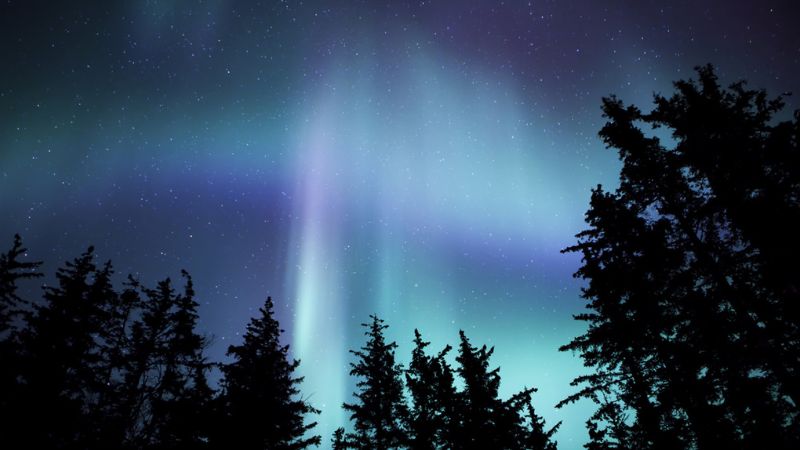
Northern lights in Alaska during a space weather event. Image used courtesy of NOAA
Understanding the Threat of Space Weather
Space weather and solar storms are threats that can hit close to home. Some make history, like the famous solar storms that hit Earth between October 19 and November 7, 2003. Intense solar flares and CMEs spewed from sunspot group 486. The eruption was exceptionally large and active, producing multiple X-class flares, the most powerful category of solar flares. It was one of recorded history's most powerful space weather events.
When the CMEs reached Earth, they caused severe geomagnetic storms, which are disturbances in Earth's magnetosphere. The storms reached G5, the highest level on the geomagnetic storm scale, indicating extreme conditions.
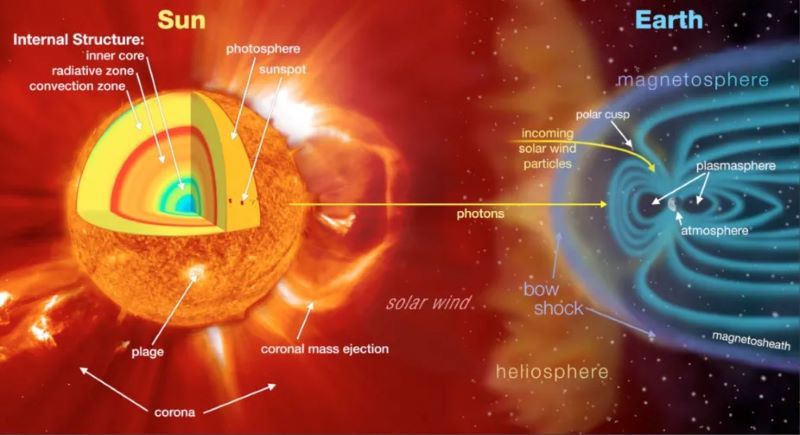
Diagram of solar weather impacting Earth’s atmosphere. Image used courtesy of NASA
However, knowing the storm reached G5 and understanding its practical impact are two different things. The solar flares’ intense radiation and the CMEs’ impact caused significant disruptions to satellite operations. Satellites experienced anomalies, including malfunctions in onboard electronics, communication interruptions, and signal loss. Some satellites temporarily lost control, and several had to be reprogrammed from the ground to restore functionality.
In addition to satellite disruptions, the storm severely affected Global Positioning System (GPS) signals. Increased ionization in the Earth's ionosphere, caused by solar radiation, led to signal degradation and inaccuracies in GPS data, affecting civilian and military navigation systems.
Lastly and perhaps most importantly, the intense geomagnetic activity induced strong electric currents in the Earth's crust, which can overload transformers and other critical infrastructure in the grid. Fortunately, major power outages were avoided, but disruptions occurred, especially in high-latitude regions.
This historical event helps map out the threat of space weather, but this challenge is hardly in the past. In a space weather event more powerful than one seen in 30 years, Earth was again caught in a solar storm in May 2024. The storm caused visible auroras far from the poles, with reports of sightings as far south as Florida and the Caribbean. But more importantly, the power grid experienced disruptions, satellites were compromised, and GPS problems forced some farmers to suspend operations.
OSU’s Space Weather Protection Project
Researchers at OSU have been working proactively to map the electrical properties of Earth's crust and mantle. With the data, they created a 3D geoelectric map crucial for protecting the power grid during extreme solar storms and electromagnetic pulses. This 3D map shows 300 km of depth from the surface into the Earth’s crust, helping to finally provide a comprehensive look at the continent’s geoelectrical structure.
Researchers systematically canvassed the land area of the U.S., electrically surveying in a pattern marked by 70-km intervals.
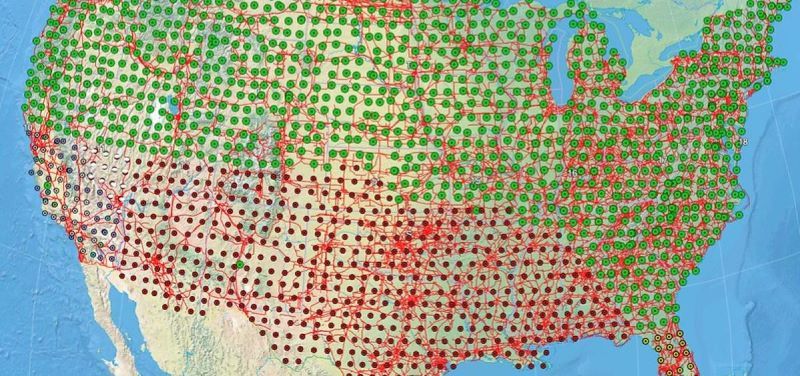
The grid pattern followed by researchers completing the survey. Image used courtesy of Oregon State University
With such a comprehensive look at the crust and mantle, we can better understand and ultimately predict how geomagnetically induced currents can impact grid functionality. When the Earth's magnetic field fluctuates, it induces electric fields in conductive materials. Because the Earth's crust and mantle contain conductive minerals and metals, they are perfect mediums for this process. The variations in the magnetic field cause these materials to generate electric currents, which are the geomagnetically induced electrical currents.
OSU’s research revealed a particularly vulnerable region on the East Coast running from Washington D.C. to Georgia, where the crust structure makes that entire region more vulnerable to power grid disruption during a space weather event.
This vulnerability is also tied to potential national security threats, as it is possible to intentionally detonate electromagnetic pulse weapons to harm grid function. While such weaponry has not been deployed, waiting until it is used to worry about protection could cause catastrophic consequences. Some regimes worldwide have claimed they have developed a super electromagnetic pulse weapon, making OSU’s work critical for protecting against natural solar storms and national security threats.
Power grid security is not about reacting to failure but preventing it. OSU’s comprehensive map showing the Earth’s electrical properties will be critical for understanding how to secure the grid from possibly rare but significant threats.