Facebook
 Google
 GitHub
 Linkedin
Smart Solar: Machine Learning Helps Add Renewables to the Grid
Researchers used machine learning algorithms to enhance energy efficiency in solar grid integration.
Renewable energy generation sources—such as solar cells, hydropower, wind turbines, and biogas plants—have grown more prominent in the energy landscape. Efficiently integrating renewables into the grid has become a universal need. These renewable energy sources are intermittent, and their output often depends on environmental and operation variables, making their integration more difficult than traditional energy sources.
Using AI with renewable energy. Video used courtesy of Stanford University
Machine learning and hybrid machine learning models are beneficial in this integration. Digitalized smart grids using AI algorithms can manage energy supply and demand, reduce carbon emissions, and improve energy security. Key network parts include physical sensors, automation software, analytics, and AI algorithms.
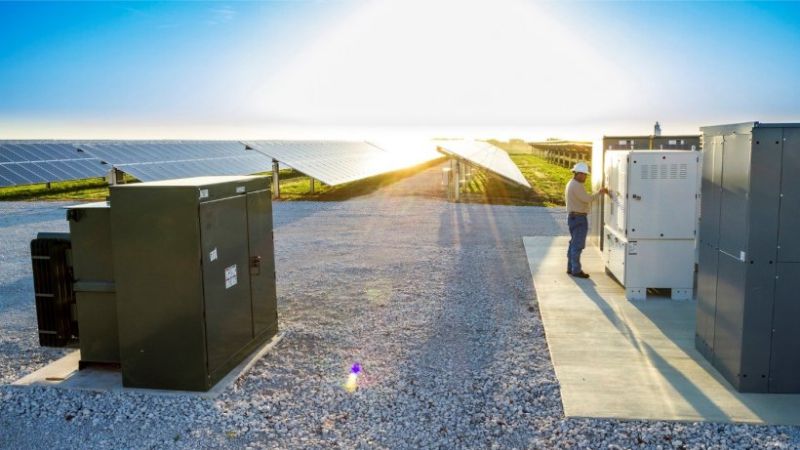
Grid-connected solar farm. Image used courtesy of Department of Energy/Ken Oltmann
The Rise of Smart Grids and AI
Power grids are transitioning to smarter technology to improve energy flow during outages, manage renewable energy integration and distribution, and offer consumers more tailored energy management consumption. AI algorithms can predict and model grid operations and the wider energy network.
Some examples where machine learning and hybrid machine learning models have been implemented with smart grids to provide real-time management operations include:
- Identifying power line outages
- Anticipating energy demand
- Optimizing the amount of energy used by smart grids
- Maximizing the generation and storage of renewable energy sources
- Forecasting the production of energy
- Tackling short-term power demands
- Predicting electricity prices
- Forecasting electricity demand
- Predicting wind speeds (for wind turbines)
Using Hybrid Machine Learning Models to Improve Solar Power Generation Efficiency
Several hybrid machine learning models have been used to predict renewable energy integration, monitor the renewable energy integration state, and forecast power demand. In a study in Scientific Reports, researchers took a new angle by using hybrid machine learning models to improve the efficiency of solar power generation systems within smart grids.
The study used Hybrid Convolutional-Recurrence Net (HCRN), Hybrid Convolutional-GRU Net (HCGRN), and Hybrid Convolutional-LSTM Net (HCLN)—which are newer, more advanced versions of the machine learning models used in past optimization operations.
The hybrid machine learning framework combines mathematical models and custom machine learning algorithms to recognize patterns in the data. The researchers trained models on 80% of the collected data, while the other 20% was used for the testing and validation processes.
The study examined a solar plant’s power production parameters, taking into account the power production (MWh), irradiance/plane of array (POA), and performance ratio (PR). Of all the models trialed, the HCLN showed the most promise with a root mean square error (RMSE) value (a measure of model accuracy) of 0.012027 for MWh, 0.013734 for POA, and 0.003055 for PR. The HLCN model also measured the absolute error (MAE) average value of 0.069523 for MWh, 0.082813 for POA, and 0.042815 for PR.
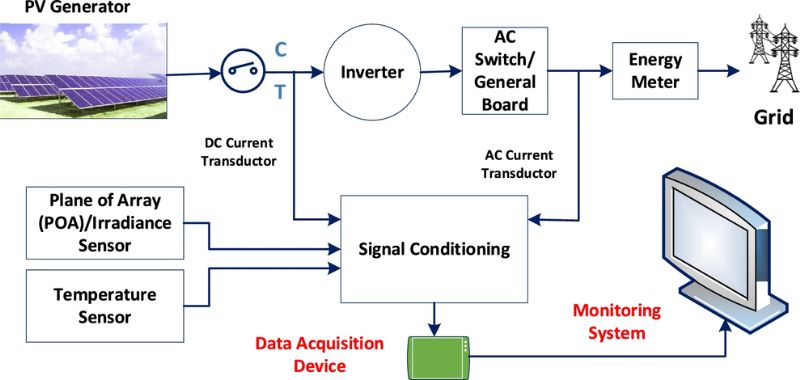
Data collection point. Image used courtesy of Bhutta, et al.
Improved Algorithms for Improving Energy Generation
The study demonstrated that the HCLM model could strengthen the efficiency of solar power generation systems by predicting the required measurements. It showed an average output of MWh ranging from around 463.71 to 592.90.
The team’s modifications to the hybrid machine learning algorithms—i.e., altering the algorithm structure to incorporate convolutional and recurrent neural networks—were better at predicting the solar plant's capabilities than individual models.
The study also showed that the new models had a higher accuracy and a lower error rate, denoted by the RMSE and MAE values. They could work better with more complex datasets and intricate patterns than their predecessor algorithms. Overall, the team’s algorithms were better at spotting patterns in the data generated from solar power systems and could analyze them more efficiently to improve performance in real time based on production, irradiance, and performance ratio.
Improving the Models Further
The HCLN models had some limitations. While showing promise, they currently have high computational requirements, which could limit their use if prompt decision-making is required. The models also require long training programs. If these challenges are improved, the models could be implemented in smart grid environments to improve renewable energy performance.