 Facebook
 Google
 GitHub
 Linkedin
Scientists Push Rechargeable Zinc-Air Battery To Over 300 Hours
Researchers at the Technical University of Darmstadt used nickel ferrite on doped carbon nanohorns in a precious-metal-free zinc-air battery. It outperformed a platinum and ruthenium oxide benchmark in lab cells.
Chemists at the Technical University of Darmstadt in Germany have developed an air-electrode catalyst made from iron, nickel, and carbon that lets a zinc-air battery charge and discharge for more than 300 hours.
The discovery could lead to a high-energy, nonflammable battery chemistry that can be recharged without relying on platinum-group metals.
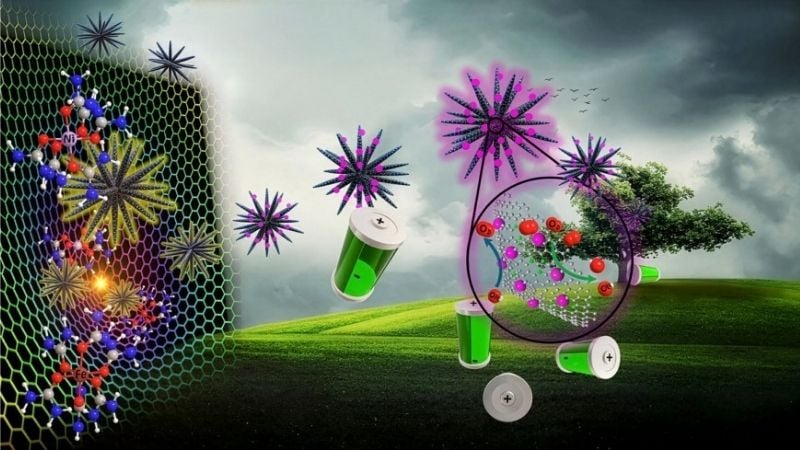
Concept of a bifunctional composite catalyst. Image used courtesy of the Technical University of Darmstadt/Sherif Okeil
The Recharging Problem at the Air Electrode
Zinc-air cells, long used in hearing aids, draw oxygen from the surrounding air as a reactant, giving the chemistry a theoretical specific energy of about 1,086 Wh/kg including oxygen. TU Darmstadt noted that zinc-air batteries can, in theory, store up to five times more energy than today's lithium-ion cells. The electrolyte is water-based and nonflammable, and zinc is abundant and inexpensive.
The weakness, however, is recharging. On discharge, the air electrode must drive the oxygen reduction reaction (ORR). On charge, it must reverse course and drive the oxygen evolution reaction (OER).
Platinum is the benchmark ORR catalyst but performs poorly for OER, while iridium and ruthenium oxides handle OER but not ORR. Combining them increases cost, and the study noted that noble-metal catalysts also suffer from limited durability and high overpotentials. The air electrode also depends on a stable triple junction where catalyst, electrolyte, and air meet, which tends to degrade with repeated cycling.
Nickel ferrite (NiFe2O4) is a cheap spinel oxide that is reasonably active for OER, but its ORR activity and stability have historically been poor. The Darmstadt group set out to fix that by pairing it with a conductive, chemically tuned carbon support.
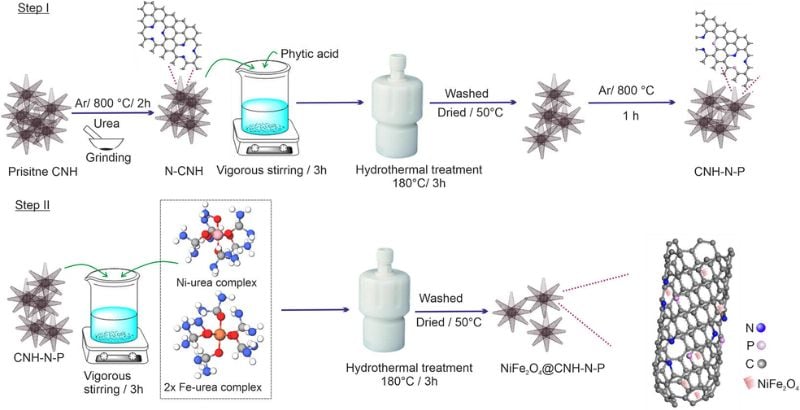
A schematic showing the two-step process for obtaining the catalyst material. Image used courtesy of Yadav et al.
Nickel Ferrite Cubes on Doped Carbon Nanohorns
The catalyst, designated NiFe2O4@CNH-N-P, combines nickel ferrite nanocubes with carbon nanohorns. Nanohorns are single-walled carbon tubules about 30-50 nm long and 2-3 nm in diameter that cluster into dahlia-like aggregates 80-100 nm.
The team first doped the nanohorns with nitrogen using a urea heat treatment, then added phosphorus through a hydrothermal treatment with phytic acid. The doping opened the horn tips and raised the BET surface area from 258 m2/g to about 696 m2/g.
The researchers then grew nickel and iron urea-nitrate precursors directly on the doped support, producing uniform ferrite cubes about 10 nm across. That’s far smaller than the roughly 84 nm particles formed without the carbon support.
X-ray photoelectron spectroscopy showed small binding-energy shifts in the iron, nickel, and nitrogen peaks, evidence of chemical coupling between oxide and carbon. A simple physical mixture of the same two materials performed noticeably worse, suggesting that coupling contributes to the activity.
In half-cell tests in 0.1 M KOH, the hybrid reached an ORR half-wave potential of 0.79 V versus the reversible hydrogen electrode, close to 0.80 V for a commercial 20% Pt/C catalyst. It needed a 290 mV overpotential to reach 10 mA/cm2 for OER, compared with 260 mV for RuO2. The resulting bifunctional gap of 0.73 V sits within 20 mV of a combined Pt/C and RuO2 reference. Hydrogen peroxide yield was 6.6%, indicating a nearly four-electron reduction pathway.
Lab-Cell Results and Remaining Hurdles
In full zinc-air cells with 4 M KOH electrolyte and a zinc oxide/carbon composite anode developed by the same group, the catalyst delivered an open-circuit voltage of 1.40 V and a peak power density of 54 mW/cm2. A cell built with the Pt/C and RuO2 benchmark reached 1.21 V and 28 mW/cm².
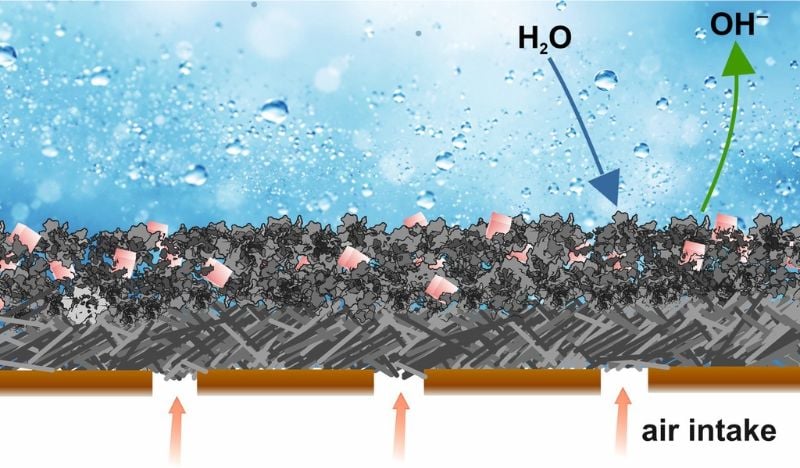
Concept of a rechargeable zinc-air battery. Image used courtesy of the Technical University of Darmstadt/Sudher K. Yadav
Durability showed the largest gap. Cycling at 0.55 mA/cm2 with three-hour cycles, the NiFe2O4@CNH-N-P cell ran for more than 300 hours (about 100 charge-discharge cycles) with a stable voltage gap.
The researchers reported that the precious-metal reference cell degraded rapidly after 50 hours. Post-mortem analysis found no detectable nickel leached into the electrolyte, and electron microscopy showed the spinel nanocubes intact. A second configuration used a standard zinc foil anode cycled for more than 250 hours at a higher 5 mA/cm2.
These results come from small lab cells operated at low current densities and partial depth of discharge, well short of practical battery conditions. The roughly 100-cycle lifetime also trails some recent single- and dual-atom catalyst work, such as Tohoku University's iron-cobalt dual-atom catalyst, which reported thousands of cycles in 2025. The Darmstadt study's contribution is a precious-metal-free spinel and doped-carbon design that beat a platinum-ruthenium control in the same cell.
TU Darmstadt described the work as basic research and suggested the urea-precursor method could extend to a broad range of mixed-metal oxide catalysts for energy conversion and storage.
The study was published in Advanced Science.