Facebook
 Google
 GitHub
 Linkedin
Modern Engineering Marvel: Inside Times Square’s Iconic Ball Drop
Every year, at precisely midnight, the drop of the brightly lit, gigantic ball signals the beginning of the new year. But the magic doesn't happen in a vacuum. Here's the engineering driving the drop.
Six men, a couple of ropes, and an analog stopwatch—that’s how the first illuminated Times Square ball was lowered to count down to the New Year in 1907. These days, the technology of lowering that six-ton ball is a bit more complicated.

Times Square ball. Image used courtesy of Wikimedia Commons
The feat involves precisely timed gears, a powerful motor, a reliable brake, and thousands of lights. When the millions of revelers in Times Square in New York City—not to mention the billions watching on TV worldwide—count the seconds to welcome in the New Year, they are not thinking about the engineering behind the scenes. What does it take to make this event happen?
The Ball’s Geodesic Construction
The famous Times Square ball is a geodesic sphere constructed of 2,688 triangles made of Waterford crystal. The aluminum-framed sphere is 12 feet in diameter and weighs 11,875 pounds—nearly 6 tons.
The ball sits atop a 130-foot tall steel pole, specially equipped with cables for the New Year’s Eve drop, mounted at the 25-story building at One Times Square. Every December 31, one minute before midnight, the ball begins its famous descent down the pole.
The present version of the ball, the Centennial Ball, was created in 2008 and took more than 3,000 hours to put together. Unlike its four historical predecessors, the Centennial Ball is considered permanent and remains lit year-round as a tourist attraction.
Lighting Up Times Square
The original Times Square ball was constructed of iron and wood, and weighed 700 pounds, illuminated by 100 25-watt incandescent bulbs. By 1955, the ball weighed a mere 150 pounds, thanks to aluminum replacing the iron framework. Colors were added, and halogen bulbs joined the incandescent bulbs.
Today, 32,256 colorful LEDs light up the Times Square ball. The lights are arranged in modules consisting of 48 LEDs, equally divided between red, blue, green, and white. According to Phillips, which designs the lighting, combinations of the LEDs can produce 16 million different colors and patterns in the billions. Each LED bulb lasts about 30,000 hours.
When the ball drops to its lowest point, it lights up the sign for the new year. The numbers for 2023 were seven feet tall and were lit with 602 LEDs.
On a typical night, all of Times Square—including lighted signs, billboards, and video displays—uses about 161 MW. The Centennial Ball adds to that energy use, though not much. The switch to LEDs in the Centennial Ball reduced its energy consumption by 88%. According to Times Square organizers, the ball uses the same energy as ten toasters.
Engineering the Ball Drop
For those cheering on the New Year, it might look like the ball just slides down the pole, but that’s not the case. A six-ton ball can’t simply be released to the forces of gravity. Instead, a specialized winch system carefully controls the drop.
Located below the platform on the mast, the winch connects to the ball by two cables measuring three-quarters of an inch in diameter. The cables wrap around helical grooves in opposite directions on a 42-inch drum. This system allows for maximum control.
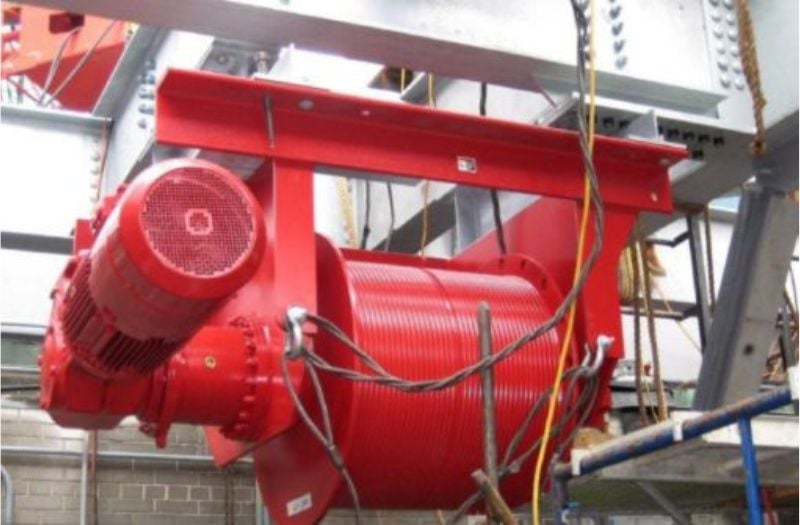
The winch that controls the Times Square ball. Image used courtesy of Thern
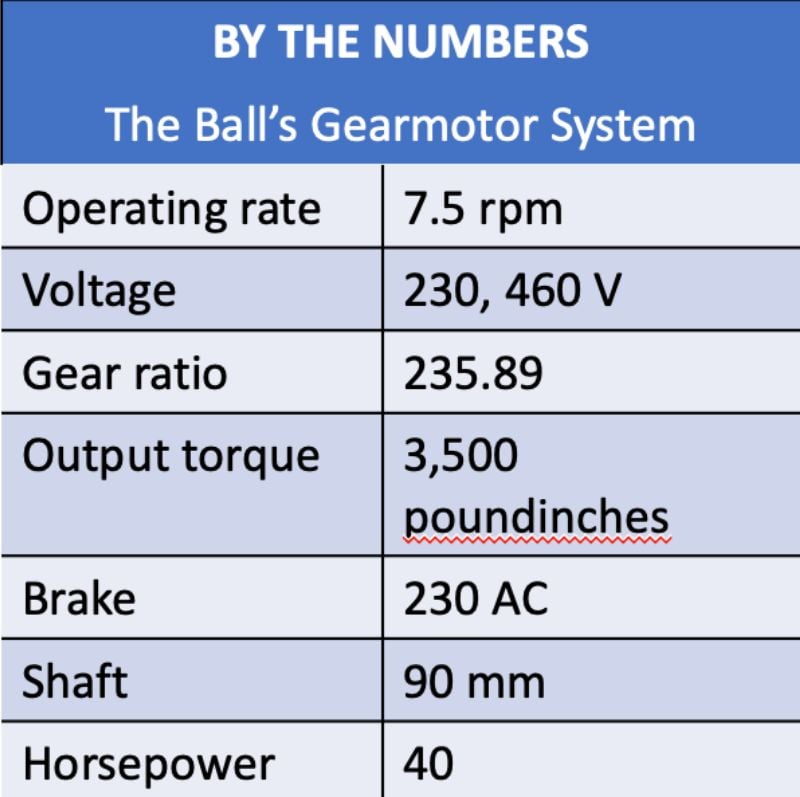
An SEW-Eurodrive gearmotor system includes a motor, planetary gear, helical-bevel gear, an encoder, and a brake. Along with a closed-loop regenerative variable frequency drive (VFD), the ball can be controlled to drop no faster or slower than 60 seconds. The regenerative VFD saves energy by generating electricity that feeds back into the grid.
The operators use a programmable logic controller (PLC) to direct the ball’s motion via about 30 multiconductor cables that transmit data and power to the system. The operators manage the ball drop on the 22nd floor of the building, where there is a human-machine interface. They can also use a handheld local controller.
Only one second separates the old year from the new, so the timing is synchronized to atomic clocks using a GPS.
Monitoring Safety
Whether the ball is stationary or in motion, it’s constantly monitored for safety risks. Precise control is crucial to protecting millions of New Year’s Eve partiers on the street, along with expensive rooftop equipment and the ball itself.
The ball is equipped with a built-in emergency stop function. Sensors are used to continually monitor the ball’s movement and position.
While the ball is only officially dropped once a year, the winch is inspected monthly, and operators send the ball up and down the pole to ensure everything is in good condition.
Ball Drops Around the World
Times Square may have the most famous—and technically complex—New Year’s Eve ball drop, but it’s not the only one. Across the world, revelers drop everything from a giant cherry (Door County, Wisc. and Traverse City, Mich.) to an illuminated maple leaf and sardine (Eastport, Maine) to a stuffed possum in a twinkly cage (Tallapoosa, Ga.).